Western intelligence agencies see non-Arab as new head of ISIS
January 21, 2020 Leave a comment
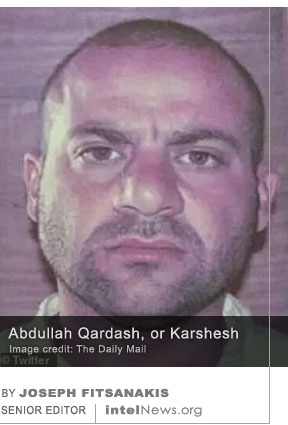 Western intelligence agencies have reportedly confirmed that a non-Arab is now leading the Islamic State for the first time in the organization’s history. Rumors of a new leader of the group began to circulate just hours after American forces killed its self-styled Caliph, Abu Bakr al-Baghdadi. On October 27, 2019, Newsweek magazine reported that the militant group, which is also known as the Islamic State of Iraq and Syria (ISIS), had appointed a man known as Abdullah Qardash (pictured) at its helm. According to the magazine, Qardash’s name was sometimes spelled in English as Karshesh. Additionally, he was sometimes referred to by his ISIS moniker, Hajji Abdullah al-Afari.
However, the names reported by Newsweek were not immediately recognizable to Western intelligence officials and other experts who monitor the Islamic State. But now British newspaper The Guardian reports that Western intelligence services have concluded that the man referred to as “Abdullah Qardash” in October is indeed the new leader of ISIS. The paper said on Monday that the new ISIS leader’s birth name is Amir Mohammed Abdul Rahman al-Mawli al-Salbi. He is allegedly not an Arab, but rather an Iraqi Turkman whose family comes from Tal Afar, a northwestern Iraqi city that is close to the borders of Syria and Turkey. In fact, al-Salbi is reported to have a brother in Turkey, who is a prominent member of an ethic political grouping called the Turkmen Iraqi Front.
Al-Salbi, who was allegedly appointed as leader of ISIS just hours after al-Baghdadi’s demise, is believed to be the first non-Arab to ever lead the militant group. Like most of ISIS’ original founders, al-Salbi is believed to have met Baghdadi in 2004 in Camp Bucca, an American-administered prison in Umm Qasr. Similarly to al-Baghadi, al-Salbi’s background is in Islamic education —something that enabled him to quickly rise in the ranks of ISIS ideologues and command significant influence. By 2018, al-Salbi had become a central decision-maker within the group, and was able to shape its activities and policies within its territory in the Middle East and beyond. The Guardian article concludes that al-Salbi is “a hardened veteran in the same vein as al-Baghdadi”, which implies that no major changes in the Islamic State’s strategy are expected to take place under his leadership.
► Author: Joseph Fitsanakis | Date: 21 January 2020 | Permalink







 intelNews.org
ISIS is tenacious, well-funded and quickly reasserting itself, new UN report warns
February 3, 2020 by Joseph Fitsanakis 1 Comment
The report (.pdf) was authored by a committee of the UN’s Security Council that monitors the impact of UN-imposed international sanctions designed to weaken the Islamic State, al-Qaeda, and groups aligned with them. It was completed on January 20 and submitted to the UN Security Council last week. Its authors state that the information used to compile it came from intelligence shared with the UN by its member states.
The report recognizes that the Islamic State has suffered significant defeats in the field of battle, which have shattered its once formidable military and logistical power. Despite these setbacks, however, the militant group remains “tenacious and well-funded”, with much of its financial income stemming from sound investing practices in business opportunities throughout the Middle East, says the report. Meanwhile, its armed units in Syria continue to sell protection and carry out extortion, now even during daylight hours, it adds. The group’s steady funding even allows it to continue to provide monthly pensions to close family members of its dead fighters.
Additionally, says the report, the Islamic State has learned to take advantage of the deficiencies of Syrian and Iraqi security forces, and is now carrying out progressively brazen armed attacks against a variety of military and civilian targets. Although it is operationally weak, it continues to aspire to launch attacks in Europe in the future. Additionally, its leaders continue to seek ways of freeing thousands of the group’s supporters from detention camps in Syria and Iraq.
The report concludes that the death of the group’s leader, Abu Bark al-Baghdadi, and his replacement by Amir al-Salbi (also known as Abdullah Qardash) is not expected to signal drastic changes in the Islamic State’s strategic direction. However, Qardash is not an Arab and may not stay at the group’s helm for long, as an Arab Emir would be more likely to be met with acceptance by the group’s wilayats, or provinces, the report adds.
► Author: Joseph Fitsanakis | Date: 03 February 2020 | Permalink
Filed under Expert news and commentary on intelligence, espionage, spies and spying Tagged with Abdullah Qardash, Amir al-Salbi, Iraq, Islamic State, News, Syria, United Nations, War on Terrorism