Australian spy agency reviews gun policy after ‘drunken episode’ in Afghanistan
October 21, 2015 Leave a comment
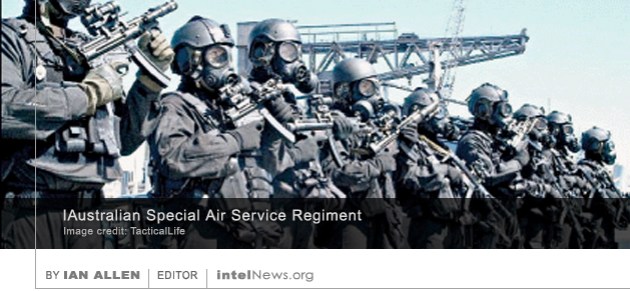 The use of firearms by Australian intelligence and security personnel stationed abroad is being reviewed following an incident in which an intoxicated special forces soldier pulled a gun on a spy in Afghanistan. According to reports in the Australian media, the review was conducted by the Inspector General of Intelligence and Security, a government-appointed office that monitors the conduct of Australian intelligence and security agencies.
It is believed that the Inspector General’s office began the investigation in 2014, shortly after it was made aware of the alleged incident in Afghanistan. According to unconfirmed reports, the incident involved two members of a “defence support team” who were stationed in Kabul. Defence support teams are highly secretive outfits that operate abroad and bring together members of Australia’s Special Air Service Regiment (SASR) with officers of the Australian Secret Intelligence Service (ASIS) —the country’s primary external intelligence agency. Some reports suggest that a group of SAS soldiers had been drinking heavily at the embassy of Australia in the Afghan capital, and that one of them, who was heavily intoxicated, pointed a loaded handgun at a female ASIS officer, while verbally threatening her.
Cooler heads prevailed and the incident ended quickly. But it allegedly shook everybody who witnessed it, and it was quickly reported to the Inspector General. The watchdog promptly carried out an audit “to make sure guns were only being issued to foreign posts that really needed them”. Its written recommendations were circulated within ASIS earlier this week. However, the agency says it will not reveal the precise content of the Inspector General’s recommendations, because it could “prejudice [Australia’s] security relations with other counties” and place spies at risk.
► Author: Ian Allen | Date: 21 October 2015 | Permalink







 intelNews.org
Indonesia halts joint military training with Australia ‘over espionage fears’
January 6, 2017 by Ian Allen 1 Comment
The unexpected announcement was made by a spokesman of the Indonesian National Armed Forces, who said that “all forms of cooperation with the Australian military, including joint training” would be “temporarily withheld”. When asked about the reasons behind the sudden move, the spokesman said it was “due to multiple reasons”, but refused to give specifics. Later on Wednesday, Indonesian officials said some print material had been found at the training center in Perth, which offended the Indonesian people. But Australian media suggested that the Indonesian government had decided to terminate the joint military training program because it feared that its special forces troops would be recruited as spies by the Australians. Some reports brought up some relevant comments made in November of last year by a senior Indonesian military official, General Gatot Nurmantyo. The general said he had ended military cooperation between troops under his command and their Australian colleagues due to fears that his troops may be compromised by the Australians during training.
But Australia’s Minister of Defense, Marise Payne, rejected that Australian espionage activities were behind Jakarta’s surprise decision. Speaking on ABC Radio on Wednesday, Payne said it was “not the case” that Australian intelligence officers had tried to recruit Indonesian soldiers. That “is something which we would not countenance”, she said. In 2013, Indonesia withdrew its ambassador from Canberra and terminated all military and intelligence cooperation with Australia, after it emerged that Australian spies had targeted the communications of the Indonesian President and other senior officials. But tensions subsided in August of 2014, when the two countries signed a joint agreement aimed at curbing their intelligence activities against each other. The last time Australia and Indonesia halted military cooperation was in 1999, when it was revealed that Kopassus troops had taken part in human rights abuses in East Timor. But the joint training was resumed in 2002, after the Bali bombings, which killed 202 people, many of them Australian tourists.
► Author: Ian Allen | Date: 06 January | Permalink
Filed under Expert news and commentary on intelligence, espionage, spies and spying Tagged with 0 Argentine Admiral fired over espionage scandal, Australia, Australian Special Air Service Regiment, Gatot Nurmantyo, Indonesia, Kopassus, Marise Payne, military cooperation, News