Brazil builds direct Internet cable to Europe to avoid US spying
November 3, 2014 5 Comments
 By JOSEPH FITSANAKIS | intelNews.org
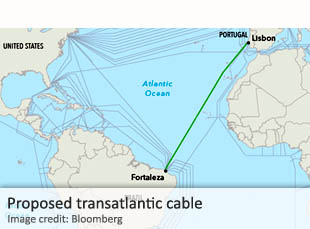
The government of Brazil is to construct a transatlantic cable across the Atlantic Ocean in order to avoid having its Internet traffic to and from Europe intercepted by American intelligence agencies. According to reports, the fiber-optic cable will stretch for 3,500 miles from the northeastern Brazilian city of Fortaleza to the Portuguese capital Lisbon. It will cost the Brazilian government in excess of US$185 million, but it will allow the country’s existing Internet traffic to and from Europe to travel without going through cables owned by American service providers. According to Brazilian officials, the construction of the cable is among several steps announced by the Brazilian government aimed at disassociating its communications infrastructure from American companies. The move follows revelations made last year by American defector Edward Snowden that the US National Security Agency specifically targeted Brazilian President Dilma Rousseff’s personal communications as part of its intelligence-collection efforts targeting Brazil. In response to the revelations, Rousseff cancelled a planned official state visit to Washington and accused the US of having committed “a breach of international law and an affront” against Brazil’s sovereignty. The planned fiber-optic cable connection to Europe will be overseen by Telecomunicacoes Brasileiras SA, Brazil’s state-owned telecommunications conglomerate, known commonly as TeleBras. The company’s president, Francisco Ziober Filho, said in an interview last week that none of the $185 million that will be spent on the project will end up in the pockets of American companies. For over a year, experts have been warning that the Snowden revelations about the extent of the NSA’s global communications-interception activities might undermine the American telecommunications sector, insomuch as it could undercut America’s role and influence in global Internet governance. Many countries, Brazil included, are beginning to actively reconsider their dependence on US-managed Internet networks that host the content of social media sites, cloud computing databases, or telecommunications exchanges. Read more of this post







 intelNews.org
Brazil’s new acting president was US embassy intelligence source in 2006
May 17, 2016 by Joseph Fitsanakis 1 Comment
But in March of this year, the PMDB dropped its support of Rousseff, accusing her of financial irregularities. In April, the speaker of Brazil’s Chamber of Deputies (the lower house of the Brazilian Parliament), Eduardo Cunha, who is himself a PMDB member, spearheaded impeachment proceedings against Rousseff. Eventually, these efforts were successful, leading to the suspension of the president, who is currently undergoing an impeachment trial. In the meantime, Temer assumed the role of president, as stipulated by the Brazilian constitution. This has led Rousseff to denounce the proceedings as a coup orchestrated by the PMDB.
Throughout this process, the United States, which has had a tense relationship with President Rousseff, and her predecessor, the leftwinger Luis Inacio Lula da Silva, has maintained a discrete silence. But two leaked cables produced by the US embassy in Brazil in 2006, show that Temer, who led the impeachment proceedings against Rousseff, was considered an intelligence informant by US diplomats. The cables, which were published on Friday by WikiLeaks, appear to show that Temer briefed US diplomats at length on sensitive matters relating to domestic Brazilian politics on at least two occasions. The cables, dated January 11 and June 21, 2006, are marked “sensitive but unclassified” and “Political Affairs—Intelligence” by their author, Christopher McMullen, who was then US consul general in Brazil. They detail the content of conversations that Temer, who was then a member of Congress, had with McMullen and an unnamed US official in the embassy’s political section.
There is no reason to assume from these cables that Temer was a paid informant, or that he was even a regular source of information for US diplomats. Nor is there any evidence that the US officials who met with Temer worked for US intelligence. However, it is clear in the cables that the Brazilian politician relayed sensitive information about his personal electoral plans, the plans of the PMDB, as well as the domestic politics of his party, which includes an analysis of various factions. Moreover, he appears to discuss matters of political strategy that are not meant for general consumption.
Ironically, the June 21 cable contains McMullen’s unfavorable assessment of Temer and the PMDB, which he describes as a “a group of opportunistic regional leaders” who have “no ideology or policy framework” and thus lack “a coherent national political agenda”. Temer was sworn in as president on May 12 and will remain in the post for no more than 180 days, during which time the outcome of the impeachment proceedings against Rousseff will be determined.
► Author: Joseph Fitsanakis | Date: 17 May 2016 | Permalink
Filed under Expert news and commentary on intelligence, espionage, spies and spying Tagged with Brazil, Christopher McMullen, Dilma Rousseff, Eduardo Cunha, informants, Michel Temer, News, PMDB (Brazil), US Department of State, US embassy in Brazil, Wikileaks