Analysis: Change in sight as Austria appoints its first-ever female spy chief
December 22, 2025 2 Comments
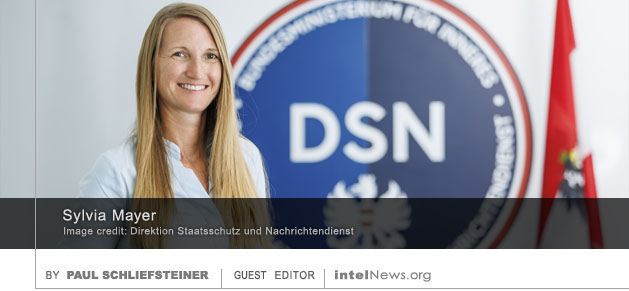 IN LATE NOVEMBER 2025 news broke that the selection for the new director of Austria’s domestic intelligence service, the Direktion Staatsschutz und Nachrichtendienst (Directorate State Protection and Intelligence Service – DSN) had been finalized: the new head of DSN would be Sylvia Mayer, a long time member of the Austrian intelligence community and the DSN’s deputy director for intelligence since October 2023. Mayer, therefore, will become the first female spy chief in Austrian history. She will officially commence her new position on the 1st of January 2026, by which time she will have fulfilled her current role as DSN interim director for several weeks.
During the selection process, Mayer did not simply prevail against her competitors, but virtually dominated the field: not only was she the sole candidate rated “highly suitable”—the highest mark in the application process— but all the remaining eleven applicants—among them two other women—were classified as “not suitable”, the lowest possible category.
Mayer being considered highly qualified by the section committee is not surprising, given her impressive career: after graduating from a higher technical education institute (an Austrian school form that educates teenagers from 15 to around 19 years of age) that focused on information technology—which earned her the title of an engineer—Mayer joined the Austrian uniformed police in Linz, the country’s third largest city.
In 2012, Mayer joined the predecessor of the DSN, the Bundesamt für Verfassungsschutz und Terrorismusbekämpfung (Federal Office for the Protection of the Constitution and Counterterrorism – BVT). Initially tasked with combating extremism, she was soon asked to establish a new unit (Referat in German) for the protection of critical infrastructure, which she consequently began heading in 2013. From 2020 to 2021 Mayer was the interim head of the protection and security department of the BVT. From December 2021 onwards, following the restructuring of the BVT into the DSN, Mayer took over the department of strategy, policy, resources and staff matters (Stabsangelegenheiten in German) within the new agency, before becoming its vice-director for intelligence, as mentioned earlier.
While working full-time, Mayer completed a law degree and doctorate in the same field, which was awarded to her in 2021 by the University of Vienna. According to her official biographical note, Mayer also holds a master’s degree in strategic security management from the University of Applied Sciences Wiener Neustadt.
Mayer is also an accomplished athlete: playing soccer since her teen years, she took part in the Austrian national league and joined the Austrian under-19 female national team. As a young girl she is said to have trained at length with the boys—an experience some have pointed out might have proven helpful for a career in Austria’s male dominated Ministry of Interior and the intelligence world. Over the years, Mayer has emphasized on several occasions that she hopes to inspire other women to also assume leadership roles and demonstrate that they are as capable as their male counterparts.
The appointment of a new DSN-chief became necessary after its current director, Omar Haijawi-Pirchner announced in September that he would be stepping down at the end of this year, citing undisclosed personal reasons. Since the DSN director post is a five-year appointment, Haijawi-Pirchner would have had to seek reappointment in 2026. That Haijawi-Pirchner stepped down before the end of his current contract came as a surprise—especially since, in addition to his largely successful tenure as the DSN’s first-ever director, Haijawi-Pirchner can also look back on a long career in Austria’s police force, where he held several important positions.
In the years following the DSN’s establishment, several terrorist plots—mainly by radical Islamists and a few by right-wing extremists—were successfully foiled. As a result, Austria suffered only a single deadly terrorist attack: in February 2025, in the town of Villach, a single Islamic State  sympathizer wielding a knife tragically killed a 14-year-old boy and injured five more people. While the attack received international attention, the ensuring investigation found that the perpetrator—a 23-year old Syrian refugee—had become radicalized largely over the internet and that this had gone unnoticed by those around him; consequently, the authorities had missed no warning signs.
Another attack—that one successfully foiled—also made global headlines under Haijawi-Pirchner’s tenure as DSN director: in August 2024 it became publicly known that a small number of Islamic State sympathizers had planned to attack one of three concerts by Taylor Swift that had been scheduled to take place in Vienna. The suspects of the attack were apprehended only a few hours before the first concert would have commenced, which caused the global superstar and her management team to cancel all three events. That decision left a lot of Taylor Swift fans heartbroken and could be seen as a partial victory for the terrorist plotters. Nonetheless, in the eyes of this author, the cancellation of the concerts, and the impression it gave about the security situation in Austria, cannot be blamed on the intelligence service and its chief; rather they should be laid at the feet of Austria’s political establishment—and especially those holding office in the federal and Viennese governments at the time. Terrorist attacks, as well as the threat of them, are highly symbolic acts; Austria’s elected officials either did not understand, or did not have the courage to counter these threats with another symbolic act—i.e. publicly guaranteeing the safety of the concerts and maybe even offering to attend a concert themselves, so as to demonstrate that the events—and by extension Austria as a whole—were safe.
Mayer clearly sees it as her task to keep the country that way—a safe place. The incoming DSN director has previously characterized her organization’s intelligence work as the “early warning system of the Republic”. Still, she will be taking over the domestic intelligence agency in challenging times: Internationally Austria is still trying to find its footing in the new geopolitical environment following the Russian invasion of Ukraine, while being criticized by other European states for not detangling from Russia fast and deeply enough. This is proving to be difficult since major Austrian firms and banks—especially Raiffeisen International—still have billions of Euros “at risk” in Russia and the Kremlin’s sphere of influence. Additionally, such markets are hard to replace for Austria’s export-driven economy. Also, Austria, and in particular Vienna, still have the reputation of being a “den of spies” and face allegations of not doing enough to curtail foreign—especially Russian—intelligence operations on their soil.
Mayer—most likely deliberately—positioned herself publicly at the end of November in this regard, calling Russia “the greatest threat to the republic” in an interview in Die Presse, one of Austria’s newspapers of record. At the end of the interview a Die Presse journalist asked Mayer if she had applied for the position of DSN director. Meyer responded with a direct and sober confirmation, thus making her earlier statements about Russia read as messages to Austria’s Western partners and allies, as well as to the Russian Federation, that she means business.
When her appointment was officially confirmed, Mayer stated: “Our services’ efforts to protect our constitution and our way of living forms the foundation for a secure shared life in our republic. I am proud to work together with the employees of the DSN and the LSE [local branches of in the federal states] to ensure this foundation.” [Translated by the author] She described security as a process, and therefore that she was looking forward to further developing the DSN. The press release by the ministry additionally emphasized that under her leadership, the DSN will continue to expand its cooperation with national and international partners, strengthen modern analysis and prevention methods, and continue the structural development of the organization.
Only time will tell, however, whether the first female spy chief in Austrian history will prevail with changing the Alpine state’s stance on intelligence and counter-espionage. To do so, she will have to face—and defeat—the country’s longstanding forces of inertia, political maneuvering on the world stage, and a general disinterest of the its political class in matters of intelligence—and especially their security implications.
► Author: Paul Schliefsteiner* | Date: 22 December 2025 | Permalink
* Paul Schliefsteiner is the Director of the Austrian Center for Intelligence, Propaganda and Security Studies (ACIPSS) and the Editor of the Journal for Intelligence, Propaganda and Security Studies (JIPSS). He studied History, Philosophy and Law at the University of Graz, as well as International Security Studies at the University of the Bundeswehr Munich and the George C. Marshall Centre in Garmisch-Partenkirchen. He was previously a guest researcher at the Institute for Peace Preservation and Conflict Research at the Defence Academy of the Austrian Armed Forces in Vienna.
 About intelNews






 intelNews.org
En tant qu’officier, j’ai déjà sécurisé des références avec des services étrangers dans un but précis, relevant d’analyses et d’évaluations de faits et de circonstances. Elles relèvent parfois de sources fiables ou d’agents de liaison, ainsi que de sources de renseignement officielles ou de documents vérifiables.
Je suis actif au sein de sources de renseignement. Si je vous livre mes impressions, ce n’est pas en tant qu’agent double, ni même pour alimenter une spéculation interne auprès des services intérieurs autrichiens. Vous le savez, ma mère de cœur reste et restera Avril Haines, pour des raisons purement personnelles et professionnelles. CUI.
Aujourd’hui, nous sommes contents d’accueillir la nouvelle responsable du DSN, Madame Sylvia Mayer, membre de longue date de la communauté du renseignement autrichienne, et directrice adjointe du renseignement du DSN depuis octobre 2023. Madame Mayer deviendra donc la première femme « chef des espions » de l’histoire de l’Autriche. Elle commencera officiellement son nouveau poste le 1er janvier 2026, date à laquelle elle aura rempli son rôle actuel de directrice par intérim du DSN pendant plusieurs semaines.
Pour toute compétence d’échange d’informations, je partagerai avec le KSO – Centre de sécurité intérieure d’Autriche, étant renseigné comme tel.
La situation représente une détermination autour d’actes d’antisémitisme et de haine à l’égard du salut nazi au sein d’une partie de la population arabe, liée parfois à des idées se rattachant au terrorisme islamique/ ou toutes autres informations liées au lien sécuritaire.
Notre directeur actuel DNI / M. Tulsi, dans son dernier discours, vient encore de mettre en garde l’Occident sur cette montée de l’islamisme. Nos rapports indiquent des infiltrations dans nos instances, nos communes, et jusqu’aux plus hautes sphères du pouvoir politique. Ils desservent notre sécurité intérieure. Sans proclamer un État devenu ingérable, les faits, bien que non officiellement établis, sont existants et présents, de quoi rester vigilants quant à l’avenir de la Belgique, de la France, et d’une Europe devenue source biologique du repli d’un islamisme grandissant sous traitant du narcotrafics, trafic d’arme, trafic de pétrole, trafic d’être humain.
Nos frontières ouvertes posent de réelles questions de fonctionnement au cœur même de l’Union européenne. Et vous n’êtes pas sans savoir que la Russie, en l’occurrence, profite de ces possibilités d’infiltration.
Il est regrettable que la Russie adopte de tels comportements, car nous avons à apprendre et à comprendre leur détermination. Nos services font partie d’analyses et d’évaluations sérieuses, et non d’états de service falsifiés.
J’ai hâte, Madame la Directrice, de proclamer avec vous une collaboration servant nos intérêts intérieurs, afin d’unir nos forces et de renforcer notre engagement.
Le dérangement peut être un sursaut de conscience éclairé, dans une cause mise à jour ; il relève d’une position établie dans le cadre d’un lien pouvant redéfinir une situation parfois méconnue des services intérieurs liés à la sécurité.
Cette réflexion constitue une part importante de l’enseignement professionnel du renseignement autrichien et sécuritaire.
Je vous invite à un simple regard sur ma page facebook.
DOD / CUI — à nous d’en faire bon usage. Pascal lembree, Pour info ? J’ai accepté la politique de confidentialité, rappelant qu’accepté ne veux pas dire partagés dans l’ensembles des faits.
Madame la Directrice, Je vous souhaite d’agréable fête de Noel, suivi d’une excellente fête de fin d’année, pour un passage en 2026 de pleine conscience.
Ce même mémo, dans la note de service à été envoyé en interne du cite de renseignement KSO-DSN- CIA- NSA- Pentagone-DGSE/VSSE/M16/M15/SHIN-BET/DEA/FBI
The appointment of women as heads of security and intelligence agencies has been occurring for the first time in Australia as well.
This began in February 2023 with Kerri Hartland being appointed Director-General of the Australian Secret Intelligence Service (ASIS) covering foreign intelligence. https://en.wikipedia.org/wiki/Australian_Secret_Intelligence_Service
Then in September 2024 with Abigail Bradshaw as Director-General of the Australian Signals Directorate (ASD) covering signals intelligence and cybersecurity. https://en.wikipedia.org/wiki/Australian_Signals_Directorate
Then October 2025 with Krissy Barrett as Commissioner of the Australian Federal Police (AFP) https://en.wikipedia.org/wiki/Australian_Federal_Police
and lastly the early December 2025 commencement of Kathy Klugman, in the most senior analysis and coordination position, as Director-General, Australian Office of National Intelligence (ONI) https://www.oni.gov.au/leadership-team
Australia has subsequently suffered its worst intelligence failure with the killing by Islamist extremists of 15 Jewish people at Bondi Beach Sydney on December 14, 2025. https://en.wikipedia.org/wiki/2025_Bondi_Beach_shooting Any misplaced gender connection can be quashed by Mr Mike Burgess holding the Director-General, Australian Security Intelligence Organisation (ASIO) position since September 2019. https://en.wikipedia.org/wiki/Mike_Burgess_(intelligence_chief)