Opinion: Gofman’s Mossad appointment poses major challenges to Israeli Intelligence
June 19, 2026 9 Comments
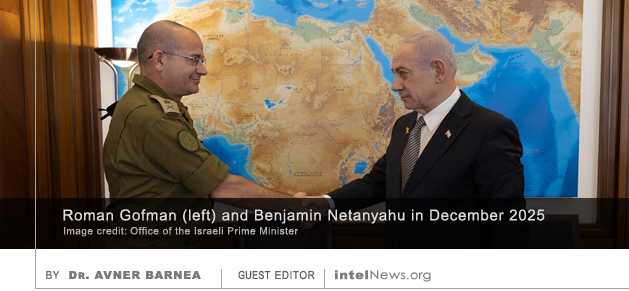 THE APPOINTMENT OF MAJOR General (res.) Roman Gofman as director of the Mossad spy agency has emerged as a flashpoint in Israel’s security landscape, underscoring sharp divisions over senior leadership choices. Announced by Prime Minister Benjamin Netanyahu in December 2025, the appointment has sparked intense debate among political, legal, and security circles. Supporters emphasize Gofman’s innovative, battle-tested military credentials, while detractors challenge both the process and his suitability to head Israel’s top foreign intelligence agency. This controversy mirrors the backlash against Netanyahu’s prior nomination of Major General David Zini as head of the Israel Security Agency (ISA), raising persistent questions about the decision-making process for key intelligence appointments.
The Appointment Process
On 4 December 2025, Netanyahu announced his decision to appoint Gofman as the next director of the Mossad. At that time, Gofman was serving as Netanyahu’s military secretary. Gofman was selected to replace outgoing Mossad Director David Barnea, whose five-year term was scheduled to end in June 2026.
The choice was notable because Gofman came from the Israel Defense Forces (IDF) rather than from within the Mossad itself. Reports indicate that Netanyahu bypassed Mossad’s existing leadership, including candidates reportedly favored by outgoing director David Barnea, in selecting Gofman.
Following the announcement, Israeli law required the Advisory Committee for Senior Appointments to review senior security appointments. Chaired by former Supreme Court President Asher Grunis, the committee examined Gofman’s candidacy and approved it in April 2026. After /approval, Netanyahu signed the appointment documents.
Nevertheless, the Committee’s approval did not resolve all disagreements. Gofman’s nomination soon became the subject of legal challenges before Israel’s High Court of Justice. Only after the Court rejected petitions seeking to block the appointment was Gofman able to assume office as Mossad Director in June 2026.
Why Netanyahu Chose Gofman
Supporters of Gofman’s appointment emphasized that, following the outbreak of the Israel-Gaza War in October 2023, Gofman brought extensive military experience and was closely involved in national security decision-making. Netanyahu’s office highlighted Gofman’s wartime operational leadership, his service as military secretary, and his coordination with intelligence agencies, including Mossad. Supporters also emphasized Gofman’s reputation as an unconventional and creative commander. During his military career, Gofman commanded armored formations, led operational units on Israel’s northern and southern fronts, and was wounded while fighting Hamas militants during the attacks of 7 October 2023. His supporters argued that the post-October 7 security environment required fresh thinking and leadership from outside traditional intelligence circles.
Lack of Intelligence Background
The most common criticism of Gofman’s appointment concerned his professional background. Unlike most recent Mossad directors, Gofman had spent his career in the military rather than in intelligence operations. Critics argued that running a global espionage organization requires skills and experience different from those needed to command military units. Several commentators noted that he would be among the few Mossad chiefs appointed without a substantial career in the intelligence service. Supporters countered that the Mossad has historically benefited from leaders with diverse backgrounds and that strategic leadership skills can be transferable across intelligence organizations. His critics emphasize his lack of experience, as four days after his appointment he fired the No. 2 at the Mossad, who had strong credentials and successful experience at the agency. It looks like more senior officials at Mossad may leave the agency, as they are not satisfied with Gofman’s nomination.
Allegations of Political Loyalty
Another major point of contention is Gofman’s close relationship with Netanyahu. As the prime minister’s military secretary, Gofman worked directly alongside Netanyahu and was regarded as a trusted adviser. Some observers stated that his appointment was based on personal loyalty rather than solely on professional considerations, and noted that Netanyahu bypassed candidates favored by the outgoing Mossad leadership.
Some warned that intelligence chiefs should provide independent assessments to political leaders, even when those assessments are unwelcome. Gofman’s nomination was included in a broader discussion about political influence over Israel’s security institutions.
The “Minor Informant” Affair and Legal Challenges
A further complication emerged during scrutiny of Gofman’s tenure as an IDF commander. Critics questioned his involvement in a controversial military operation that used a minor in a sensitive information campaign. This became a focal point during the vetting process and was cited by those challenging his appointment.
Although the advisory committee approved his nomination, the issue caused delays. It also provided grounds for legal petitions.
Gofman’s nomination faced formal legal challenges before the High Court of Justice in Israel. Petitioners argued that aspects of Goffman’s conduct and the appointment process raised concerns regarding standards expected of senior public officials. The litigation delayed the completion of the appointment process and prolonged public debate about the nomination. Ultimately, the High Court rejected the petitions and allowed the appointment to proceed.
Conclusion
Roman Gofman’s appointment as Mossad director illustrates the tensions that frequently accompany senior security appointments in Israel. On the one hand, supporters viewed him as a highly capable commander whose operational experience, creativity, and wartime service made him well-suited to lead the country’s foreign intelligence service. On the other hand, critics questioned his lack of intelligence experience, his close association with Prime Minister Netanyahu, and controversies stemming from allegations of lapses in decision-making and command disputes during his military career.
Despite these challenges, Gofman ultimately secured approval from both the Advisory Committee for Senior Appointments and the High Court of Justice, allowing him to assume leadership of the Mossad in June 2026. His performance as director will be subject to close scrutiny.
► Author: Avner Barnea* | Date: 19 June 2026 | Permalink
* Dr. Avner Barnea is a research fellow at the National Security Studies Center of the University of Haifa in Israel. He served as a senior officer in the Israel Security Agency (ISA). He is the author of We Never Expected That: A Comparative Study of Failures in National and Business Intelligence (Lexington Books, 2021).
 About intelNews








I strongly agree with Dr. Avner Barnea’s independent and comprehensive analysis.
The leadership of a global intelligence organization such as Mossad should be selected through a strategic, merit-based, and future-oriented process, not one shaped by internal politics, favoritism, personal loyalty, or the inertia of the existing apparatus.
Israel’s geostrategic reality has changed dramatically. Its global position, adversarial environment, alliance structure, technological challenges, and international reputation all require intelligence leadership with deep professional credibility, institutional independence, and the capacity to reposition the organization for the next era.
This also requires a serious reevaluation of the KPIs attached to the role of Mossad Director and, more broadly, to the organization itself. Traditional indicators of operational success are no longer sufficient. The next generation of performance criteria should reflect strategic foresight, intelligence impact on national decision-making, technological adaptation, interagency coordination, risk anticipation, reputational resilience, alliance management, and the ability to operate effectively in an increasingly contested global environment.
A further priority should be the development of closer, more structured partnerships with trusted, capable, and efficient regional allies. In the current environment, intelligence effectiveness depends not only on unilateral capability, but also on selective cooperation, shared situational awareness, operational interoperability, and reliable regional networks built on mutual strategic interest.
Equally important, the role and job description of the Mossad Director should be revisited and expanded. In periods of local or global political turbulence, regional escalation, or social instability, intelligence leadership must have clearly defined decision-making authority, crisis-management responsibilities, and institutional latitude to act quickly, responsibly, and in alignment with national strategy. Ambiguity in authority during instability can weaken both responsiveness and accountability.
The question is therefore larger than one appointment. It concerns the standards, criteria, mandate, and strategic logic by which Israel selects, evaluates, empowers, and holds accountable the leadership of one of its most consequential national institutions.
The appointment of Gofman may be good for Mossad if it is giving Gofman easy and quick access to Netanyahu.
However, as Dr Barnea suggests, Gofman’s prior closeness to Netanyahu may compromise the independence of the Mossad intelligence assessments Gofman sends to Netanyahu.
Then there are Israel’s Knesset elections, to be held October 27, 2026. or a little earlier https://en.wikipedia.org/wiki/2026_Israeli_legislative_election. If Netanyahu remains Prime Minister then all the better for Gofman’s position heading Mossad. But if Netanyahu loses office then Gofman may lose his job and Mossad’s organizational stability and assessment capacity might suffer.
Hi Anonymous at June 19, 2026 at 02:20
A rather odd comment in style and wording – without any sources or specific details. Are you sure it wasn’t AI produced?
Cheers Pete
It must be difficult, balancing what is good for the leaders of a country, and what is good for the country. Netanyahu is now running on self preservation protocol. As long as he can keep Israel at war he is safe from trials as war criminal.
Very true Anonymous at June 23, 2026 at 12:19
Netanyahu has a number of corruption matters pending against him https://theconversation.com/what-charges-does-benjamin-netanyahu-face-and-whats-at-stake-if-he-is-granted-a-pardon-270970
However, even if Netanyahu loses the October 2026 election his possible replacement may be worse for Israelis, Palestinians, the region and even for Mossad. I’m thinking of Defense Minister, Israel Katz https://en.wikipedia.org/wiki/Israel_Katz#Peace_and_security “he supports continued settlement construction,[62] extending full Israeli sovereignty to the West Bank,”
Pete: https://www.thefp.com/p/larry-sanger-wikipedia-co-founder-banned
I find most non political, and educational subjects OK for the most part on Wikipedia, but when the subject goes political or even some history subjects become slanted in some bias form. and when one looks at how Academia and it’s union bosses were taken over be the left when the Department of Education was formed at the end of 70’s, it easy to see how & why. Not only that, but even US test scores show a clear pattern of decline. Avner Barnea is like Bernie Sander, or Nancy Pelosi in the states, and has been hell bent on damaging anything to do with Israel’s current government.
Where has the balance gone?
I wonder, if say the French or Italians sent troops to the West bank to defend the Palestinians, would they technically or legally be doing anything against Israel, I mean supposedly the land belongs to Palestine?
Hi Anonymous at June 27, 2026 at 04:48
I reckon its one of the axioms of history that most educated people are center-left.
Tertiary education gives them more time to reflect on the ploys (and not a little corruption) of dictators.
For some reason the mainstream in the US may be further to the right than most. To be labelled a Democratic Socialist who supports public health schemes is a compliment in most of Europe, Canada, Australia, New Zealand and maybe in Israel. In the US socialism may be considered tantamount to communism.
Cheers Pete
Its good for an intelligence officer to be politically, religiously and ideologically neutral (or as near as possible) at all times.
Any strong leanings erode analysis and judgements.