Germany set to enact most sweeping intelligence reforms since World War II
August 13, 2026 5 Comments
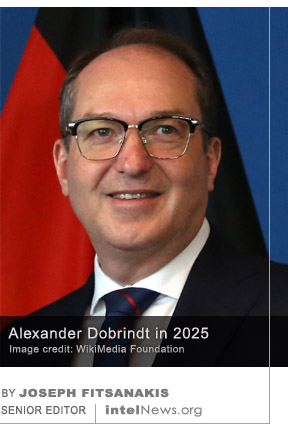 GERMANY IS ONE CLOSER to putting in motion the broadest and most wide-reaching reforms of its intelligence services since the end of World War II, which are expected to completely transform the country’s spy agencies. Among other powers, Germany’s two covert intelligence agencies will be given the ability to engage in offensive intelligence that includes carrying out sabotage and offensive information operations abroad.
Earlier this week, the proposed reforms were approved by the Federal Cabinet, which consists of German Chancellor Friedrich Merz and 17 senior federal ministers. Speaking in Berlin about the proposed reforms, Germany’s Minister of the Interior, Alexander Dobrindt (pictured), said on Wednesday that the nation’s intelligence services will be “turned into genuine secret services”. He went on to describe the proposed changes as “a revolution” in the history of German national security.
The proposed reforms apply to Germany’s two covert intelligence agencies: the Federal Office for the Protection of the Constitution (BfV) which operates domestically, and the Federal Intelligence Service (BND), which operates abroad. Since their establishment in the 1950s, the two agencies have been tasked with gathering intelligence for purely defensive/protective reasons. Both operate under stringent oversight by committees in the Bundestag—Germany’s lower house of parliament.
The proposed reforms will permit the agencies to neutralize “threats to Germany and its allies […] using kinetic means if necessary”. This means that special agents will be allowed to employ firearms and other weapons in the course of operations—though only in self-defense. They will also be permitted to engage in sabotage and other offensive information operations, and carry out offensive cyber espionage and cyber sabotage.
The government is largely justifying the as a response to what it describes as “state terrorism” in reference to Russian hybrid warfare—a phenomenon that Western European intelligence agencies consistently claim is growing in both scope and intensity. On the same day the German Federal Cabinet approved the proposed intelligence reforms, the Bloomberg news agency //reported// that the United States Central Intelligence Agency had reported its European counterparts that Moscow was preparing to intensify its campaign of “sabotage against infrastructure facilities and ‘false-flag’ operations” on European soil.
The proposed reforms will not become law until they are formally approved by the Bundestag in September. However, this is expected to occur with a high degree of certainty, given that the majority of seats is held by the governing coalition. The latter includes the center-left Social Democrats (SPD) and the center-right Christian Social Union (CSU) and Christian Democratic Union (CDU).
► Author: Joseph Fitsanakis | Date: 13 August 2026 | Permalink









good glad to see updating their protocols
If EU control intelligence, or bring it under a ministry, its limited power cannot protect a country’s national security. I personally support recent intelligence reforms in Germany.
“After WW2 West Germany undertook painful soul searching driven by guilt about the activities and memory of the Abwehr (military-foreign intelligence) and more particularly the Gestapo and SS security services during the years of Nazi Germany.
This caused a “soft security” revisional response for decades after WW2. Some felt the intelligence and security services of West Germany and re-unified Germany (1990 on) were too defensive, toothless and publicly transparent – all reducing their operational performance. (East Germany’s KGB run Stasi was clearly hard-line different).
The revised approaches outlined in the above article can be seen as redressing the “wokeness” (useful word in this context) of the post WW2 West German approaches. Also the rising challenge of Putin’s Russia (and possibly Belarus) would be driving “free” European counter-measures styled on the CIA’s/US Special Forces’ long established approaches – see this 6 month old video explainer https://youtu.be/DqyhyQnL3EE?si=TscZh63xfwPwJs_G
Russia would see its increasingly aggressive hybrid warfare against free Europe as just. This is given free European funding of Ukraine’s large drones (long range slow missiles) that are doing increasing damage. This is to Russia’s energy infrastructure and weapons eg. $Billiion aircraft on the ground (military purposes) and to Russian civilian areas, including Moscow (for political propaganda purposes.)
Anonymous says:
So, I think there should be some context for reference:
Germany is a federation. There are 3 federal secret services and 16 state secret services. They all need some form of coordination and clear fields of responsabilites. All state services and one federal service are dedicated to internal security (“Verfassungsschutzämter” – services for the constitutions’ protection); intelligence against foreign espionage, all forms of extremism and terrorism. One federal service (BND) is the external secret service and one is the military secret service (MAD). All constitution protection services are subject to relatively tight parliamentary control through parliamentary committees that act under secrecy. They don’t act “kinetically”, but gather information and call in e.g. SWAT (Gwrman: SEK) or GSG9 commandos in order to intervene. The same is true for the military service, the MAD.
The BND however, is a totally different matter… Officially, it is subject to parliamentary control aswell. Practically, it’s only reporting to the chancellor’s office. Officially, it only collects intelligence for “external actions of unknown kind”. In reality, it passes information on to KSK, KSM and allied military commando units. It even has it’s own intervention unit, which lacks a name. Only in 2022 it was revealed that this unit was kept on stand by in order to evacuate the BND director himself from Kiev at short notice… That’s how its existence became public, but nothing more.
Some years ago, BND and KSM? even founded a fake-shipping company, the “Beluga Reederei” for arms exports to African countries… The BND is certainly one if the “more capable” secret services on the globe.
Germany’s national security state revisions would need to take into account Operation Rubicon (German: Operation Rubikon), until the late 1980s called Operation Thesaurus. It was a secret operation by the West German Federal Intelligence Service (BND) and the CIA, lasting from 1970 to 1993 and 2018, respectively, to gather communication intelligence of encrypted government communications of other countries. This was accomplished through the sale of manipulated encryption technology (CX-52) from Swiss-based Crypto AG, which was secretly owned and influenced by the two services from 1970 onwards. In a comprehensive CIA historical account of the operation leaked in early 2020, it was referred to as the “intelligence coup of the century” in a Washington Post article. The Maximator alliance, which in addition to (West) Germany also includes Denmark, France, the Netherlands and Sweden, was also familiar with the vulnerabilities and used it in their own intelligence gathering.”