Israeli expert warned of aviation security breach risk prior to Flydubai hijack attempt
October 5, 2026 2 Comments
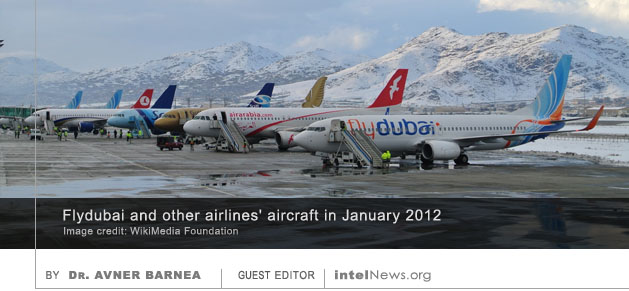 AN ARTICLE PUBLISHED LAST summer in Mabat Malam, the journal of the Israel Intelligence Heritage and Commemoration Center, identified “insider threats”, ranging from aircrew members to airport employees, as major dangers to civil aviation. The article, “Terrorist Attacks on Civil Aviation: A Threat That Must Not Be Ignored”, was authored by Danny Shenar, former Director of the Security, Emergency and Cyber Division at Israel’s Ministry of Transport. It was published in July 2026, ahead of the summer vacation season and the expected increase in the number of Israelis traveling abroad.
In his article, Shenar highlights a recognized vulnerability in aviation security: the insider threat. This refers to the danger that someone within the aviation system, with authorization and access to sensitive systems or restricted areas, could exploit authorized access to circumvent security measures. In light of this week’s serious incident on a Flydubai flight to Israel, Shenar’s warnings highlight the need for Israeli professionals responsible for civil aviation security to remain alert to vulnerabilities in the security system. The similarity between the incident and the scenario identified by Shenar does not necessarily mean that the event was a terrorist attack—something that has not yet been established. Rather, the similarity lies in the possibility that the risk may have originated within the system itself, from an individual on the aircraft’s crew with direct access to the cockpit and the aircraft’s systems.
Shenar’s article addresses what he calls “the reliability of personnel authorized to access restricted areas, the ‘Trojan horse'”. While an ordinary passenger undergoes security screening before boarding an aircraft, an airport employee or another person authorized to enter restricted areas may already be on the other side of the security perimeter. If such a person becomes hostile, they may exploit their authorized access to circumvent protective mechanisms. “The insider threat is a significant vulnerability”, Shenar wrote. “A single radical employee is enough to circumvent the entire security system and assist in introducing prohibited materials into restricted areas”.
Shenar provides several examples of this type of threat in his article. Among them, he refers to a security employee at Heathrow Airport who was suspected of assisting a terrorist plot in 2006; a British Airways employee convicted in 2011 of planning terrorist activity; and the 2016 attack on a Daallo Airlines aircraft, in which an explosive device was brought aboard a plane departing from Mogadishu, Somalia.
 According to Shenar, the insider-threat problem does not end with the background check conducted before an employee is hired. He notes that people may change during their employment and that repeated vetting of employees faces legal, ethical, and practical limitations. He further argues that, in practice, no uniform standard defines the criteria, quality, and frequency of background checks for employees working in sterile areas of airports. In fact, the article focuses primarily on the potential for aviation terrorism at small and peripheral airports abroad, where, according to the author, technological and organizational gaps sometimes exist in comparison with major international airports.
In his article, Shenar emphasizes that he does not have concrete intelligence or other specific information indicating a particularly high risk to foreign civil aviation operating flights to Israel. Rather, his assessment constitutes a risk evaluation, based on—among other factors—the availability of explosives, the accumulated knowledge of terrorist organizations, and awareness of the limitations of existing screening methods.
At the conclusion of the article, Shenar calls on Israeli security authorities to actively assess security levels at foreign airports from which flights depart for Israel, identify security gaps, and demand that those gaps be corrected. His main takeaway is clear: treat the threat seriously and review security measures before flights depart. Shenar’s call was ignored.
► Author: Avner Barnea* | Date: 05 October 2026 | Permalink
* Dr. Avner Barnea is a research fellow at the National Security Studies Center of the University of Haifa in Israel. He served as a senior officer in the Israel Security Agency (ISA). He is the author of We Never Expected That: A Comparative Study of Failures in National and Business Intelligence (Lexington Books, 2021).
 About intelNews








Here are 4 historical examples of proven or suspected Trojan horse/insider incidents. A summary of AI reveals:
Malaysia Airlines Flight MH370 (2014) Captain (suspected) The aircraft vanished over the Indian Ocean after its communications were manually disabled. A leading theory points to a deliberate pilot-suicide/mass murder plot executed by the captain.
Germanwings Flight 9525 (2015) First Officer Co-pilot named Andreas Lubitz utilized post-9/11 reinforced security doors to lock the captain out of the cockpit while he was using the restroom, deliberately flying the plane into the French Alps.
EgyptAir Flight 990 (1999) A Relief First Officer when left alone on the flight deck, named Gameel El-Batouty disabled the autopilot and initiated a rapid dive into the Atlantic Ocean, repeating “I rely on God” (Arabic: ‘Aetamid Ealaa Allah)
Metrojet Flight 9268 (2015) Egypt Sinai (Airport location) Ground/Airport Baggage handlers believed to have planted an explosive device hidden in a soda can in an airliner hold was planted by airport insiders at Sharm El Sheikh International Airport, detonating mid-air and killing all 224 people on board. [See my article on this at the time https://gentleseas.blogspot.com/2015/11/russian-airliner-crash-in-sinai-egypt.html ]
[THE FOLLOWING IS PERHAPS MOST INTERESTING] “Impact on Global Aviation Security”
These incidents forced international aviation regulators to redesign safety protocols to mitigate internal risks:
Danny Shenar is not wrong in this piece. I’m a frequent flyer like most of us are these days. I’d like to add that I had an injury for a couple of years and requested Special Assistance at the departure airports, connecting points and arrivals. I was quite surprised that at times I by-passed security because I was deemed disabled and perhaps not a threat. My walking stick in open sight was not inspected while my bag was. Shenar addressed the potential of local staff being a threat but I’m saying the pax (passengers) they are supposedly assisting, too, can gain access unnoticed. The number of times I was left unattended with no CCTV to be seen was quite often. – Nicholas Anderson, author