Argentina’s spy chief allegedly implicated in Brazil money-laundering scandal
March 2, 2018 Leave a comment
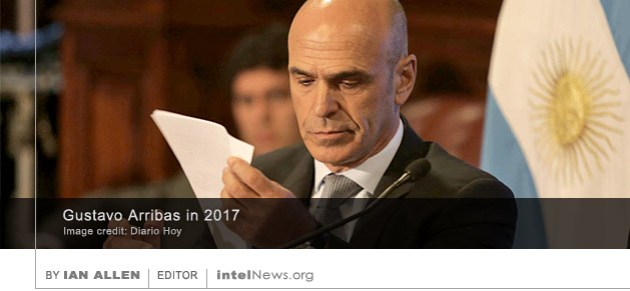 The director of Argentina’s spy agency has been accused by security officials in Brazil of being implicated in a multi-million dollar money-laundering scandal that involves dozens of senior officials across Latin America. The allegations were made in the context of the so-called “operation car wash”, known in Portuguese as Operação Lava Jato. The term refers to a money-laundering probe that began in 2014, following allegations of illegal financial practices by a number of private import-export companies in Brazil. Soon, however, Lava Jato led to the exposure of large-scale corruption, nepotism and bribing practices at the core of Brazil’s state-owned oil company Petrobras. Today, four years later, the constantly expanding investigation has implicated nearly 200 people —many of them well-known politicians— in numerous Latin American countries, including Mexico, Peru and Venezuela.
On Thursday, the car wash probe appeared to implicate for the first time a senior state official in Argentina. The figure at the center of the allegations is Gustavo Arribas (pictured), the Director General of the country’s Federal Intelligence Agency (AFI). A former sports tycoon, who made his fortune as a footballers’ representative, he surprised many in December 2015 when he was appointed spy director by Argentina’s President, Mauricio Macri. Arribas has financial dealings with Brazil, where he owns real estate. But these properties may become liabilities after Arribas was accused by Victor Ferreira, a federal police official and Lava Jato investigator, of having received nearly $1 million in a money-laundering scheme involving fraudulent invoices submitted for financial compensation to the Brazilian government by bogus companies. The money was allegedly sent to Arribas via a wire transfer that was routed to him through a bank in Hong King. The transfer had not been approved by the Central Bank of Brazil, which is supposed to supervise all overseas money transfers involving government contracts.
Brazilian prosecutors served several suspects across Brazil with search warrants on Thursday, in an attempt to uncover more information about the alleged illegal money transfer. Arribas, however, issued a statement later on the same day, in which he denied any connection with Lava Jato and said that allegations against him were motivated by malice. In 2016, Arribas was accused in Argentina of having received nearly $600,000 from corrupt officials of Brazilian construction company Odebrecht, which is implicated in operation car wash. However, he was cleared by a federal judge, who threw the case out of court. In his statement issued on Thursday, Arribas stressed that he had not been officially charged with any crime in Argentina or Brazil.
► Author: Ian Allen | Date: 02 March 2018 | Permalink
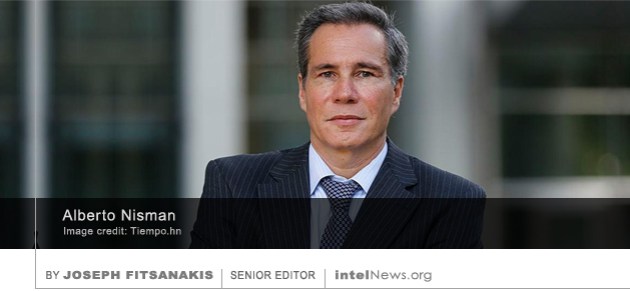 An Argentine former senior intelligence official has claimed in court testimony that the administration of President Cristina Fernández de Kirchner murdered a state prosecutor who had accused senior officials of having colluded with Iran to bomb Israeli targets in Buenos Aires. In January 2015, the prosecutor, Alberto Nisman, prompted international headlines by launching a criminal complaint against President Kirchner and several other notable personalities of Argentine political life. Nisman accused them of having colluded with the government of Iran to obstruct an investigation into the bombings of the Israeli embassy and a Jewish cultural center in Buenos Aires in the mid-1990s. A dozen people died in the bombing of the embassy, while another 85 were killed two years later, when the Asociación Mutual Israelita Argentina community center in the Argentine capital was bombed. Nisman was
 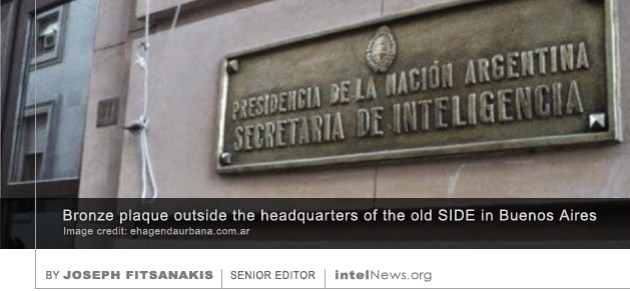 An Argentine former senior intelligence official, who is wanted in connection with the murder of a federal prosecutor in Buenos Aires, is hiding in the United States, according to the President of Argentina, who says Washington should extradite him. Antonio Horacio Stiuso, better known as Jaime Stiuso, rose through the ranks of Argentina’s Secretaría de Inteligencia del Estado (SIDE) to become its director of counterintelligence. In 2012, Argentine President Cristina Fernández de Kirchner appointed Stiuso to chief operating officer of SIDE, working directly under the agency’s director. However, Stiuso was fired in a massive agency shake-up in February of this year, when the government suddenly dissolved SIDE and replaced it with a new agency, called Agencia Federal de Inteligencia.






 intelNews.org
Argentine former president and spy agency director indicted in wiretapping probe
June 2, 2020 by Joseph Fitsanakis Leave a comment
In 2015, Macri, a successful businessman and former mayor of Buenos Aires, became the first democratically-elected president of Argentina in 100 years that came from a party other than the populist brand described as ‘Peronist’ in the post-war era. His presidency was marked by a turn to the right, as well as numerous investigations into allegations of corruption against prior heads of state, notably Cristina Fernández de Kirchner, whom Macri succeeded in the presidency.
But Kirchner is now back, serving as vice-president under Argentina’s new president, Alberto Fernández. Fernández, a Peronist, took office in December of 2019, after defeating Macri in a hotly contested race. Among Fernández’s top agenda items is the reform of the country’s Federal Intelligence Agency (AFI). The agency used to be known as the Secretaría de Inteligencia del Estado (SIDE) until 2015, when then-President Kirchner dissolved the organization and replaced it with the AFI, in order to combat alleged human-rights abuses by SIDE agents. But Kirchner has always said that her work in reforming the old SIDE was left incomplete. Her running mate, Fernández, promised to complete her work if elected. In his first post-election speech, President Fernández said that the SIDE/AFI would be reformed. He famously told his jubilant supporters: “Never again, the secret state. Never again, the cellars of democracy”. Soon afterwards, Fernández appointed Cristina Caamaño, an attorney and government administrator with experience in the area of civil liberties, to lead the AFI.
Last week, Caamaño gave a federal court in Buenos Aires a deposition containing list of over 80 names of Argentine citizens, who were allegedly spied on by the AFI without a warrant during Macri’s administration. In her deposition, Caamaño alleges that the individuals had their emails “spied on without any court order”, from as early as June 2016 until the final days of Macri’s presidency. According to local media reports, the list of alleged victims includes political opponents of Macri, as well as investigative journalists, government officials, and notable members of Argentina’s business community. There are also police and military officers on the list as well as artists, intellectuals, and trade unionists. Caamaño asked the court to investigate, aside for Macri, Gustavo Arribas, who served as AFI director under the previous president, as well as his deputy director in the spy agency, Silvia Majdalani, and her brother-in-law, Darío Biorci. The names of other alleged culprits in Caamaño’s deposition remain secret, reportedly because these individuals are still serving as undercover agents in the AFI.
On Wednesday, Caamaño’s deposition was shared with the Argentine Congress, and are now being debated in various committees, including the intelligence committee. Congress members from President Fernández’s Partido Justicialista have expressed strong support for the probe. But the opposition is highly skeptical and has asked for more information from Caamaño’s office.
► Author: Joseph Fitsanakis | Date: 02 June 2020 | Permalink
Filed under Expert news and commentary on intelligence, espionage, spies and spying Tagged with AFI (Argentina), Alberto Fernández, Argentina, civil liberties, Cristina Caamaño, intelligence reform, Mauricio Macri, News, SIDE (Argentina), warrantless communications interception