Irish officials raise espionage concerns about expansion of Russian embassy in Dublin
February 12, 2021 3 Comments
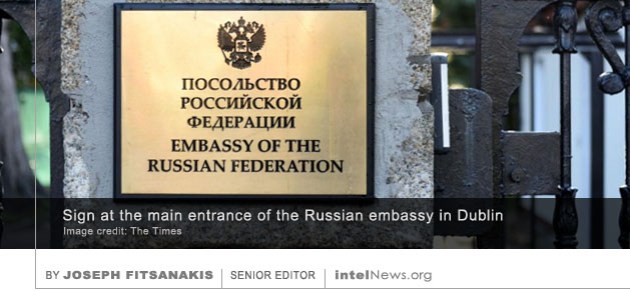 IRELAND’S COUNTERINTELLIGENCE SERVICE HAS launched an investigation into an expansion project at the embassy of Russia in Dublin. According to sources cited by The Times newspaper, the Irish government is concerned that the expansion project is part of a secret plan by Moscow to turn its embassy in Dublin into a major espionage hub in Europe.
The two nations had no diplomatic relations until September 1973, when the Republic of Ireland officially recognized the Soviet Union, and the two countries proceeded to establish embassies at each other’s capitals. Since then, the Russian embassy in Dublin has been located on Orwell Road, in the southern suburb of Rathgar. For at least three decades, the embassy has been considered by Western intelligence a hub of Russian intelligence collection operations in Europe. Some claim that the tranquil environs of the Irish capital, coupled with Ireland’s relatively relaxed counterintelligence posture, have encouraged Moscow to use its Dublin embassy as a support base for espionage activities throughout much of Western Europe.
But the Irish government changed its stance in 2018 when, in a surprising move, it introduced emergency legislation aimed at stopping a previously approved expansion of the Russian embassy complex. The government reportedly feared that the initial plan, which proposed to add 86,000 sq ft of structures to the embassy’s existing 21,000 sq ft of building space, threatened Ireland’s national security. The Russians had little choice but to comply with the restrictions imposed by the Irish government. Now, however, the Irish government is reportedly concerned that Moscow was able to proceed with the establishment of an “intelligence hub”, despite the reduced size of the embassy’s expansion.
According to The Times, the Irish government’s concerns center on a building inside the Russian embassy compound, “whose design appears to incorporate military security features”. Another issue concerns an underground car park built by the Russians at the southern rear of the embassy complex, which can accommodate up to 23 vehicles. Apparently, Irish officials cannot explain why the Russians would go to the added trouble —and expense— of building an underground car park, when there appear to be sufficient car parking spaces above ground inside the embassy compound.
The paper reports that the new review of the Russian embassy compound is being led by the Directorate of Military Intelligence and the National Crime and Security Intelligence Service of the Garda, Ireland’s national police and security service. These two entities are expected to brief the National Security Committee in the coming weeks. Known also as “Cabinet Subcommittee F”, the National Security Committee is Ireland’s highest executive decision-making body, which is led by the prime minister.
► Author: Joseph Fitsanakis | Date: 12 February 2021 | Permalink
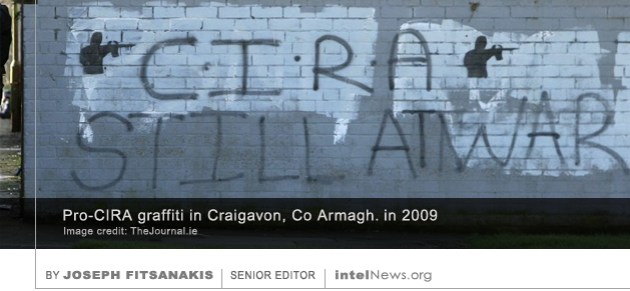 A leading dissident republican group in Ireland has claimed responsibility for a bloody attack in Dublin, which was carried out last week by a group of masked assailants disguised as police and carrying AK-47 assault rifles. Police said that the carefully planned attack involved at least six people wearing SWAT-style police uniforms, at least one of whom was disguised as a woman. The assailants







 intelNews.org
Ireland halts issuances of Russian diplomatic visas due to espionage concerns
February 18, 2024 by Joseph Fitsanakis 2 Comments
In April 2022, Ireland expelled four Russian diplomats, which it claimed were undercover intelligence officers. A subsequent report by the London-based Times newspaper alleged that a major reason Dublin had expelled the diplomats was their “efforts to cultivate contacts with dissident republicans and loyalist paramilitaries” in the Republic of Ireland and in Northern Ireland, which is British soil. The report added that at least one of the four expelled Russian diplomats was believed to be an intelligence officer for the Main Intelligence Directorate of the General Staff of the Russian Armed Forces —widely known by its Cold War-era initials, GRU.
On February 10, The Irish Times alleged that the Irish government was “refusing to allow Russia to replace diplomats assigned to its Dublin embassy […] due to concerns over espionage”. The article went on to claim that Russia’s diplomatic presence in Ireland had “dropped by half” and was causing a “tense standoff” between Ireland and Russia. It also quoted a spokesman from the Russian embassy in Dublin, who decried Ireland’s “unacceptable visa and accreditation policy”. The Russians told the paper that their embassy was staffed by just eight administrative staff and six diplomats.
On February 17, The Irish Times said it had corroborated the Russian officials’ claims by speaking with Micheál Martin, Ireland’s Deputy Prime Minister and Minister for Foreign Affairs. Martin was approached by the newspaper’s reporters in Germany, where he attended the Minich Security Conference. Martin told The Irish Times that the Irish Department of Foreign Affairs was carefully “scrutinizing” every new application for a diplomatic visa by the Russian government. The reason for the careful scrutiny, said Martin, was a number of advisories issued by Ireland’s intelligence services, suggesting “that other activities were underway” at the Russian embassy and that some embassy staff “were not actually diplomats but were performing intelligence functions”. Martin added that the Irish government had determined “15 diplomats should be adequate for [Russia’s] needs” in Ireland.
► Author: Joseph Fitsanakis | Date: 18 February 2024 | Permalink
Filed under Expert news and commentary on intelligence, espionage, spies and spying Tagged with diplomacy, Dublin (Ireland), Ireland, Micheál Martin, News, Russia, Russian embassy in Ireland