Pakistan’s spy chief visits Kabul in an effort to unify rival Taliban factions
September 6, 2021 Leave a comment
 THE DIRECTOR OF PAKISTAN’S powerful intelligence agency paid a surprise visit to the Afghan capital Kabul on Saturday, reportedly in an effort to mediate between rival factions of the Taliban. Lieutenant General Faiz Hameed, director of the Inter-Services Intelligence (ISI) directorate, was accidentally spotted by a British television crew in a Kabul hotel on Saturday. When asked about the purpose of his visit, Hameed said he planned to hold a meeting with Pakistan’s ambassador to Afghanistan. He did not respond to questions about whether he would also meet with the leadership of the Taliban, with whom the ISI has traditionally had close relations.
On Sunday, however, it emerged that Hameed had met with Gulbuddin Hekmatyar, the Pakistan-supported Pashtun leader and founder of Afghanistan’s Hezb-e-Islami Gulbuddin party. There are rumors that Hekmatyar, who served twice as Afghanistan’s prime minister in the 1990s, will be asked by the Taliban to join a coalition government. There are rumors that Islamabad is pressuring the Taliban to include non-Taliban figures in their cabinet, and thus form a governing partnership with non-Taliban elements.
Additionally, numerous reports claim that serious differences have emerged between the two strongest factions of the Taliban, which concern the appointment of cabinet officials. One faction is led by the group’s co-founder, Mullah Abdul Ghani Baradar, and the other by the Taliban deputy leader, Anas Haqqani. The latter is the brother of Sirajuddin Haqqani, who leads the powerful Haqqani Network —a militant group that works closely with the Taliban but has retained its operational independence. There were even reports that Haqqani militia members exchanged gunfire with Taliban units in Kabul last Friday, though these were dismissed as untrue by the Taliban.
Many observers believe that the differences between the various Taliban factions are real, and that Hameed traveled to Kabul in an effort to help them resolve their differences with the help of Pakistan’s mediation. The Reuters news agency cited an anonymous Pakistani senior official as saying that Hameed’s visit was also aimed to help the new Afghan government organize its military, and to ensure that the airport in the Afghan capital will become operational soon.
► Author: Joseph Fitsanakis | Date: 6 September 2021 | Permalink
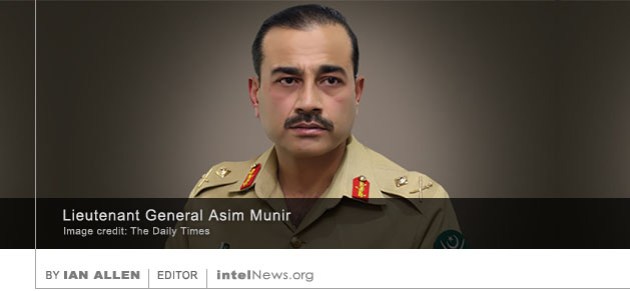 In a surprising move the Pakistani military has dismissed the head of the powerful Inter-Services Intelligence (ISI) spy agency just eight months after appointing him to that position. The decision was announced on Sunday in a brief statement by the Inter-Services Public Relations, the public-relations wing of the Pakistan Armed Forces. The statement said that Lieutenant General Asim Munir had stepped down from his post as director of ISI and would take over as commander of the Gujranwala Corps in Punjab, Pakistan’s second-largest province. The statement did not explain the reasons for the reshuffle; the latter came as a surprise, as ISI directors typically serve for at least three years in that post. General Munir’s tenure






 intelNews.org
Director of Pakistan’s powerful spy agency replaced following much speculation
October 15, 2021 by Joseph Fitsanakis 1 Comment
As F.M. Shakil notes in The Asia Times, General Hameed’s removal from the top post at ISI had been speculated about for some time. His leadership in the ISI was marked by the spy agency’s increasingly close relations with the Afghan Taliban, as the group prepared to take back power in Afghanistan. Hameed’s activities in Afghanistan were strongly supported by Pakistan’s Prime Minister, Imran Khan, who is believed to have fought to retain him as ISI director until the dust from the Taliban’s takeover settles in Kabul. The fact that Khan’s wish did not materialize is interesting, especially since, under Pakistani law, it is the prime minister’s office that appoints the director-general of the ISI.
Shakil suggests that Khan may have faced pressure from two fronts. First, from China, which is arguably Pakistan’s most important international ally. Beijing has been notably unhappy with the inability of the ISI to stop a string of armed attacks against Chinese workers, who are employed by the China-Pakistan Economic Corridor (CPEC), as well as other projects throughout Pakistan. These attacks have angered China, and have prompted strong calls for more security around Chinese-funded building projects in Pakistan. Beijing is believed to have asked for Hameed’s replacement as a result.
Second, the Pakistani military leadership saw Hameed’s relationship-building program with the Afghan Taliban as having gone a few steps too far. The issue is not so much the relationship-building itself —on the contrary, the Pakistani military wants to be in a position to influence Afghanistan’s new masters. But Hameed stands accused of having maneuvered too visibly. As Shakil notes, the ISI strongman visited Kabul just days after the Taliban takeover and was photographed “sipping green tea [next to Taliban leaders] with a triumphant smile”. That angered the Americans and caused some Pakistani military leaders to believe that Washington might even impose sanctions on Islamabad.
The argument, therefore, is that Hameed’s replacement pleases the Chinese, the Americans and the Pakistani military. The only side that did not get its way is that of the prime minister. Time will show what this means for the future of civilian rule in the world’s only nuclear-armed Muslim-majority nation.
► Author: Joseph Fitsanakis | Date: 15 October 2021 | Permalink
Filed under Expert news and commentary on intelligence, espionage, spies and spying Tagged with Analysis, Faiz Hameed, Imran Khan, ISI, Nadeem Ahmed Anjum, Pakistan