News you may have missed #0010

  • Kim Jong Il’s son to head North Korea secret police. Since 1987, Kim Jong Il has been the official leader of the State Security Department of North Korea. However, South Korea’s Dong-a Ilbo reports that Kim Jong Un, Kim Jong Il’s third son, has now been named as the agency’s head. There are rumors in South Korea that the move could signify that a handover of power in Pyongyang may be imminent.
  • First US economic espionage trial winds down. A US court is preparing to sentence Dongfan “Greg” Chung, a Chinese-born engineer accused of passing critical trade secrets on the US space program to China for three decades. 
  • US and Venezuela to restore expelled ambassadors. The move appears to be a thawing gesture toward the new leadership in Washington by Venezuelan President Hugo Chavez. The Latin American leader has toned down his criticism of US foreign policy since Barack Obama took office in January, partly because the US president is popular in Latin America in contrast to his predecessor George W. Bush. 
  • US to send ambassador to Damascus. Washington has confirmed it is to send an ambassador to Damascus, ending a four-year diplomatic absence in Syria. The US envoy in Syria was withdrawn in 2005, following the assassination of Lebanon’s former PM Rafiq Hariri. 
  • Cuban Five spy case an obstacle to US-Cuban thaw, says Havana. The Cuban Five were arrested in 1998 and convicted of spying on anti-Castro exile groups on behalf of Havana. Cuba regards them as political prisoners and has lobbied intensively for their release. Cuban President Raúl Castro has said he would be willing to swap jailed political dissidents for the Five, but the US government has rejected the idea.

CIA expert claims Chávez rigged 2004 Venezuela vote

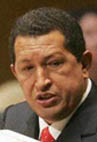
Hugo Chávez

Hugo Chávez

By IAN ALLEN | intelNews.org |
In a development that will undoubtedly worsen relations between Washington and Caracas, a CIA expert has accused Venezuelan president Hugo Chávez of rigging the 2004 recall referendum. Speaking before the US Election Assistance Commission in Orlando, Florida, CIA cybersecurity specialist Steve Stigall said that all networked election systems are inherently insecure, and gave the 2004 Venezuelan referendum as an example. Stigall claimed that president Chávez fixed the referendum results through the Venezuelan government’s control of the electronic ballot systems firm that oversaw the voting. He also pointed to a programming analysis of the voting systems by a group of anti-Chávez mathematicians, who allegedly discovered “a very subtle algorithm that appeared to adjust the vote in Chavez’s favor”. Read more of this post

Venezuela says it uncovered new coup attempt

Hugo Chávez

Hugo Chávez

By JOSEPH FITSANAKIS| intelNews.org |
Venezuela has announced the arrest of five active duty soldiers whom it accuses of conspiring to storm the presidential palace and overthrow the government. The news was revealed on Wednesday by Venezuelan President Hugo Chávez. The President said the country’s General Counterintelligence Office apprehended the soldiers, after intercepting messages they exchanged with “a soldier on the run in the US [and] protected by the US government”. The soldiers were allegedly conspiring to storm the Palacio de Miraflores, which houses the office of the President, under an operation codenamed “Operativo Independencia”. Read more of this post