Profile of Tang Yuanjun, alleged asset for Chinese intelligence 2018-2023
September 5, 2024 1 Comment
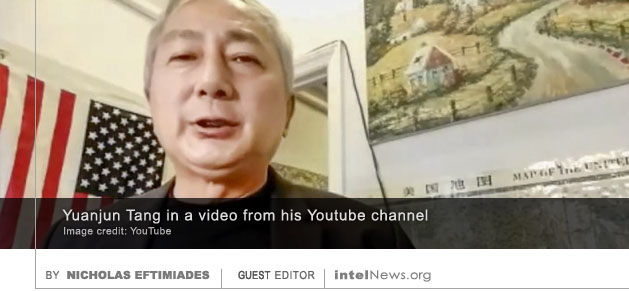 TANG YUANJUN WAS ARRESTED by the United States Federal Bureau of Investigation (FBI) in August 2024. He allegedly worked as a Chinese Ministry of State Security (MSS) asset between 2018 and 2023. He reported on the following categories of information that were of interest to the MSS:
- Prominent U.S.-based Chinese democracy activists and dissidents.
- US Chinese-American Member of Congress Xiong Yan, from New York.
- Immigration claims from dissidents wanting to leave China for the US.
According to the US Department of Justice (DoJ), Tang expressed his desire to see his aging family in China. A prominent dissident such as Tang would not be able to travel to China without being arrested, unless his travel had been approved by authorities. An acquaintance helped him establish secure online contact with the MSS. After being recruited, Tang reported to the MSS using an email account, encrypted chats, text messages and audio and video calls. Tang helped the MSS infiltrate a group chat on WhatsApp; used by numerous People’s Republic of China (PRC) dissidents and pro-democracy activists to communicate about pro-democracy issues and express criticism of the PRC government. In fact, this was what users called a “super group”. It is a group that consists of many other groups. Members could not even identify who was the sponsor of the group chats [1].
In addition, Tang reportedly video-recorded a June 2020 Zoom discussion commemorating the anniversary of the Tiananmen Square massacre in the PRC. The Zoom online discussion was led by Zhou Fengsuo, Director of the June 4th Memorial Museum in New York City and a leading advocate for democracy in China. The Ministry of Public Security also infiltrated these discussions with the assistance of Zoom China and US based employees [2].
Tang was Secretary General of the overseas headquarters of the China Democratic Party United Headquarters in New York City. This non-profit organization assists mainland Chinese dissidents in immigration and asylum applications for the US. Tang allegedly provided information on these individuals to the MSS [3]. Tang also allegedly identified ten immigration attorneys to support MSS efforts to place assets in the US. Other dissident organizations in New York and Los Angeles provide similar visa application services to generate income.
In 2022, reportedly Tang met with the MSS in Changchun City, Jilin Province, China, where an officer installed a software on Tang’s phone which Tang believed to be a “bug” that caused all photographs and videos captured on the phone to be transmitted to the MSS. In his role as leading democracy advocate Tang encouraged dissidents to attend protests in Manhattan and Washington DC. He used the compromised phone to take photographs of the events. The Chinese Communist Party (CCP) then used the photographs as evidence against overseas dissidents. Read more of this post
 SEVERAL CASES OF CHINESE espionage have been






 intelNews.org
Review of “Chinese Espionage Operations and Tactics” (Second Edition)
February 19, 2025 by intelNews 2 Comments
Throughout much of the latter part of the 20th century, United States and other Western security services viewed Chinese intelligence and security services as being focused on their own internal security matters. They were not nearly as well-known or recognized as other adversarial intelligence and security services. Nick was one of first experts to shine a light on Chinese intelligence operations. Since that time, he has dedicated his career and untold time and efforts to better understand Chinese intelligence tactics and techniques.
In the second edition of the book, Nick provides a comprehensive analysis and assessment on how the espionage and intelligence threat from China has grown significantly over the past three decades. He explains this in very clear and unambiguous terms to anyone who seeks a better understanding of these threats. This book is a culmination of more 30 years of dedicated research and the analysis of hundreds of cases that involve China. It focuses, not only on traditional espionage cases and operations, but examines motives, techniques and tactics relating to economic espionage, the theft of trade secrets and the theft of academic research and development.
There are a number of detailed case studies and real-life examples in the book, which show it is not only Chinese government organizations that pose a significant threat to United States and Western interests, but also a multitude of actors —e.g., academia, business people and researchers, with access to universities, commercial entities and think tanks. Chinese intelligence operatives conduct activities in all these areas in order to help China fulfill its strategic information and technology requirements and objectives. Nick examines China’s Whole of Society approach to a number of recent traditional and non-traditional collection efforts.
Chinese Espionage Operations and Tactics is an absolute must-read for individuals who handle national security matters; for state and local officials who are engaged in discussions with Chinese officials; for American and other Western businesses who are, or who will be, doing business with Chinese counterparts; for those in academia and research institutes involved with technology research and development, and finally for those who seek a better understanding of the threats posed by China’s growing and expanding worldwide presence and intelligence apparatus.
► Author: John N. Wanat* | Date: 19 February 2025 | Permalink
Filed under Expert news and commentary on intelligence, espionage, spies and spying Tagged with book news and reviews, China, espionage, Nicholas Eftimiades