Panel to present findings on mysterious death of UN secretary general
June 22, 2015 Leave a comment
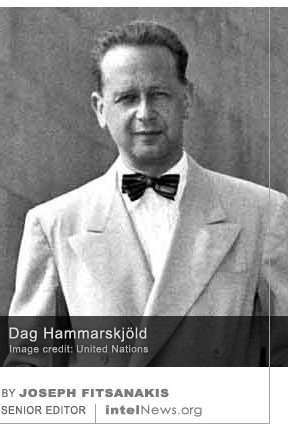 A panel of experts commissioned by the United Nations is about to unveil fresh evidence on the mysterious death in 1961 of UN secretary general Dag Hammarskjöld, who some claim was murdered for supporting African decolonization. The evidence could spark a new official probe into the incident, which has been called “one of the enduring mysteries of the 20th century”.
On September 17, 1961, a Douglas DC-6 transport aircraft carrying United Nations Secretary General Dag Hammarskjöld crashed in the British-administered territory of Northern Rhodesia (now Zambia). The crash killed everyone onboard. Three successive investigations into the crash, conducted by the Rhodesian Board of Investigation, the Rhodesian Commission of Inquiry, and the United Nations Commission of Investigation, viewed “pilot error” as the most likely cause of the tragedy. However, the latter probe, which was closed in 1962, opined that deliberate sabotage could not be ruled out as a likely cause of the tragedy.
Since that time, numerous scholars and independent investigators, such as Swedish development expert Göran Björkdahl and British academic Susan Williams, have raised the possibility that the plane carrying Secretary General Hammarskjöld may have been “shot down by an unidentified second plane”. Several commentators have also pointed to what seemed like eagerness by British colonial administrators in Northern Rhodesia to obscure the details of the incident. One argument is that Hammarskjöld, described as the most independent-minded secretary general in the history of the UN, had angered many world powers due to this fierce support for anti-colonial movements that were sweeping the African continent. Indeed, at the time of his death, Hammarskjöld was flying to the Congo’s mineral-rich Katanga region to meet European-supported chieftains who in 1960 had seceded from the nationalist government of Congolese Prime Minister Patrice Lumumba. Ironically, Lumumba had been assassinated in a Western-backed coup exactly eight months before Hammarskjöld’s own death.
In 2012, the independently funded Hammarskjöld Inquiry Trust appointed an international team of jurists to study all available evidence on the plane crash. The team, called the Hammarskjöld Commission, was composed of a diplomat and three judges from the Netherlands, the United Kingdom, South Africa, and Sweden. The Commission reported in 2013 that “significant new evidence” had emerged, which suggested that American intelligence agencies, notably the National Security Agency and the Central Intelligence Agency, held “crucial evidence” that could help clarify the causes of the crash.
The report by the Hammarskjöld Commission prompted the UN’s current Secretary General, Ban Ki-moon, to appoint a UN-sponsored panel of experts to examine the new evidence and present it before the UN General Assembly. The three-member panel traveled to several countries, including Zambia, the US, Britain and Belgium, to access government, as well as private archives. Its report is expected to be delivered to the UN General Assembly this week. It is said to include written testimony by a Belgian pilot who says he shot down the plane carrying Hammarskjöld by error, while trying to divert it on orders by a government entity. Another witness, a former intelligence officer with the US National Security Agency, is believed to have told the UN experts that he listened to a recording of a pilot who said he shot down the UN Secretary General’s plane.
Once this new evidence is presented, the UN General Assembly will have to vote on whether the UN should hold an official probe into the plane crash. It would mark the first such inquiry since 1962.
► Author: Joseph Fitsanakis | Date: 22 June 2015 | Permalink: https://intelnews.org/2015/06/21/01-1719/







 intelNews.org
“External attack” may have caused crash that killed UN secretary general in 1961
September 27, 2017 by Joseph Fitsanakis 7 Comments
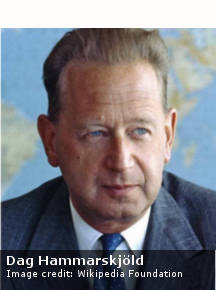
Three successive investigations into the crash, conducted by the Rhodesian Board of Investigation, the Rhodesian Commission of Inquiry, and the United Nations Commission of Investigation, pointed to “pilot error” as the most likely cause of the tragedy. However, research carried out in recent years, including by the Hammarskjöld Commission, which was composed of a diplomat and three judges from the Netherlands, the United Kingdom, South Africa, and Sweden, has shown that the crash could have been the result of deliberate actions. In February of this year, following a recommendation by a UN-appointed three-member expert panel, the organization tasked Mohamed Chande Othman, a former Tanzanian chief justice, to research the topic in depth. Othman reportedly delivered his final report to the UN Secretary General António Guterres in August. However, it has not yet been made public.
On Tuesday, however, British newspaper The Guardian said it had seen an executive summary of Othman’s report. Read more of this post
Filed under Expert news and commentary on intelligence, espionage, spies and spying Tagged with Dag Hammarskjöld, Hammarskjöld Commission, history, Mohamed Chande Othman, News, Northern Rhodesia, suspicious deaths, United Nations