French spy agency summons reporters, prompting press-freedom concerns
May 24, 2019 Leave a comment
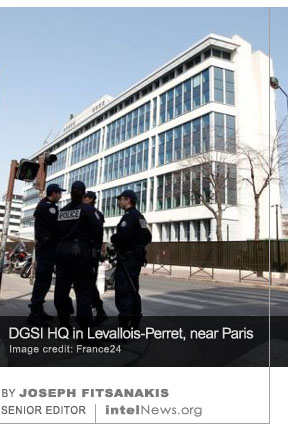 France’s domestic intelligence agency has summoned eight journalists for questioning in relation to two separate investigative reports, prompting concerns about press freedom, according to reports from Paris. Last month, France’s domestic security and counter- intelligence agency, the General Directorate for Internal Security (DGSI), summoned three journalists for questioning. The summonses related to a leaked document that detailed the use of French-made weapons in the Yemeni Civil War. The 15-page document was prepared by France’s main military intelligence agency, the Directorate of Military Intelligence (DRM). It was reportedly meant to be read only by France’s President, Emmanuel Macron, and senior members of his security cabinet, including ministers. However, the report was leaked to the media and published in full. The leaked report revealed that a significant amount of French-made weapons are being used by the United Arab Emirates and Saudi Arabia in the Yemeni Civil War. The weapons allegedly include laser-guided missile systems and armored vehicles, as well as tanks, which the Saudi-led coalition is deploying against Iranian-supported Houthi rebels in Yemen.
On Wednesday, new summonses were issued for five more reporters, including two senior members of staff of Le Monde, which, along with Libération, and Le Figaro, is one of France’s newspapers of record. One of the reporters who have been summoned by DGSI is senior Le Monde reporter Ariane Chemin, who in 2018 broke a story about Alexandre Benalla, a senior security aide to President Macron. Benalla is believed to have illegally participated in a scuffle with ‘yellow vest’ protesters while wearing police riot gear in 2018. Subsequent reports in Libération linked Benalla with a questionable state contract handed out to a security company owned by a Russian oligarch. The reports centered on a former officer in the French Air Force named Chokri Wakrim, who some say facilitated Benalla’s contacts with the Russian’s company. An official anti-corruption investigation was sparked by these revelations. But in April of this year, Wakrim filed a complaint against the press, claiming that his identification in the media broke legal statutes that forbid the “revelation of the identity of a member of the [French] special forces”. This counter-complaint, according to reports from Paris, is what prompted Wednesday’s five new summonses by the DGSI.
On Thursday, nearly 40 French media outlets issued a joint statement in support of those journalists who were summoned by DGSI. The statement condemns the summonses an attack on press freedom and as “a new attempt by authorities to circumvent” France’s laws on freedom of the press and the protection of sources, which date back to 1881. In reference to the Wakrim case, the statement goes on to say that “military secrecy cannot restrict the right to information, which is essential for informed public debate, nor can it be [used] to deter [journalists] from investigating and publishing”.
► Author: Joseph Fitsanakis | Date: 24 May 2019 | Permalink
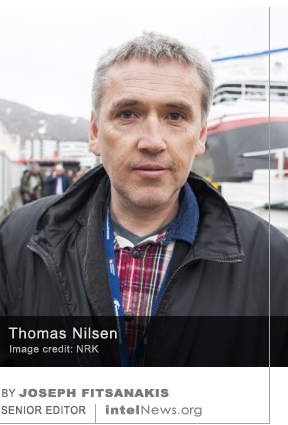 Norway’s state broadcaster has alleged that the Russian intelligence service pressured a Norwegian newspaper to fire one of its journalists who covered fossil fuel exploration in the Arctic Ocean. Last week, journalist Thomas Nilsen was fired by








 intelNews.org
Spies are known to use journalistic cover, claims Australian intelligence agency
August 15, 2019 by Joseph Fitsanakis 2 Comments
At the parliamentary inquiry that started on Monday, members of the media have argued that journalists should have the right to scrutinize the government’s actions and that journalism in the public interest is not harmful to the national security of Australia. But this argument was refuted yesterday by Heather Cook, deputy director-general of the Australian Security Intelligence Organisation (ASIO), Australia’s primary counterintelligence agency. Cook warned that if Australia exempted journalists from national security investigations, hostile foreign powers would exploit journalism to spy on the country. She added that the journalistic profession was being “used nefariously” by foreign intelligence agencies to spy on Australia. “In Australia today, journalism is being used as a cover by foreign intelligence actors”, said Cook, and went on to note that “there is a long history of this worldwide”. She said that journalism offers a convenient cover for spies because it provides “access to senior people and sensitive information” held by those in power.
Journalistic covers are therefore used by “foreign intelligence actors” who seek to “exploit vulnerabilities” and harm the security of Australia, said Cook. She went on to claim that members of foreign intelligence agencies regularly attempt to recruit Australian journalists for purposes of espionage. “In light of this”, said Cook, “ASIO has concern about the concept of exemptions for particular classes of people in the community, such as journalists. Broad exemptions for the media and journalists would invite exploitation by foreign intelligence actors and may increase the intelligence threat faced by Australian journalists”, she concluded. Also on Wednesday, the Australian Federal Police said that it would not rule out further raids on journalists’ offices and homes.
► Author: Joseph Fitsanakis | Date: 15 August 2019 | Permalink
Filed under Expert news and commentary on intelligence, espionage, spies and spying Tagged with Australia, Australian Security Intelligence Organisation, Australian Signals Directorate, civil liberties, Heather Cook, News, press freedom