South African spy agency can’t account for over $100 million in expenses
September 18, 2017 2 Comments
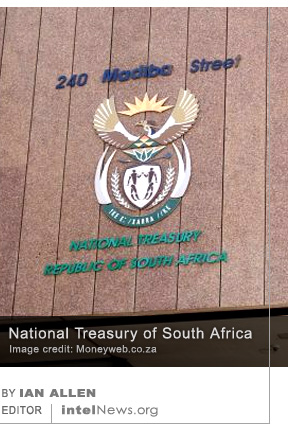 South Africa’s National Treasury threatened to terminate all funding for covert operations last year, after the country’s spy agency refused to account for tens of millions of dollars in expenses, saying the money had been put to “secret use”. An investigation by two leading South African news outlets, the Afrikaans-language weekly newspaper Rapport and the English-language online news portal News24, has revealed the existence of a major bureaucratic spat between the National Treasury and the State Security Agency (SSA), the country’s primary civilian intelligence organization.
The investigation cited “seven independent sources” with direct involvement and knowledge of the National Treasury and the South African intelligence services. According to the report, National Treasury officials contacted the SSA last year, demanding to know how it used 1.5 billion rand (approximately US $114 million) that it took from government coffers between 2012 and 2016. But the spy agency refused to provide a detailed answer, and said instead that most of the money had been used to fund unspecified “secret operations”, and that its use was therefore classified.
However, the SSA did not realize that National Treasury officials have the same level of security clearance as senior SSA officials, said sources. Consequently, a Treasury probe was launched by Treasury investigators with access to SSA’s activities. The probe uncovered several instances of irregular expenditures and serious mismanagement, said the report. There were repeated instances when funds assigned to non-covert operations were “inexplicably moved to the covert fund” and SSA officials were unable to explain why. There were also numerous cases of abuse of procurement procedures. One source told the News24/Rapport team that “Treasury officials kept asking [SSA officials] how they tender for goods and services, and they kept saying that they can’t tell us, because it is classified information”. At that point, the National Treasury threatened to terminate all funding for intelligence operations unless answers were provided by the SSA leadership. After a series of frantic and tense negotiations, the SSA agreed to change its procurement practices and “at least submit [to National Treasury] a list of suppliers so that there could be a degree of oversight”.
The SSA’s reputation has not emerged unscathed from the broader crisis that has been plaguing South African politics in recent years. In 2014, the Johannesburg-based newspaper City Press alleged that the SSA maintained a secret unit used to target domestic political opponents of South African President Jacob Zuma. The paper also said that senior SSA official Thulani Dhlomo, a close ally of President Zuma, had been placed at the head of the secret unit in 2012. Another leading Johannesburg-based newspaper, The Mail & Guardian, repeated these claims earlier this month.
► Author: Ian Allen | Date: 18 September 2017 | Permalink








 intelNews.org
South African president abolishes security ministry, assumes control of spy agencies
August 9, 2021 by Joseph Fitsanakis Leave a comment
IN A SURPRISE ANNOUNCEMENT last week, South African President Cyril Ramaphosa abolished the country’s Department of State Security and assumed direct control over its spy agencies. The unexpected move was part of an extensive government reshuffle, meant to address the security shortcomings exposed by last month’s riots, which marked the worst political unrest in the country’s post-apartheid history.
Nearly 330 people died, thousands were injured, and thousands of businesses were looted in July, when extensive violent protests erupted in the provinces of KwaZulu-Natal and Gauteng. The riots lasted several days following the jailing of Ramaphosa’s predecessor, Jacob Zuma, for contempt of court. Zuma was facing a high-profile trial for 16 counts of corruption, racketeering, fraud, and money laundering.
In a televised announcement aired live on Thursday, Ramaphosa said he would terminate the post of security minister and abolish the Department of State Security. Instead, the country’s domestic and external intelligence agencies will from now on operate under the office of the presidency and at times report directly to the president. In this way, Ramaphosa aims to assume “political responsibility” for, as well as oversight of, intelligence programs and activities.
In explaining his decision, Ramaphosa said that the South African intelligence agencies had been “found wanting in several respects” during last month’s riots. From now on, instead of a security minister, the work of South African spy agencies will be supervised by the new Minister in the Presidency, Mondli Gungubele. His two deputies, Zizi Kodwa and Pinky Kekana, who were also appointed on Thursday, will share the task of supervising the agencies. According to Ramaphosa, the reform will “ensure that the country’s domestic and foreign intelligence services [will] more effectively enable the president to exercise his responsibility to safeguard the security and integrity of the nation”.
Speaking on South African television on Saturday, Ronnie Kasrils, South Africa’s former Minister of Intelligence Services under President Thabo Mbeki, said he supported the move. He added that the country’s leadership had received “poor service” from the intelligence community, especially from the State Security Agency (SSA), during last month’s riots. Kasrils noted that “the centralization of SSA was a good move” because it reflects “best general practice internationally”.
► Author: Joseph Fitsanakis | Date: 09 August 2021 | Permalink
Filed under Expert news and commentary on intelligence, espionage, spies and spying Tagged with Cyril Ramaphosa, Mondli Gungubele, News, Pinky Kekana, Ronnie Kasrils, South Africa, South African Ministry of Intelligence, South African State Security Agency, Zizi Kodwa