More on senior North Korean diplomat who defected in London
August 19, 2016 Leave a comment
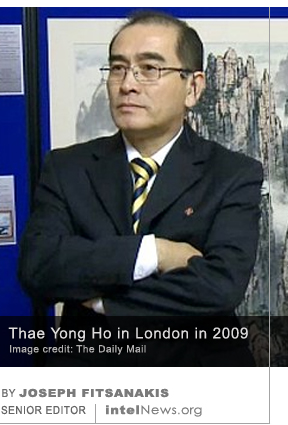 A high-ranking North Korean diplomat, who defected with his wife and children in London, and is now in South Korea, is from a privileged family with a long revolutionary pedigree in North Korean politics. South Korea’s Ministry of Unification confirmed on Wednesday that Thae Yong-Ho, the second-in-command at the North Korean embassy in the United Kingdom, had defected with his wife and children and had been given political asylum in South Korea. As intelNews reported earlier this week, Thae, a senior career diplomat believed to be one of North Korea’s foremost experts on Western Europe, had disappeared with his family and was presumed to have defected “to a third country”.
New information has since emerged on Thae and his family, confirming that both he and his wife are members of North Korea’s privileged elite, with decades-old connections to the ruling Workers’ Party of Korea. According to the Seoul-based JoongAng Daily, Thae’s wife, O Hye-Son, is a niece of the late O Peak-Ryong, a decorated communist guerrilla who fought Korea’s Japanese colonialists in the 1930s. O, who died in the 1980s, joined the Korean anti-Japanese struggle alongside Kim Il-Sung, founder of the Workers’ Party of Korea and first leader of North Korea. This means that O Hye-Son is also the cousin of O Peak-Ryong’s son, General O Kum-Chol, who is currently vice chairman of the General Staff of the Korean People’s Army. Thae himself is the son of Thae Pyong-Ryol, a four-star general who also fought against the Japanese in the 1930s, alongside Kim Il-Sung. In the postwar period, General Thae became a senior member of the Workers’ Party of Korea and was appointed to the Party’s powerful Central Committee. He died in 1997.
JoongAng Daily quoted an unnamed “source familiar with the matter” of Thae’s defection, who said that the diplomat’s loyalty to the North Korean leadership had been unquestioned prior to his surprise defection. Most North Korean diplomats are posted at an embassy abroad for a maximum of three years before being moved elsewhere in the world. The fact that Thae had been allowed to remain in the United Kingdom for 10 years shows his privileged status within the Workers’ Party of Korea, said the source. Additionally, the children or most North Korean diplomats are required to return to their native country after completing high school. But this did not seem to apply to Thae, whose three children were living with him in Britain even after graduating from university. This and many other clues reflect Thae’s “impeccable credentials”, said the source, which made him one of the most trusted government officials in the regime’s bureaucratic arsenal.
It is believed that Thae defected because he had been told that his tenure in London was coming to an end after a decade, and he would have to relocate to a less desirable location, or possibly recalled back to Pyongyang. Defections among North Korea’s privileged elite are rare, but have been happening increasingly frequently in the past few years. This makes some observers believe that disillusionment among Supreme Leader Kim Jong-Un’ inner circle is growing and that the North Korean regime is becoming weaker.
► Author: Joseph Fitsanakis | Date: 19 August 2016 | Permalink
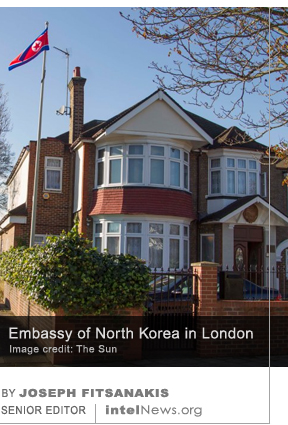 A senior member of North Korea’s diplomatic representation in the United Kingdom, who is considered one of his country’s leading specialists in Western European affairs, has reportedly defected “to a third country” with his family. The alleged defection was first






 intelNews.org
North Korea asked Israel for $1 billion to stop giving missile technology to Iran
July 10, 2018 by Joseph Fitsanakis Leave a comment
Now Thae has written a book about his experiences as a North Korean diplomat from a family that is close to the country’s ruling Kim dynasty. In his memoir, Thae claims that he acted as a translator during a series of meetings between Son Mu Sin and Gideon Ben Ami, respectively North Korea’s and Israel’s ambassadors to Sweden. The alleged meetings took place in secret in the winter of 1999 in Stockholm, says Thae. During the first meeting, Son allegedly told Ben Ami that Pyongyang had a series of agreements to sell ballistic missile technology and know-how to Israel’s adversaries, such as Syria, Pakistan and Iran. However, the North Korean government would be willing to scrap the agreements in exchange for $1 billion in cash from Israel, said Son. Ben Ami reportedly told his North Korean counterpart that he would pass along his offer to the Israeli government. Three days later, says Thae, the two men held another secret meeting, during which the North Korean ambassador was told that Israel was not willing to pay Pyongyang $1 billion in cash. However, it could offer humanitarian aid of equal value. But according to Thae the North Koreans refused and “the talks ended without an agreement”.
It is believed that North Korea then went ahead and supplied both Syria and Iran with missile and nuclear technology. On Sunday, The Wall Street Journal reported that it contacted the government of Israel with several questions stemming from Thae’s account of the alleged diplomatic exchange of 1999. However, it received no response. The paper also tried to elicit responses from Ben Ami and Son, but had no success. According to The Journal, Ben Ami said during a television interview last week that he held three meetings with a group of North Korean officials in 1999. But he did not name the diplomats, nor did he discuss the subject of his conversations with them.
► Author: Joseph Fitsanakis | Date: 10 July 2018 | Permalink
Filed under Expert news and commentary on intelligence, espionage, spies and spying Tagged with Gideon Ben Ami, Israel, News, North Korea, North Korean nuclear program, Son Mu Sin, Thae Yong Ho