Israeli intelligence ‘critical’ in US case for strikes on Syria
August 28, 2013
 By JOSEPH FITSANAKIS | intelNews.org |
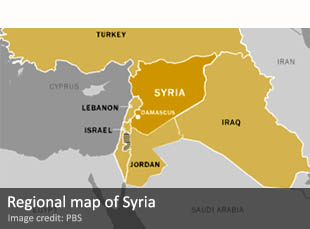
As the United States prepares to make its case in support of military action against the Syrian government, there are reports that Israeli intelligence will be playing “a central role in cementing” Washington’s argument. The White House indicated this week that it is prepared to launch military strikes against Syrian government targets, following reports that chemical weapons were fired at a Damascus suburb. Western intelligence sources suggest that last week’s chemical weapon strikes killed “hundreds of people” and wounded “at least a thousand”, including many civilians. Interestingly, while the US administration of President Barack Obama is collating the evidence of the Syrian government’s complicity in the attacks, reports from Israel have identified even the Syrian Army unit that allegedly fired the chemical rounds. Late last week, Israel’s Channel 2 claimed that the attack was launched by the 155th Brigade of the Syrian Army’s 4th Armored Division, which is known to be commanded by Maher al-Assad, brother of Syrian President Bashar al-Assad. German media reports suggest that the source of the claim was Unit 8200, the electronic interception division of the Israel Defense Forces (IDF). It is believed that the IDF has in its possession intercepted conversations between senior Syrian military commanders allegedly discussing last week’s chemical attack. Most analysts appear confident that Israel would play no visible part in a possible US-led military strike on Syria. But many senior Israeli cabinet ministers are voicing strong support for direct Western military involvement in the Syrian civil war. On Tuesday, Naftali Bennett, Israel’s Economy and Commerce Minister, said the time for intervention had come: “it cannot be that less than 100 kilometers from Israel, children are being gassed to death and we let the world remain silent and ignore it”, he told reporters. Read more of this post







 intelNews.org
Iran serious about nuclear deal, says senior Israeli intelligence official
June 11, 2014 by Ian Allen Leave a comment
A senior Israeli intelligence official said on Monday that Iran appears to be genuinely interested in entering an agreement with world powers that would lead to the termination of its nuclear program. In November of 2013, Iran signed a Joint Plan of Action with six world powers in Geneva, Switzerland. Known as the Geneva interim agreement, the pact eases economic sanctions on the Islamic Republic in exchange for a short-term suspension of core aspects of the Iranian nuclear program. The Israeli government’s negative response to the agreement was headed by Benjamin Netanyahu. The Israeli Prime Minister called the pact a “historic mistake”, which enabled “the most dangerous regime in the world” to get closer to “attaining the most dangerous weapon in the world”. Since that time, Tel Aviv has continued to criticize the governments of the United States, Russia, China, Germany, France, and the United Kingdom, known as P5+1, for signing the interim agreement with Tehran. On Monday, however, Israel’s senior intelligence analyst, Brigadier-General Itai Brun, told a conference near Tel Aviv that Iran has so far abided by the interim agreement and added that he was cautiously optimistic about the future of the negotiations between Iran and the P5+1. Brun was speaking at the Herzliya Conference, an annual gathering of senior Israeli political leaders, which typically serves as a public platform for articulation of Israel’s national policy on critical issues. Senior figures in Israel, including the President and Prime Minister, typically use their keynote addresses at the conference to set the tone for the future policies of their administration. Brig. Gen. Brun, 51, has led the research division of the Military Intelligence Directorate of the Israeli Defense Forces. His position is generally viewed as the second most senior within Israel’s military intelligence establishment. Brun’s address at the conference appeared to be deliberately designed to challenge Netanyahu’s skepticism of the Geneva interim agreement. He told conference participants that it was “very possible” that Iran and the P5+1 were “moving toward the signing of a permanent nuclear deal”. Read more of this post
Filed under Expert news and commentary on intelligence, espionage, spies and spying Tagged with Aharon Ze'evi Farkash, Amir Eshel, Amos Yadlin, Herzliya Conference, Iran, Iranian nuclear program, Israel, Itai Brun, News