The Real War Is About To Begin: Iran Enters Full-Scale Insurgency
March 30, 2026
by Joseph Fitsanakis
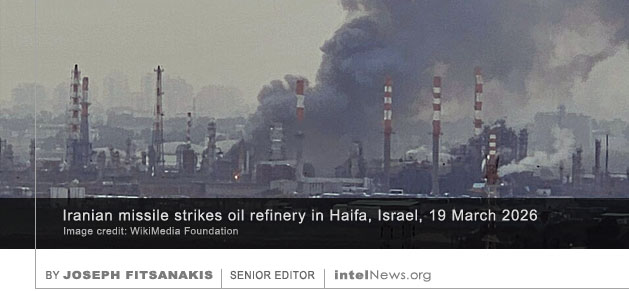 THE IRAN WAR OPENED with a shock. In minutes, the United States and Israel struck deep into Iran’s command structure, killing nearly fifty senior figures—among them the Supreme Leader and much of the military high command. It was a ruthless display of intelligence, surveillance, and targeting at a level rarely seen in modern warfare. Russian forces only wish they could have achieved even a fraction of this effect in Ukraine in 2022. Had they done so, the war’s trajectory might have unfolded very differently. But this kind of operational success is exceptionally hard to deliver in warfare.
And yet, as Carl von Clausewitz cautioned centuries ago, the outcome of war is not governed by formulaic calculus. Operational sophistication and technological prowess—no matter how astounding—do not guarantee success. Instead of an immediate collapse, the decapitation of the Iranian regime appears to have produced an unpredictable constellation of second-order effects. At the very least, it physically eliminated Iran’s few pragmatic leaders who in the past favored restraint. It thus handed over power to the hardliners of the Islamic Revolutionary Guard Corps. Moreover, the war appears to have paralyzed Iran’s domestic opposition, whose adherents may despise the regime but—unlike the U.S. and Israel—do not want to see their country break up into ethnic statelets.
Most importantly, the February 28 decapitation strike convinced Iran’s remaining leadership that this is an existential war—not a limited confrontation like the Twelve-Day War. Today’s ruling Principalists in Iran differ sharply from the cosmopolitan, Western-educated elite of the 1960s and 1970s. They are largely provincial in origin, domestically rooted, and lack the international ties that once offered pathways of exit. They do not hold dual citizenships, do not maintain  foreign residences, and few of them possess the linguistic or social capital to relocate abroad. Simply put, they have no viable exit. For them, defeat is not exile—it is annihilation. Under such conditions, the expectation is not capitulation, but resistance to the very end.
Activating the Iranian Asymmetric Doctrine
Starting in 2001, the campaigns in Afghanistan and Iraq offered Iranian war planners a prolonged and unusually comprehensive vantage point from which to study the American way of war in their immediate neighborhood. For over two decades, the Iranians analyzed these methods, learned from them, and internalized their logic into their own asymmetric warfare doctrine. And now, having survived the February 28 decapitation attack, the Iranian regime has put that doctrine into operation. Iran’s asymmetric doctrine channels the state’s military, civilian, economic, and informational assets into a multi-domain, protracted insurgency campaign designed to inflict maximum pain on its enemies. In doing so, it rests on what is perhaps the Islamic Republic’s greatest asset: its asymmetric patience—i.e., its capacity to endure more physical and emotional torment than its Western or Western-backed opponents.
The Iranians refined that skill during what they refer to as the “War of Holly Defense” (1980-1988), one of the 20th century’s longest conflicts and the deadliest conventional war ever fought in the developing world. The then-newly formed Islamic Republic suffered over 500,000 casualties—many of those due to exposure to chemical warfare—but managed to bring Saddam Hussein’s Western-backed Iraq into a standstill and force it into a truce. To do so, they even resorted to so-called “human wave assaults”, large masses of mostly unarmed youth who swarmed enemy positions and overwhelmed them by the sheer power of their number. That was largely how the Basij, the Iranian regime’s paramilitary street gangs that continue to operate in modern-day Iran, were initially formed.
Iran’s “Economy of Resistance”
On March 28, the Telegram channel belonging to the Iranian Supreme Leader Mojtaba Khamenei issued an infographic titled “The Path to Defeating the Enemy in the Economic War”. The information in the infographic reflects the Islamic Republic’s concept of “economy of resistance”, which was first developed in 2014 by Mojtaba Khamenei’s father, the late Supreme Leader Ali Khamenei. The central idea behind this concept is restructuring the Iranian economy, not simply to reduce its susceptibility to Western-imposed sanctions, but to also allow it to become stable and develop. The goal of the economy of resistance is to prevent the destruction of the Islamic Republic and the Westernization of Iranian society. Through the economy of resistance doctrine, and with crucial help by China and Russia, Iran has largely managed to insulate its economy from the global economic system that is now reeling under Iran’s asymmetric attacks.
After February 28, controlling the flow of traffic in the Arabian Gulf through the Strait of Hormuz is the center of gravity of Iran’s economy of resistance doctrine. Through this method, the Iranian regime has managed to transform its conflict with the U.S. and Israel from a regional skirmish into an international war with potentially epoch-defining ramifications for the global financial system. Tehran is therefore highly unlikely to surrender the Strait back to its Gulf Cooperation Council neighbors without expressed guarantees for the regime’s survival.
It is exceedingly difficult to see how the control of the Strait could be wrestled away from Iran using naval military assets. The capacity of most warships to protect merchant vessels are structurally limited by their Vertical Launch Systems (VLS). As the world discovered during the peak of the Red Sea crisis, even the most advanced navy destroyers can be overwhelmed by a land-based assailant that is able to launch a saturation attack against them with drones or other projectiles. These warships can defend themselves, but not much else, until they run out of ammunition and are forced to return to port in order to rearm (VLS  cells cannot be restocked at sea). One way around this logistical problem is to surround commercial ships with a large number of protective smaller boats staffed by marine expedition units—providing the defender is immune to high rates of attrition.
Iran Is Unlikely to Run Out of Drones
Unlike the White House, Russia and China do not distinguish between the war in Iran and the war in Ukraine, or the spiraling dispute over Taiwan. Open-source analyses of Iranian targeting reveal Tehran’s central tactical goal, which is to disable enemy radar installations and refueling aircraft. The latter are desperately needed to support American and Israeli fighter jets for long-range air operations. In the absence of such operations, the U.S.-Israeli forces cannot reach deep inside Iran, where the regime has placed most of its strategic military components. There is little doubt that Moscow began providing Tehran real-time targeting data about American and Israeli military and civilian assets at the very onset of the war. It has continued to do so unabated ever-since. After verifying that the Iranian regime was resilient enough to survive the critical first few days of the U.S.-Israeli air campaign, Moscow and Beijing also begun supplying Iran with drones and rocket fuel, according to Western intelligence.
This means that, so long as the Iranian regime remains in control domestically, it will never run out of drones, which they can use to attack ships sailing through the Strait of Hormuz. For the foreseeable future, therefore, Iranian authorities will continue to force ships sailing through the Strait of Hormuz to pay a toll in order to sail through unharmed. Many ships have complied by paying as much as Chinese ¥14 million (U.S. $2 million) in exchange for an official certificate from the Iranian authorities. By showing this certificate to their marine insurer they keep their insurance costs manageable and stay in business. Without such a certificate no insurance firm in the world will agree to insure a ship going through the Strait of Hormuz at a reasonable price. And, unlike the stock market, maritime insurance firms such as Lloyds of London do not get swayed by U.S. President Donald Trump’s posts on TruthSocial. They will wait until they see tangible proof before lowering insurance costs.
Russian and Chinese assistance to Iran undoubtedly frustrates American and Israeli war planners. However, it is entirely rational. The Kremlin has emerged as one of the primary beneficiaries of the Iran war, as the surging oil prices and the lifting of American sanctions on Russian oil exports have helped reinvigorate Russia’s long-suffering economy. China has also seen an extensive array of American carrier strike groups and highly sophisticated air defense systems vacate the Indo-Pacific region for the Middle East. As The New York Times reported recently, this sudden shift in the White House’s priorities is causing “U.S. allies [to] feel the deficit acutely as they struggle to counter China’s surging military and increasingly aggressive regional maneuvers”. China has stockpiled enough oil for over 200 days, after which time it can secure oil via land from both Iran and Russia. In contrast, a prolonged energy standoff in the Arabian Gulf has the potential to push the economies of its regional rivals—including Korea, Japan, the Philippines, and Thailand, to the brink. Beijing has therefore much to gaDissssin from a protracted and inconclusive conflict in Iran, and will do its best to ensure that it continues.
The U.S. and Israel Could Still Win—But at a Cost
The longer this war continues, the less likely the Iranian regime is to survive. Yet victory in this war, however pyrrhic, will not belong to the side that can inflict the most pain, but rather to the side that can endure the most pain for the longest time. Iran’s demonstrated asymmetric patience places it in a dominant position over the neurotic and anxiety-ridden markets, to which the Trump administration is extremely attune. The Iranian regime is also far better-placed to endure this conflict than the demanding and perpetually impatient American voter, to whom Trump promised in 2024 that “starting on day 1, we will end inflation and  make America affordable again”. Even the Israelis, who are markedly more stoic than the Americans, cannot necessarily be counted to continue to support this war for very long. They will soon be entering their second month of nightly air raids, with massive disruptions in daily life and a desperately strained war economy.
What options do the U.S. and Israel have? The White House is clearly weighing the possibility of using a ground force as a means of putting added economic and military pressure on Tehran. Much has been made of the 5,000 U.S. Marines, as well as a host of stand-by global-response elements of the U.S. Army’s 82nd Airborne Division, who are on their way to the Gulf. There are reports that these forces could move in on Kharg island and occupy the sea port that Iran uses to distribute up to 90 percent of its oil exports via tankers. Other reports claim that U.S. ground forces could occupy Iranian coastal regions around the Strait of Hormuz, in an effort to prevent Iran from launching missiles and drones against cargo ships.
Such plans are unlikely to materialize, given that the troWould op numbers associated with these reports seem inadequate to occupy Kharg or the coastline around the Strait of Hormuz for more than a few days. Moreover, even a temporary expeditionary force would require substantial support in the form of near-complete air dominance, persistent surveillance capabilities, as well as a multitude of naval assets for force protection and adequate resupply. Given these logistical constraints, it is far more likely that these troops will be used for short-term raids aimed at destroying or disabling key Iranian military or civilian installations. These operations may or may not prove successful. They are also likely to face rates of attrition that the U.S. has not seen since the peak period of the Iraqi insurgency.
Another possible option is for the U.S. and Israel to leave the Iranian regime in place and attempt instead to defang it by covertly extracting its strategic uranium stockpiles. This would require the use of highly specialized Joint Special Operations Command (JSOC) elements trained in the covert extraction of weapons of  mass destruction. But such an extraction operation would require the possession of exceptionally reliable intelligence as to the precise whereabouts of these stockpiles. Providing that such intelligence can be acquired, that the stockpiles are not scattered in too many disparate locations, and that the uranium is physically possible to extract safely, a covert expeditionary force is conceivable. Alternatively, the JSOC extraction force would need to be supported by elements of the 82nd Airborne Division, possibly the Ranger Regiment, as well as perhaps multiple Delta Force squadrons. Instead of a surgical extraction operation, this could end up resembling a small military campaign. Once again, the possibility of high attrition rates would need to be carefully weighed.
There Are No Good Choices Left
The strategic reality is now stark. The U.S. and Israel are no longer dictating the tempo of this war—they are reacting to it. Their opening gambit failed to produce the desired results. Now a wounded but resilient Iranian regime has seized the initiative, and no external actor—certainly not NATO—is coming to reverse that fact. There is no deus ex machina waiting in the wings. What remains are narrowing choices, each more costly than the last: escalation, attrition, or strategic compromise. None promise clean outcomes. All carry risk. One thing is certain: this war will not stay contained. It will spill into markets, into supply chains, into households. It will be paid for—in blood, in capital, and in time. What comes next will be messy, it will be violent, and it will be expensive.
► Author: Joseph Fitsanakis | Date: 30 March 2026 | Permalink








 intelNews.org
The Real War Is About To Begin: Iran Enters Full-Scale Insurgency
March 30, 2026 by Joseph Fitsanakis Leave a comment
And yet, as Carl von Clausewitz cautioned centuries ago, the outcome of war is not governed by formulaic calculus. Operational sophistication and technological prowess—no matter how astounding—do not guarantee success. Instead of an immediate collapse, the decapitation of the Iranian regime appears to have produced an unpredictable constellation of second-order effects. At the very least, it physically eliminated Iran’s few pragmatic leaders who in the past favored restraint. It thus handed over power to the hardliners of the Islamic Revolutionary Guard Corps. Moreover, the war appears to have paralyzed Iran’s domestic opposition, whose adherents may despise the regime but—unlike the U.S. and Israel—do not want to see their country break up into ethnic statelets.
Most importantly, the February 28 decapitation strike convinced Iran’s remaining leadership that this is an existential war—not a limited confrontation like the Twelve-Day War. Today’s ruling Principalists in Iran differ sharply from the cosmopolitan, Western-educated elite of the 1960s and 1970s. They are largely provincial in origin, domestically rooted, and lack the international ties that once offered pathways of exit. They do not hold dual citizenships, do not maintain foreign residences, and few of them possess the linguistic or social capital to relocate abroad. Simply put, they have no viable exit. For them, defeat is not exile—it is annihilation. Under such conditions, the expectation is not capitulation, but resistance to the very end.
Activating the Iranian Asymmetric Doctrine
Starting in 2001, the campaigns in Afghanistan and Iraq offered Iranian war planners a prolonged and unusually comprehensive vantage point from which to study the American way of war in their immediate neighborhood. For over two decades, the Iranians analyzed these methods, learned from them, and internalized their logic into their own asymmetric warfare doctrine. And now, having survived the February 28 decapitation attack, the Iranian regime has put that doctrine into operation. Iran’s asymmetric doctrine channels the state’s military, civilian, economic, and informational assets into a multi-domain, protracted insurgency campaign designed to inflict maximum pain on its enemies. In doing so, it rests on what is perhaps the Islamic Republic’s greatest asset: its asymmetric patience—i.e., its capacity to endure more physical and emotional torment than its Western or Western-backed opponents.
The Iranians refined that skill during what they refer to as the “War of Holly Defense” (1980-1988), one of the 20th century’s longest conflicts and the deadliest conventional war ever fought in the developing world. The then-newly formed Islamic Republic suffered over 500,000 casualties—many of those due to exposure to chemical warfare—but managed to bring Saddam Hussein’s Western-backed Iraq into a standstill and force it into a truce. To do so, they even resorted to so-called “human wave assaults”, large masses of mostly unarmed youth who swarmed enemy positions and overwhelmed them by the sheer power of their number. That was largely how the Basij, the Iranian regime’s paramilitary street gangs that continue to operate in modern-day Iran, were initially formed.
Iran’s “Economy of Resistance”
On March 28, the Telegram channel belonging to the Iranian Supreme Leader Mojtaba Khamenei issued an infographic titled “The Path to Defeating the Enemy in the Economic War”. The information in the infographic reflects the Islamic Republic’s concept of “economy of resistance”, which was first developed in 2014 by Mojtaba Khamenei’s father, the late Supreme Leader Ali Khamenei. The central idea behind this concept is restructuring the Iranian economy, not simply to reduce its susceptibility to Western-imposed sanctions, but to also allow it to become stable and develop. The goal of the economy of resistance is to prevent the destruction of the Islamic Republic and the Westernization of Iranian society. Through the economy of resistance doctrine, and with crucial help by China and Russia, Iran has largely managed to insulate its economy from the global economic system that is now reeling under Iran’s asymmetric attacks.
After February 28, controlling the flow of traffic in the Arabian Gulf through the Strait of Hormuz is the center of gravity of Iran’s economy of resistance doctrine. Through this method, the Iranian regime has managed to transform its conflict with the U.S. and Israel from a regional skirmish into an international war with potentially epoch-defining ramifications for the global financial system. Tehran is therefore highly unlikely to surrender the Strait back to its Gulf Cooperation Council neighbors without expressed guarantees for the regime’s survival.
It is exceedingly difficult to see how the control of the Strait could be wrestled away from Iran using naval military assets. The capacity of most warships to protect merchant vessels are structurally limited by their Vertical Launch Systems (VLS). As the world discovered during the peak of the Red Sea crisis, even the most advanced navy destroyers can be overwhelmed by a land-based assailant that is able to launch a saturation attack against them with drones or other projectiles. These warships can defend themselves, but not much else, until they run out of ammunition and are forced to return to port in order to rearm (VLS cells cannot be restocked at sea). One way around this logistical problem is to surround commercial ships with a large number of protective smaller boats staffed by marine expedition units—providing the defender is immune to high rates of attrition.
Iran Is Unlikely to Run Out of Drones
Unlike the White House, Russia and China do not distinguish between the war in Iran and the war in Ukraine, or the spiraling dispute over Taiwan. Open-source analyses of Iranian targeting reveal Tehran’s central tactical goal, which is to disable enemy radar installations and refueling aircraft. The latter are desperately needed to support American and Israeli fighter jets for long-range air operations. In the absence of such operations, the U.S.-Israeli forces cannot reach deep inside Iran, where the regime has placed most of its strategic military components. There is little doubt that Moscow began providing Tehran real-time targeting data about American and Israeli military and civilian assets at the very onset of the war. It has continued to do so unabated ever-since. After verifying that the Iranian regime was resilient enough to survive the critical first few days of the U.S.-Israeli air campaign, Moscow and Beijing also begun supplying Iran with drones and rocket fuel, according to Western intelligence.
This means that, so long as the Iranian regime remains in control domestically, it will never run out of drones, which they can use to attack ships sailing through the Strait of Hormuz. For the foreseeable future, therefore, Iranian authorities will continue to force ships sailing through the Strait of Hormuz to pay a toll in order to sail through unharmed. Many ships have complied by paying as much as Chinese ¥14 million (U.S. $2 million) in exchange for an official certificate from the Iranian authorities. By showing this certificate to their marine insurer they keep their insurance costs manageable and stay in business. Without such a certificate no insurance firm in the world will agree to insure a ship going through the Strait of Hormuz at a reasonable price. And, unlike the stock market, maritime insurance firms such as Lloyds of London do not get swayed by U.S. President Donald Trump’s posts on TruthSocial. They will wait until they see tangible proof before lowering insurance costs.
Russian and Chinese assistance to Iran undoubtedly frustrates American and Israeli war planners. However, it is entirely rational. The Kremlin has emerged as one of the primary beneficiaries of the Iran war, as the surging oil prices and the lifting of American sanctions on Russian oil exports have helped reinvigorate Russia’s long-suffering economy. China has also seen an extensive array of American carrier strike groups and highly sophisticated air defense systems vacate the Indo-Pacific region for the Middle East. As The New York Times reported recently, this sudden shift in the White House’s priorities is causing “U.S. allies [to] feel the deficit acutely as they struggle to counter China’s surging military and increasingly aggressive regional maneuvers”. China has stockpiled enough oil for over 200 days, after which time it can secure oil via land from both Iran and Russia. In contrast, a prolonged energy standoff in the Arabian Gulf has the potential to push the economies of its regional rivals—including Korea, Japan, the Philippines, and Thailand, to the brink. Beijing has therefore much to gaDissssin from a protracted and inconclusive conflict in Iran, and will do its best to ensure that it continues.
The U.S. and Israel Could Still Win—But at a Cost
The longer this war continues, the less likely the Iranian regime is to survive. Yet victory in this war, however pyrrhic, will not belong to the side that can inflict the most pain, but rather to the side that can endure the most pain for the longest time. Iran’s demonstrated asymmetric patience places it in a dominant position over the neurotic and anxiety-ridden markets, to which the Trump administration is extremely attune. The Iranian regime is also far better-placed to endure this conflict than the demanding and perpetually impatient American voter, to whom Trump promised in 2024 that “starting on day 1, we will end inflation and make America affordable again”. Even the Israelis, who are markedly more stoic than the Americans, cannot necessarily be counted to continue to support this war for very long. They will soon be entering their second month of nightly air raids, with massive disruptions in daily life and a desperately strained war economy.
What options do the U.S. and Israel have? The White House is clearly weighing the possibility of using a ground force as a means of putting added economic and military pressure on Tehran. Much has been made of the 5,000 U.S. Marines, as well as a host of stand-by global-response elements of the U.S. Army’s 82nd Airborne Division, who are on their way to the Gulf. There are reports that these forces could move in on Kharg island and occupy the sea port that Iran uses to distribute up to 90 percent of its oil exports via tankers. Other reports claim that U.S. ground forces could occupy Iranian coastal regions around the Strait of Hormuz, in an effort to prevent Iran from launching missiles and drones against cargo ships.
Such plans are unlikely to materialize, given that the troWould op numbers associated with these reports seem inadequate to occupy Kharg or the coastline around the Strait of Hormuz for more than a few days. Moreover, even a temporary expeditionary force would require substantial support in the form of near-complete air dominance, persistent surveillance capabilities, as well as a multitude of naval assets for force protection and adequate resupply. Given these logistical constraints, it is far more likely that these troops will be used for short-term raids aimed at destroying or disabling key Iranian military or civilian installations. These operations may or may not prove successful. They are also likely to face rates of attrition that the U.S. has not seen since the peak period of the Iraqi insurgency.
Another possible option is for the U.S. and Israel to leave the Iranian regime in place and attempt instead to defang it by covertly extracting its strategic uranium stockpiles. This would require the use of highly specialized Joint Special Operations Command (JSOC) elements trained in the covert extraction of weapons of mass destruction. But such an extraction operation would require the possession of exceptionally reliable intelligence as to the precise whereabouts of these stockpiles. Providing that such intelligence can be acquired, that the stockpiles are not scattered in too many disparate locations, and that the uranium is physically possible to extract safely, a covert expeditionary force is conceivable. Alternatively, the JSOC extraction force would need to be supported by elements of the 82nd Airborne Division, possibly the Ranger Regiment, as well as perhaps multiple Delta Force squadrons. Instead of a surgical extraction operation, this could end up resembling a small military campaign. Once again, the possibility of high attrition rates would need to be carefully weighed.
There Are No Good Choices Left
The strategic reality is now stark. The U.S. and Israel are no longer dictating the tempo of this war—they are reacting to it. Their opening gambit failed to produce the desired results. Now a wounded but resilient Iranian regime has seized the initiative, and no external actor—certainly not NATO—is coming to reverse that fact. There is no deus ex machina waiting in the wings. What remains are narrowing choices, each more costly than the last: escalation, attrition, or strategic compromise. None promise clean outcomes. All carry risk. One thing is certain: this war will not stay contained. It will spill into markets, into supply chains, into households. It will be paid for—in blood, in capital, and in time. What comes next will be messy, it will be violent, and it will be expensive.
► Author: Joseph Fitsanakis | Date: 30 March 2026 | Permalink
Related
Filed under Expert news and commentary on intelligence, espionage, spies and spying Tagged with 2026 Iran War, Analysis, Iran, Joseph Fitsanakis, Newstex