German parliament approves most sweeping intelligence reforms since World War II
November 21, 2026 1 Comment
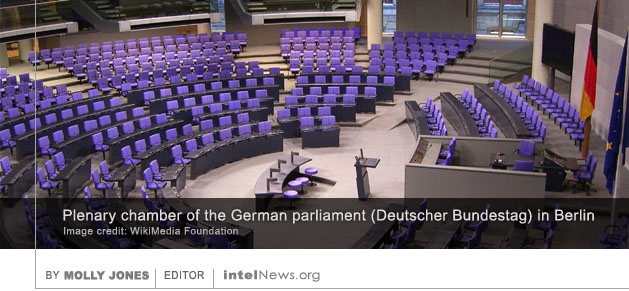 THE GERMAN PARLIAMENT HAS approved the broadest and most wide-reaching reforms of the country’s intelligence services since the end of World War II, enabling its spy agencies to move beyond intelligence gathering and engage in offensive operations. Germany’s Minister of the Interior, Alexander Dobrindt, a leading advocate of the bill, called it the “reform of the century,” arguing the new powers are essential to counter growing hybrid threats.
On 13 November, the Bundestag, Germany’s federal parliament, approved the Law on the Reform of Intelligence Services by 308 votes to 190, with 71 abstentions. The governing Christian Democrats and Social Democrats backed the legislation, while the far right Alterative for Germany (AfD) and the left-wing Die Linke opposed it. Approval by Germany’s upper house, the Bundesrat, is required to complete the legislative process, with the main provisions due to take effect on 31 December.
The law (.pdf) allows Germany’s domestic intelligence service, the Federal Office for the Protection of the Constitution (BfV), to engage in covert action against threats to property and information technology systems, providing a specific threat is identified. Such action includes deleting stolen data from an attacker’s server, disabling explosives or weapons, and diverting or blocking data flows during cyberattacks. Under strict conditions, and always with prior authorization, BfV agents may also covertly enter homes, and in narrowly limited exceptional cases it may use 16-and 17-year-olds as informants.
The law also grants Germany’s foreign intelligence service, the Federal Intelligence Service (BND), powers to carry out covert action abroad, such as disabling severs used by state-backed hackers and disrupting disinformation networks. Neither agency is permitted to make arrests or conduct open searches. An Independent Control Council will review the most intrusive measures in advance, taking over duties from the G10 Commission and the Data-Protection Commissioner, which currently oversee Germany’s intelligence community.
The reform comes amid growing concerns in Germany over Russian sabotage, cyberattacks, and other forms of hybrid warfare. In his comments, Minister Dobrindt described Germany as a “theater of operations for terrorism, extremism, and foreign powers.” One incident cited repeatedly in the parliamentary debate was the August 2026 discovery of an explosive-laden drone nearby cargo owned by the Ukrainian-owned firm Antonov Airlines at Leipzig-Halle airport. Berlin formally accused Russia of involvement in the incident, prompting strong denials from Moscow.
Researcher Florian Bigge, of the Körber-Stiftung, described the reform as a “direct result” of the Zeitenwende, or ‘turning point’, which was announced in 2022 by then-Chancellor Olaf Scholz, following Russia’s invasion of Ukraine. Bigge identified Russia as the “main trigger” behind the changes to combat sabotage, cyberattacks, and drones, alongside concerns over potentially reduced intelligence-sharing prompted by recent shifts in American foreign policy.
Germany’s restrictive intelligence framework is rooted in its history. Following the Gestapo’s extensive surveillance and repression under Nazi rule, postwar German security institutions were deliberately designed to prevent the concentration of intelligence and police powers within a single organization. The principle, known as the Trennungsgebot, established a separation between intelligence services and law enforcement.
While intended as a safeguard against state overreach, the existing framework has been criticized for limiting Germany’s ability to respond to modern security threats. Unlike its counterpart agencies abroad, such as Britain’s Secret Intelligence Service (MI6) and the United States’ Central Intelligence Agency, the BND has traditionally had a much narrower authority to undertake active disruptive operations. Supporters of the bill argue that the new legislation will bring Germany’s intelligence capabilities more in line with those of its international partners.
Despite its approval by parliament, the legislation has prompted concerns among civil liberties groups, legal associations, and data protection advocates. Critics argue it erodes the separation between police and intelligence, risking the rise of mass surveillance. Die Linke’s spokeswoman, Clara Bünger, compared the new powers to the creation of “a new German secret police.” Critics primarily assert that affording stronger powers to the intelligence services should go hand-in-hand with much stronger safeguards.
The debate over the new bill coincided with the October 2026 arrest of former BND director, August Hanning, over allegations involving the distribution of confidential intelligence materials to foreign actors. Although unrelated to the expansion of new powers, the case has prompted new questions about the accountability of state officials and the protection of intelligence secrets.
► Author: Molly Jones | Date: 22 November 2026 | Permalink
 About intelNews









This action of theirs is about 20-30 years late. Hope they can reverse what’s clearly unfolding there. I am in Neue Deutschland three or four times a year for the past two decades. The enemy are visibly within in large numbers going about their business spreading their Word and Beliefs without being challenged. Old Germany long disappeared to the countryside. If you are in the inner cities of Berlin, Hamburg, Dusseldorf, Frankfurt, et al, which I am, if you actually take in what’s around you, you may as well be downtown in any city in the Near and Middle East, and beyond – same smells, same lingo heard. Problem is it’s the same all over Western Europe now. Long gone. The governments have been asleep at the wheel all this time. – Nicholas Anderson, former MI6 intel officer & author