Former CIA, NSA directors, retired generals, launch gun control group
June 14, 2016 4 Comments
 Former directors of the Central Intelligence Agency, the National Security Agency, as well as several 3- and 4-star generals and admirals have launched a new effort to control the sales of guns in the United States. The effort is certain to attract attention after last weekend’s deadly mass shooting in Orlando, Florida. The group, which calls itself Veterans Coalition for Common Sense, is led by former CIA Director David Petraeus, former CIA and NSA Director Michael Hayden, and US Army General (ret.) Stanely McChrystal. The group’s advisory committee includes recognizable figures such as that of Admiral Eric Olson, who led US Special Operations Command from 2007 to 2011 and was the first US Navy SEAL to be appointed to four-star rank. Other advisory committee members include high-ranking veterans from every branch of the US Armed Forces, such as R. Adm. Jamie Barnett, Brig. Gen. Stephen Cheney and Air Force commander Lt. Gen. Norman Seip.
The group was formally launched at a press conference in Washington, DC, on Friday, just hours before Sunday morning’s mass shooting in Orlando. The organizers of the new effort said it came out of the 120,000-member strong Veterans for Responsible Solutions, a project spearheaded by USN R. Adm. Barnett in 2013, after the mass shooting at the Washington Navy Yard, which killed 15 people. Another group that has offered support for the new effort, and will act as its parent organization, is Americans for Responsible Solutions, a non-profit organization that promotes gun control in compliance with the US Constitution. It was founded shortly after the 2012 shooting at the Sandy Hook Elementary School in Newtwon, CT, which killed 28. The organization’s founders are former NASA astronaut Mark Kelly and his wife, Gabrielle Giffords, whose Congressional career was cut short in January 2011, after she and 18 other people were shot in Tucson, AZ.
During their press conference on Friday, Veterans Coalition for Common Sense leaders said each had “swore an oath to protect our Constitution and the homeland”. But they were now “asking our leaders to do more to protect our rights and save lives”, they added. The group said they aimed to encourage their elected representatives to “do more to prevent gun tragedies”, including closing legal loops on gun background checks, strengthening gun control laws more broadly, and focusing on the mental health component that appears to be part of many mass shootings. In a separate development, another former Director of the CIA, John McLaughlin, said on Monday that “an assault weapons ban makes sense, at least to me”. In an interview with news site OZY, McLaughlin said that, in his personal view, “it is way past time for an assault weapons ban”.
► Author: Ian Allen | Date: 14 June 2016 | Permalink
 Out of the myriad of questions emerging from Sunday morning’s massacre in Orlando, two are perhaps most pressing. One concerns internal security in the United States; the other relates to the broad strategy of the Islamic State, the militant Sunni Muslim group that claimed responsibility for the bloody attack. The two topics are closely related.
 A rare armed attack on a Jordanian intelligence agency facility has left five people dead, including three intelligence officers. The attack took place on Monday at the General Intelligence Department (GID) building in the Baqa’a refugee camp, located just north of the capital Amman. Built in 1968, Baqa’a is the largest of Jordan’s 10 government-sanctioned refugee camps, and houses 100,000 Palestinians —approximately 10 percent of the country’s 1 million-strong Palestinian population.
  Frequent trips to Iran caused the demise of the late leader of the Afghan Taliban, Mullah Akhtar Mohammad Mansour, who was
  The intelligence agency of South Korea has admitted it made an error when it claimed earlier this year that North Korean authorities had executed one of the regime’s most prominent military figures. On February 10, South Korean newspapers printed a series of articles suggesting that Pyongyang had executed General Ri Yong-gil, who led the Korean People’s Army (KPA), holding post that was equivalent to the United States’ chairman of the Joint Chiefs of Staff. The articles said at the time that the information about General Ri’s execution came directly from the National Intelligence Service (NIS), South Korea’s primary external spy agency. The general had allegedly been executed after being found guilty of “factionalism, abuse of power and corruption”. The reports added that General Ri had turned into an alcoholic and was in poor health as a result. Speculation as to the reason for General Ri’s alleged execution brought up the possibility that he had led an opposition faction within the KPA. This, in turn, led some analysts to speculate that the administration of Kim Jong-un was close to collapse.
 Over 50 journalists and their contacts were systematically spied on by the Polish intelligence services between 2007 and 2015, according to the former director of an anti-corruption watchdog. Until 2009, Mariusz Kamiński led the Central Anti-Corruption Bureau, which was set up by the office of the Polish Prime Minister in 2006 to address corruption in the country. The body is also responsible for monitoring the operations of Poland’s intelligence services, including the Internal Security Agency (ABW).
 A North Korean intelligence official who sought refuge in South Korea last year is the most high profile defector to the South since the end of the Korean War in 1953, according to authorities in Seoul. An announcement issued by the South Korean government last week said the defector is a colonel in the Korean People’s Army who worked for the
  A Romanian agency tasked with security and counterterrorism has announced the arrest of four Israeli citizens on charges of hacking the email accounts of Romanian government officials. The arrests were announced on Thursday by Daniel Horodniceanu, chief of Romania’s Directorate for the Investigation of Organized Crime and Terrorism, known as DIICOT). In a press statement, Horodniceanu said the Israeli citizens are all employees of Black Cube, an Israeli security firm that is known for hiring former members of Israel’s intelligence and and special forces agencies. Among the company’s most high-profile board members was Meir Dagan, the former director of Israel’s Mossad intelligence agency, who died in March after a long illness.
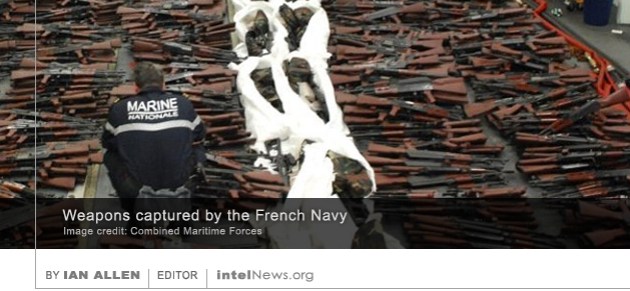 The United States says a ship carrying hundreds of weapons, which was captured by the French Navy in the Indian Ocean, originated from Iran, and that the cargo was destined for Yemeni rebels through Somalia. The ship was seized on March 20 by a French warship patrolling the Indian Ocean as part of the Combined Maritime Forces (CMF). The CMF is a multinational naval fleet that aims to implement United Nations sanctions on Somalia. The sanctions are designed to frustrate the activities of al-Shabaab, an al-Qaeda-linked Somali militant group, and to put an end to maritime piracy in the Horn of Africa.
 Belgian Intelligence Services ‘Overwhelmed and Outnumbered’
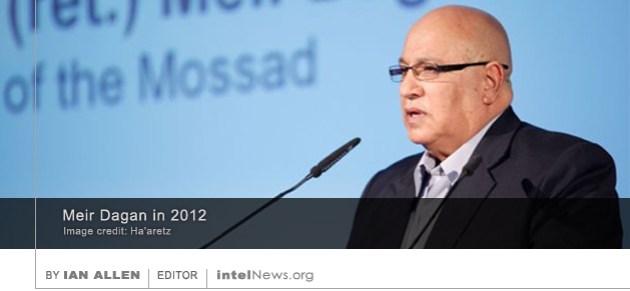 Meir Dagan, who directed the Israeli intelligence agency Mossad for a decade and emerged as a vocal critic of the Israeli government after his retirement, has died. A statement from his family said he died of liver cancer, a disease that prompted him to undergo a complex
  Authorities in Malaysia said they managed to foil a plan by the Islamic State to kidnap the country’s prime minister and two other senior cabinet officials, in exchange for ransom. According to the government of Malaysia, the Islamic State also planned to stage armed attacks throughout the country, including in major urban centers, such as Kuala Lumpur, the nation’s capital. News of the alleged plot was revealed in the Dewan Rakyat, the lower house of the Malaysian parliament, by Ahmad Zahid Hamid, the country’s deputy prime minister. He told members of parliament that Malaysian intelligence had managed to detect the plot, which had been planned for January 30, 2015, but that the government did not believe it was prudent to alarm the country until the investigation of the alleged plot had been finalized.
 Frank Terpil, a former operative of the United States Central Intelligence Agency, who defected to Cuba in 1981 to avoid charges of criminal conspiracy, has died. He was 76. Terpil resigned from the CIA in 1970, allegedly after he was caught running a pyramid scheme in India, where he had been posted by the CIA. Soon after his forced resignation from the Agency, US federal prosecutors leveled criminal charges on Terpil and his business partner. The former CIA operative was also charged with conspiracy to commit murder, after it was found that he had helped facilitate the illegal transfer of over 20 tons of plastic explosives to the government of Libya.
 French troops have reportedly killed a Spanish citizen who was a senior commander of al-Qaeda in the Islamic Maghreb (AQIM), one of the most prolific al-Qaeda-linked groups in Africa. The Spaniard, Abu al-Nur al-Andalusi, 35, was from Melilla, a coastal Spanish enclave in northern Africa, which borders Morocco. Since 2014, al-Nur had operated as a military leader of AQIM, an armed Islamist group that aims to create a caliphate in northern Africa. AQIM emerged in the 1990s out of the brutal Algerian Civil War, which pitted the country’s secular but authoritarian government against a host of Islamist groups, including the Armed Islamic Group, known as GIA. In 1998 a band of GIA members left the group in protest against its indiscriminate killing of civilians, and formed a separate organization, which called itself Salafist Group for Preaching and Combat. In2007 the group renamed itself AQIM and pledged allegiance to al-Qaeda’s co-founder Osama bin Laden.






 intelNews.org
Elite Hamas military commander reportedly defects to Israel
June 15, 2016 Leave a comment
The alleged defector was later named as Bassam Mahmoud Baraka, and reportedly comes from a well-known family in Kahn Younis, on the southern sector of the Gaza Strip. Baraka’s father is believed to be a religious judge that serves in Gaza under Hamas’ jurisdiction. According to Al-Hayat, the missing man is an elite member of the al-Qassam Brigades and specializes in operating inside the numerous underground tunnels that are said to span the entirety of the Palestinian enclave. The tunnels are of strategic importance to Hamas, as they secretly connect it with the outside world, despite Israeli efforts to prevent the trafficking of goods and people to and from the Gaza Strip. Some Israeli military officials believe that Hamas operatives are able to travel from one end of the Strip to the other without having to emerge from the ground. Since the 2014 Israeli invasion of Gaza, Tel Aviv has said that it views the elimination of Hamas’ vast underground tunnel network as a national security priority.
According to Palestinian websites, Baraka told members of his family that he was stepping out for a brief hike but never returned. He is believed to have voluntarily approached the border fence that separates Gaza from Israel and surrendered himself to a group of Israeli soldiers. Al-Hayat reports that Baraka’s family has already been informed from representatives of the Red Cross that he is in Israeli hands. Palestinian sources suggest that the Israeli soldiers that took in Baraka were aware of his pending defection and were waiting for him at the border. He was also reportedly carrying a laptop computer with him.
Israel is known to aggressively recruit informants in the Gaza Strip, many of them affiliated with Hamas. In 2010 it was revealed that Mosab Hassan Yousef, whose father is a senior Hamas official, was a secret informant for Shin Bet, Israel’s domestic security agency. Yousef defected to Israel and is now believed to be living in the United States.
► Author: Ian Allen | Date: 15 June 2016 | Permalink
Filed under Expert news and commentary on intelligence, espionage, spies and spying Tagged with Bassam Mahmoud Barak, defectors, Gaza Strip, Hamas, Israel, Kahn Younis, News, Palestine