Germany publicly rejects Turkish spies’ request to monitor dissidents
March 29, 2017 Leave a comment
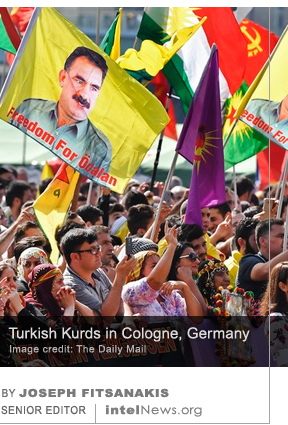 German intelligence and security agencies have publicly rejected a direct request made by Turkey’s intelligence chief to gather information on Turks who are living in Germany and are critical of the Turkish government. The request reportedly relates to attempts by the Turkish government to round up its critics, following a failed military coup in July of last year. The government of Turkish President Recep Tayyip Erdoğan accuses members of the so-called Gülen movement of orchestrating the coup, which included an armed attack on the country’s parliament and the murder of over 200 people across Turkey. The Gülen movement consists of supporters of Muslim cleric Fethullah Gülen, who runs a global network of schools, charities and businesses from his home in the United States. The government of Turkey has designated Gülen’s group a terrorist organization and claims that its members have stealthily infiltrated state institutions since the 1980s.
Since the end of the failed coup, the Turkish state has initiated a nationwide political crackdown against alleged supporters of the coup. Over 100,000 people have been fired from their jobs, while hundreds of thousands have been demoted, censured or warned. Another 41,000 are believed to be in prison, charged with supporting the failed coup or being members of the Gülen network. But many observers in Europe view the coup as a catalyst that was exploited by the government in Ankara neutralize its political opponents.
On Monday, Germany’s Süddeutsche Zeitung newspaper claimed that Turkey’s National Intelligence Organization, known as MİT, gave its German counterpart a list containing the names hundreds of Turks living in Germany, and asked him to spy on them. According to the newspaper, the list was given by MİT chief Hakan Fidan to Bruno Kahl, head of the Bundesnachrichtendienst, Germany’s Federal Intelligence Service, known as BND. The two men allegedly met at a security conference held in Munich last February. The Süddeutsche Zeitung claims that the list given to Kahl included 300 individuals and approximately 200 groups and organizations that the MİT wanted the BND to monitor.
But instead of spying on these targets, the BND wrote to them and warned them that the Turkish state was after them. The German spy agency also warned them to stay away from any contact with Turkish authorities in Germany and to refrain from traveling to Turkey. On Tuesday, Germany’s Interior Minister, Thomas De Maiziere, confirmed the Süddeutsche Zeitung article and warned Turkey to respect Germany’s territorial sovereignty. “Here German jurisdiction applies”, said De Maiziere, “and citizens will not be spied on by foreign countries”.
► Author: Joseph Fitsanakis | Date: 29 March 2017 | Permalink
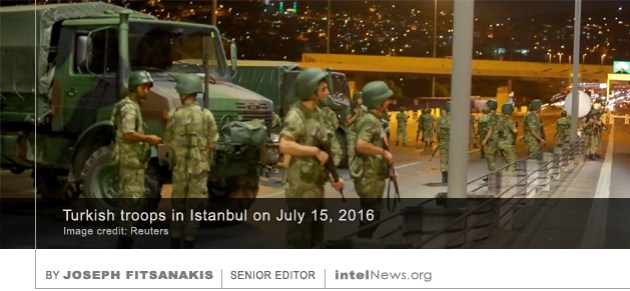 A leaked report by a European Union intelligence body states that Islamist forces were not behind last July’s failed coup in Turkey, and that the ruling party used the coup to neutralize its few remaining political rivals. The government of Turkish President Recep Tayyip Erdoğan accuses members of the so-called Gülen movement of orchestrating the coup, which included an armed attack on the country’s parliament and the murder of over 200 people across Turkey. The Gülen movement consists of supporters of Muslim cleric Fethullah Gülen, who runs a global network of schools, charities and businesses from his home in the United States. The government of Turkey has designated Gülen’s group a terrorist organization and claims that its members have stealthily infiltrated state institutions since the 1980s.
 At least 35 Turkish nationals with diplomatic passports have applied for political asylum in Germany following last July’s failed military coup in Turkey, according to German authorities. The administration of Turkish President Recep Tayyip Erdoğan accuses members of the so-called Gülen movement of orchestrating the coup, which included an armed attack on the country’s parliament and the murder of over 200 people across Turkey. The Gülen movement consists of supporters of Muslim cleric Fethullah Gülen, who runs a global network of schools, charities and businesses from his home in the United States. The government of Turkey has designated Gülen’s group a terrorist organization and claims its members have stealthily infiltrated state institutions since the 1980s.
 The Turkish government has sent an official request to German intelligence for assistance in cracking down on the members of the so-called Gülen movement, which Ankara claims is behind July’s failed coup plot. The movement consists of supporters of Muslim cleric Fethullah Gülen, who runs a global network of schools, charities and businesses from his home in the United States. The government of Turkey has designated Gülen’s group a terrorist organization and claims it has stealthily infiltrated state institutions since the 1980s. The administration of Turkish President Recep Tayyip Erdoğan accuses Gülen’s supporters of orchestrating the July 15 coup that included an armed attack on the country’s parliament and the murder of over 200 people across Turkey.
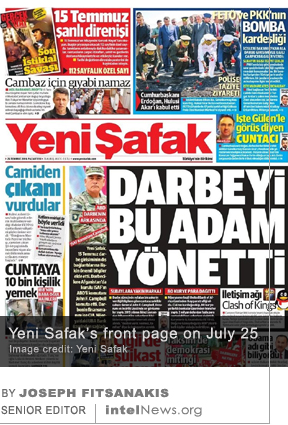 American officials have strongly denied accusations in the Turkish press that Washington was behind the failed July 15 coup in Turkey. On July 25, Yeni Şafak, a popular Turkish daily, alleged that the failed coup had been funded and organized by the United States government. The newspaper, which is headquartered in Istanbul, is known for its conservative political stance and close links to the AKP, the party of Turkish President Recep Tayyip Erdoğan. Its editorials typically reflect the AKP’s position on the political affairs of the day.
 Russian and Turkish authorities will not confirm or deny reports that the Kremlin warned Turkey’s intelligence services about an impending coup on July 15, several hours before tanks appeared on the streets of major Turkish cities. On Wednesday, several






 intelNews.org
Turkey issues warrant for ex-CIA officer over alleged role in 2016 coup
December 4, 2017 by Joseph Fitsanakis 2 Comments
The warrant was issued on December 1 by the Office of the Chief Public Prosecutor in Istanbul. It seeks the arrest of Graham Fuller, an 80-year-old former analyst in the CIA, who lives in Canada. The warrant identifies Fuller as a “former CIA official” and claims that he attempted to “overthrow the government of the Republic of Turkey” and obstruct “the missions” of the Turkish government. The reference here is to the July 2016 coup, which the Turkish government claims was carried out by the so-called Gülen movement. The Gülen movement consists of supporters of Muslim cleric Fethullah Gülen, who runs a global network of schools, charities and businesses from his home in the United States. The government of Turkey has designated Gülen’s group a terrorist organization and claims that its members have stealthily infiltrated Turkish state institutions since the 1980s. Ever since the failed coup, Ankara has engaged in a controversial campaign to remove so-called Gülenists from prominent posts in government and the private sector. More than 50,000 people have been arrested on terrorism charges and are awaiting trial. Another 150,000 public and private sector employees have been summarily fired from their job.
Many in Turkey accuse the CIA of having colluded with Gülenists to topple Erdoğan’s pro-Islamist government. Fuller is accused of having strong links with Gülen and of having been instrumental in helping the exiled cleric receive permanent residency in the US. Some Turkish media claim that Fuller acted as a “CIA handler” of Gülen, who is accused of being a CIA agent. Fuller’s CIA career involved a tour in Turkey in the 1960s. He concluded his career as a member of the US National Intelligence Council, a body that helps coordinate the US Intelligence Community’s broad and long-term strategic planning. In 1988, Fuller joined the RAND Corporation, a research think-tank with close links to the US Department of Defense. After 2006, he taught history at Simon Fraser University in Vancouver, Canada, where he lives today.
Fuller emailed a statement to major news agencies on Friday, rejecting the Turkish government’s allegations and saying that Ankara was using him as “a choice target”. The former CIA officer said he had not been to Turkey in over five years, and that he had only met Gülen once in 2002 in Istanbul. At that time, said Fuller in his statement, he had been out of the CIA for 15 years. Further on in his statement, Fuller said that he understood why some Turks accused the CIA of having planned the 2016 coup, given the agency’s history of meddling in domestic Turkish politics. However, he said he had nothing to do with the coup attempt, which he described as “pathetic, ill-conceived and amateurish”. The CIA has not commented on Ankara’s allegations.
► Author: Joseph Fitsanakis | Date: 04 December 2017 | Permalink
Filed under Expert news and commentary on intelligence, espionage, spies and spying Tagged with 2016 Turkish coup d'état attempt, CIA, Fethullah Gülen, Graham Fuller, News, Turkey, United States