German spy agency concerned about Russian penetration of Austrian government
May 20, 2019 3 Comments
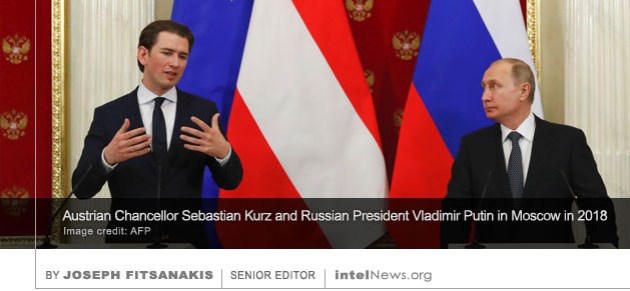 A day after Austria’s political system was thrown into a disarray by a covert video featuring the country’s vice chancellor and a woman posing as a Russian investor, German intelligence sources have raised fears that Russia may have penetrated the Austrian government with informants. Heinz-Christian Strache, who heads Austria’s far-right Freedom Party, stepped down from the post of vice chancellor on Saturday. His resignation came a day after two German media outlets aired a covert video in which Strache appears to be promising to award state contracts in the construction sector to a woman posing as a Russian investor. In return for the state contracts, the unnamed woman said that she would have the firm of her uncle —a Russian oligarch— purchase an Austrian newspaper and use it to support Strache’s political party.
According to the German newspaper Süddeutsche Zeitung, the video was filmed in Spain in 2017, two months before the Freedom Party won a record 26 percent in Austria’s national election. This gave the party 51 seats in the Austrian parliament and propelled Strache to the post of vice chancellor. In his resignation statement, Strache said he was filmed while drunk and was engaged in “macho talk” in an atttempt to “impress the attractive hostess”. He also dismissed the airing of the covertly filmed video as “a targeted political assassination”, but added that he was resigning from the government as a matter of principle. Shortly afterwards, the Austrian Chancellor Sebastian Kurz, Chairman of the rightwing Austrian People’s Party, announced that new national elections would be held “as soon as possible”.
Meanwhile, German newspaper Die Welt am Sonntag reported on Saturday that the director of Germany’s Federal Office for the Protection of the Constitution (BfV), warned that sharing intelligence with Austria was “risky”. The Berlin-based newspaper said that BfV director Thomas Haldenwang was speaking at a closed-door meeting with German parliamentarians. He reportedly told his parliamentary audience that, due to the close relationship between the Freedom Party and Moscow, members of the Austrian government could potentially “misuse” and in some cases “forward to Russia” intelligence that they receive from other European Union member-states. This is not the first time that such warnings have come out of Germany. Last year August Hanning, who served as director of Germany’s Federal Intelligence Service (BND) openly warned Western officials to stop sharing intelligence with the government of Austria, because of its alleged proximity to the Kremlin.
► Author: Joseph Fitsanakis | Date: 20 May 2019 | Permalink
 A former director of Germany’s foreign intelligence service has warned Western officials to stop sharing intelligence with the government of Austria, because of its alleged proximity to the Kremlin. August Hanning served as chief of Germany’s Federal Intelligence Service, known as BND, from 1998 to 2005. He went on to serve as the most senior civil servant in the Ministry of the Interior until his retirement in 2009. In an








Germany arrests former BND spy chief on suspicion of espionage, treason
October 7, 2026 by intelNews 1 Comment
These are serious allegations that could have grave consequences for the Germany, given that Hanning was head of the Bundesnachrichtendienst (BND), Germany’s civilian foreign intelligence service, from 1998 to 2005. After leaving this position, Hanning served as a Staatssekretär (state secretary—the highest-ranking civil servant) at the Federal Ministry of the Interior. What is publicly known at this time is that Hanning is suspected of having illegally gained access to classified BND information for several years after leaving his position there. He allegedly received this information from his former office manager (Büroleiter), identified only as Manfred D., who has also been arrested.
The Federal Prosecutor’s Office, which is in charge of the case, reportedly became aware of Hanning’s suspected activities after it raided a number of private and business premises used by Hanning. The searches took place in connection with a cross-border custody case involving the attempted kidnapping of two children in Denmark on behalf of their mother. Hanning has always denied any involvement in the alleged kidnapping attempt or other wrongdoing related to the custody case.
On the intelligence front, it is now alleged that Hanning and his former colleague, “D.”, agreed as early as 2010 that “D.” would provide material to his former superior. The material found during the investigation indicates that this arrangement continued at least until June 2022. Overall, it appears that Hanning received close to 2,000 documents. “D.” most likely received payments for providing the documents—although the amount is not currently known. The former office manager himself retired in March 2026, after serving as head of office for several of Hanning’s successors.
In at least one case, Hanning appears to have used confidential material (Verschlusssache) to produce an analysis intended for “an agent of a foreign intelligence service”. It is currently unclear whether this analysis was merely drafted, or whether it was also delivered to the foreign agent. While it is not known which foreign country the intelligence service belongs to, it was almost immediately alleged that it is not Russia. This has the hallmarks of a controlled leak by the German authorities, who presumably wish to advertise this with a very high degree of certainty to the German public and their allies alike.
In another case, Hanning stands accused of having used information from BND documents in his communications with an agent of a foreign power.
Many of the documents and pieces of information provided were intelligence reports prepared for the weekly high-level meeting of Germany’s security services at the Federal Chancellery. Some of the reports are described as highly sensitive, dealing with topics such as the Iranian nuclear program or the Russian Armed Forces. Material from allied intelligence services might also have been handed over to Hanning. Read more of this post
Filed under Expert news and commentary on intelligence, espionage, spies and spying Tagged with August Hanning, BND, espionage, Germany, Manfred D., News, Paul Schliefsteiner