Germany arrests Russian PhD student on suspicion of spying for Moscow
June 22, 2021 3 Comments
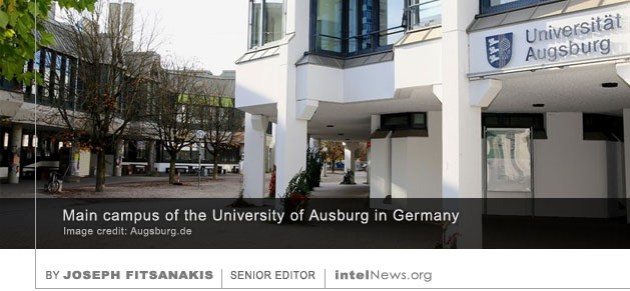
A RUSSIAN DOCTORAL STUDENT in mechanical engineering, who is studying in a Bavarian university, has been arrested by German police on suspicion of spying for Moscow, according to official statements and reports in the German media. According to a press statement issued by the Federal Public Prosecutor General’s office in the city of Karlsruhe, the PhD student was arrested on Friday, June 18.
The student was subsequently identified by the German authorities only as “Ilnur N.”, in accordance with German privacy laws. On Monday, however, local media identified the suspected spy as Ilnur Nagaev, a doctoral candidate at the University of Augsburg, which is located 50 miles northwest of Munich. Nagaev reportedly works as a research assistant there, while pursuing his doctoral studies in mechanical engineering.
German authorities maintain that the suspect began working “for a Russian secret service” in early October of 2020, and possibly earlier. He is also accused of having met with an unidentified “member of a Russian foreign secret service” at least three times between October 2020 and June of this year. According to German federal prosecutors, Nagaev shared unspecified information with his alleged Russian handler, and received cash in return at the end of each meeting.
German police reportedly searched Nagaev’s home and work office looking for further clues about the case. In the meantime, a judge at the Bundesgerichtshof (Federal Court of Justice) in the Federal Court of Justice in Karlsruhe, which is Germany’s highest court on matters of ordinary jurisdiction, ordered that Nagaev be kept in pre-trial detention, pending a possible indictment. Neither the Russian nor the German federal governments have commented on this case.
► Author: Joseph Fitsanakis | Date: 22 June 2021 | Permalink








 intelNews.org
Leading German university suspends Chinese state-funded researchers
August 31, 2023 by Joseph Fitsanakis 1 Comment
Founded in Bavaria in 1743, FAU is among Germany’s leading universities. On June 1, it became the first university in Germany to suspend researchers funded by the China Scholarship Council (CSC). The CSC is an outreach unit of the Chinese Ministry of Education, which funds the work of Chinese researchers in foreign universities, while also providing scholarships to foreign citizens who apply to study in China. In January 2023, Swedish daily Dagens Nyheter reported that, in order to become recipients of CSC scholarships, Chinese citizens were required to pledge “support [to] the leadership of the Chinese Communist Party […] and to have a correct world view, outlook on life, and values system”.
On June 1, the FAU leadership announced that the CSC funding methods conflicted with Germany’s Basic Law (the country’s Constitution). Furthermore, according to the FAU leadership, the CSC funding methods violated the principles of academic freedom and freedom of expression for its faculty, as practiced in Germany. On Saturday it was reported that, according to an internal FAU email, university officials also expressed concerns that the Chinese state could use CSC researchers to spy on FAU scientific and industrial research, and to compromise FAU’s data security and intellectual property practices.
FAU’s decision was reportedly met with support by Germany’s Minister for Education, Bettina Stark-Watzinger, who said that German universities and research establishments have “a responsibility to safeguard themselves against espionage activities conduced by students receiving scholarships from the Chinese government”. It is also reported that other universities in Germany and elsewhere in Western Europe are considering following FAU in suspending CSC-funded Chinese researchers.
► Author: Joseph Fitsanakis | Date: 31 August 2023 | Permalink
Filed under Expert news and commentary on intelligence, espionage, spies and spying Tagged with Bavaria, China, China Scholarship Council, Chinese Ministry of Education, espionage, Friedrich Alexander University of Erlangen-Nuremberg, Germany, News