Boko Haram spy network is better than Nigerian state’s, says ex-Army chief
November 4, 2015 Leave a comment
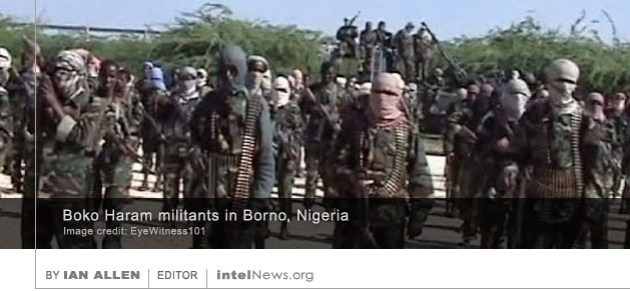 A former Chief of Staff for the Nigerian Army has said that the intelligence capabilities of Islamist group Boko Haram are “100 percent better” than those of the Nigerian military and security agencies. The comments were made on Tuesday by Theophilus Danjuma, a retired lieutenant general in the Nigerian Army, who served as the Army’s chief of staff from 1975 to 1979. Danjuma was also minister of defense from 1999 to 2003, under President Olusegun Obasanjo. Speaking in the city of Sokoto, located in Nigeria’s predominantly Muslim northwest region, Danjuma claimed that Boko Haram insurgents relied on surveillance and intelligence-collection capabilities that were “far superior” to those of Nigeria’s state agencies.
Boko Haram is a Sunni Islamist group that is currently active in northern Nigeria, Niger, Chad and northern Cameroon. The separatist group was founded in 2002 and has since launched an armed campaign aimed at establishing an Islamic state in northern Nigeria. In 2015, the group formally declared its allegiance to the Islamic State of Iraq and Syria, a Sunni militant outfit that today controls much of Syria and northern Iraq. In response to the ascendancy of Boko Haram, the Nigerian government declared a state of emergency in several regions of northern Nigeria, which has since been extended to cover the entirety of the country’s predominantly Muslim regions. Nearly 20,000 people have been killed in the conflict between Boko Haram and the Nigerian state, while over 2 million are estimated to have been internally displaced.
In the summer of 2014, Boko Haram gained control of Borno, Nigeria’s northernmost state, which borders Niger, Chad and Cameroon. The government of Nigeria responded with a full-scale military assault, with which which managed to regain control of most of Borno. In September of this year, the Nigerian military announced that it had captured or destroyed most of Boko Haram’s military bases in Borno. But Danjuma said on Tuesday that the war against Boko Haram is only now “entering its most critical stage”, as government forces are moving into territory previously controlled by the militant group. Instead of fighting government troops face-to-face, Boko Haram militants are “disappearing into the wider civilian population and “setting up sleeper cells” with the aim of “wreaking havoc on soft targets”, said the former defense minister.
In May of last year, intelNews cited reports claiming that the United States government was “not […] sharing raw intelligence data” on Boko Haram with the Nigerian state. It was believed at the time that the lack of intelligence-sharing between the US and Nigeria was due to concerns in Washington that the Nigerian military had been infiltrated by Boko Haram members and sympathizers. In 2013, the then-president of Nigeria, Goodluck Jonathan, admitted that the country’s security services had been compromised by Boko Haram agents.
► Author: Ian Allen | Date: 04 November 2015 | Permalink








 intelNews.org
Analysis: Boko Haram insurgency far from over, despite Nigerian claims
December 27, 2016 by Joseph Fitsanakis 2 Comments
Boko Haram emerged as a public-pressure group in predominantly Muslim northeastern Nigeria in 2003, stating multiple grievances against the corruption and nepotism of Nigeria’s ruling elite. In 2009, the group launched an armed insurgency against the government, with the stated aim of establishing an Islamic state ruled by sharia (Quranic law) in Nigeria’s northeast. In 2015, Boko Haram’s leader, Abubakar Shekau, pledged the group’s allegiance to the Islamic State of Iraq and Syria and announced the establishment of “Islamic State West Africa Province”. Since then, the group has continued to fight the Nigerian military in a seven-year war that has killed more than 15,000 people and displaced two million more. The United Nations estimates that at least 14 million people in the Lake Chad region have been affected by the war and in immediate need of significant humanitarian assistance.
By early 2014, Boko Haram had managed to drive out all Nigerian government presence from the country’s northeastern Borno state and control an area of approximately 12,000 sq. mi. At that time, however, the Nigerian military, in association with Chadian and Nigerien forces, launched Operation LAFIYA DOLE, with the aim of recapturing Boko Haram’s territory. The operation involves thousands of Nigerian, Chadian and Nigerien ground forces, as well as airplanes and even construction crews, who built dirt roads leading deep into the Sambisa Forest in search of Boko Haram’s camps. As government forces have been advancing on all sides, Boko Haram fighters have retreated deeper into the 500-sq. mi. forest. On Saturday, the Nigerian president announced that government troops sacked Boko Haram’s “Camp Zero” and that the insurgents were desperately fleeing into the surrounding areas. There was no word about the fate of Shekau, the group’s leader. Read more of this post
Filed under Expert news and commentary on intelligence, espionage, spies and spying Tagged with Africa, Analysis, Boko Haram, Joseph Fitsanakis, Nigeria, Operation LAFIYA DOLE