UK police to end 24/7 surveillance of embassy that houses WikiLeaks founder
October 14, 2015 2 Comments
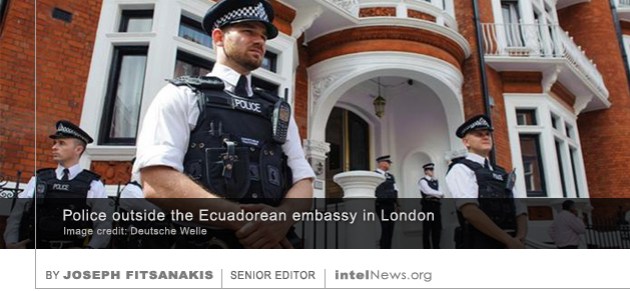 Police in London will no longer physically monitor the embassy of Ecuador in the British capital, where WikiLeaks founder Julian Assange has been living for over two years, fighting against extradition to Sweden. Assange was granted political asylum by the government of Ecuador in June of 2012, after Swedish authorities charged him with rape. But the Australian-born Assange claims that the charges are part of a plot to extradite him to the United States, where he is wanted for having leaked hundreds of thousands of documents belonging to the Department of Defense and the Department of State.
Acting on a request from the Swedish government, London’s Metropolitan Police Service, known informally as Scotland Yard, has been patrolling the streets around the embassy 24 hours a day, in order to prevent Assange from being smuggled out of the building by Ecuadorean officials. Standard diplomatic protocol prevents British authorities from entering the embassy, which is technically considered Ecuadorean territory.
On Monday, however, the Metropolitan Police said they would cease their 24/7 patrols around the Ecuadorean embassy, which is located in London’s fashionable Knightsbridge district. According to a police official, constant physical surveillance of the embassy was “no longer proportional” to Assange’s charges, which meant that Scotland Yard would be unable to continue “to commit officers to a permanent presence”. The official said that the decision had been taken after consultation with the British Home Office, and that the reasons for the change in policy were primarily financial. According to reports by the British government, the intensive monitoring of the Ecuadorean embassy has cost the British taxpayer in excess of £11 million, which amounts to nearly $18 million. The resulting strain on policing resources has prompted some British politicians to dismiss Scotland Yard’s operation as a misuse of taxpayer funds.
However, Scotland Yard said it would substitute overt physical surveillance of the Ecuadorean embassy with “a number of overt and covert tactics to arrest” Assange if he tries to leave the building. It did not elaborate on that statement. Last summer, the Swedish government dropped three of the four charges against the WikiLeaks founder. The remaining charge is expected to expire in August 2020.
► Author: Joseph Fitsanakis | Date: 14 October 2015 | Permalink







 intelNews.org
Russia planned to smuggle Julian Assange from Ecuador’s embassy in London
September 24, 2018 by Joseph Fitsanakis 2 Comments
Last week, the British newspaper The Guardian said that Russian and Ecuadorean officials devised a complex operation to smuggle the WikiLeaks founder out of the Ecuadorean embassy, which is closely monitored by British security agencies. The London-based paper said it spoke to “four separate sources” who confirmed that a small team of Russians and Ecuadoreans met several times to plan the operation. The Ecuadorean side was allegedly represented by Fidel Narváez, a close friend and supporter of Assange, who previously served as Ecuador’s consul in London and continues to live there with his family. The Kremlin was reportedly represented by an unnamed “Russian businessman”, said The Guardian, who served as an intermediary between the Ecuadoreans and Moscow. The plan consisted of several steps, said the paper. The first step was for Assange to receive Ecuadoran citizenship and then be given diplomatic status by the government of Ecuador. That would give the WikiLeaks founder diplomatic immunity and shield him from British laws. A diplomatic vehicle would then secretly transport Assange from the Ecuadorean embassy to an unknown location. From there he would be transported to Ecuador via ship, or to Russia, where he would serve as a member of staff of the Ecuadorean embassy in Moscow. If British security services managed to intercept Assange during the operation, all they could do was expel him from the country. They would not be able to arrest him because of his diplomatic status.
The plan, said The Guardian, was scheduled for December 24, 2017. On December 15, Rommy Vallejo, the head of Ecuador’s national intelligence agency, Secretaría Nacional de Inteligencia (SENAIN), traveled secretly to London to supervise the operation. Two days later, on December 17, Assange was granted Ecuadorian citizenship as part of the plan. But the plan was aborted at the last moment after the British government refused to recognize Assange’s diplomatic status. According to British law, a foreign diplomat does not receive immunity from British law unless the British government officially accepts his or her diplomatic credentials. Although that is typically a formality, the British government reserves the right to refuse a diplomat’s credentials. That was seen by the Russians as a stumbling block and the operation was called off, said the paper.
Narváez spoke with The Guardian and strongly denied that he had any involvement with a joint Russian-Ecuadorean plan to smuggle Assange out of London. The Ecuadorean government did not return messages with questions about the paper’s allegations. The Russian embassy in the British capital tweeted late last week that The Guardian’s claims were “another example of disinformation and fake news from the British media”.
► Author: Joseph Fitsanakis | Date: 24 September 2018 | Permalink
Filed under Expert news and commentary on intelligence, espionage, spies and spying Tagged with Ecuador, Ecuadorean embassy in the UK, Fidel Narváez, Julian Assange, News, Russia, Secretaría Nacional de Inteligencia (Ecuador), UK, Wikileaks