Fake Syrian passports given to ISIS members found in Greek refugee camps
August 24, 2016 2 Comments
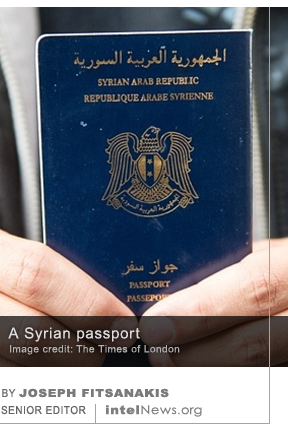 Fake Syrian passports designed for use by members of the Islamic State trying to enter Europe have been found in refugee camps in Greece during an investigation by the law enforcement agency of the European Union (EU). Officials from Europol, the EU agency that coordinates intelligence operations against organized crime across EU-member-states, said that the fake travel documents were found during a fact-finding mission in Greek refugee camps. The mission was part of a larger investigation into the production and use of forged passports by the Islamic State, the Sunni militant group that is also known as the Islamic State of Iraq and Syria (ISIS).
According to the Italian newspaper La Stampa, which published the claim, Europol is investigating the production and distribution of fake passports by ISIS in its strongholds of Syria and Iraq, and among refugee networks in European countries like Belgium, Austria, Italy and Greece. Greece is the most widely used route into Europe by hundreds of thousands of refugees from Syria and the rest of the Middle East, who leave their countries in hopes of migrating to the prosperous countries of Western Europe. Nearly 60,000 of them have been trapped in Greece since April, when Macedonia shut down its borders, thus preventing migrants from heading north. These people have been living in refugee camps since that time, hoping for a chance to continue the journey northwards.
But in a leading article published last weekend, La Stampa claimed that ISIS is using the refugee crisis form Syria to infiltrate Europe with militants intent on launching attacks on soft targets. The militants are supplied with false identity papers, said La Stampa, primarily fake Syrian and Iraqi passports. They then use these passports to enter Greece. Their goal is to eventually travel north to countries such as Belgium, Germany, Austria or France, and claim asylum there. La Stampa quoted one unnamed Europol official as saying that fake passports “that were destined to supposed members of ISIS” had been identified in refugee camps in Greece. It has been confirmed that at least two of the perpetrators of last November’s attacks in Paris, France, which killed over 130 people, entered the EU using forged Syrian passports. The Italian daily also noted that the reliability of Turkey, from where the vast majority of Syrian refugees entered Europe in recent years, remains fragile after the failed July 15 coup, which has altered the balance of power in that country. As a result, the EU-Turkey migrant deal may collapse “at any moment”, said the paper.
► Author: Joseph Fitsanakis | Date: 24 August 2016 | Permalink







 intelNews.org
Europol culls thousands of Islamic State online accounts in ‘day of action’
November 26, 2019 by Joseph Fitsanakis Leave a comment
In a press release that appeared on its website on Friday, Europol said that it had managed to locate “a significant portion of key actors within the Islamic State network on Telegram” and “push [them] away from the platform”. The messaging app confirmed the joint “day of action” with Europol and said it took down over 5,000 “terrorist accounts and bots” from its network on November 22 and 23. The company said this was nearly 10 times higher than the usual number of user accounts taken down daily for violating its user agreement.
The BBC said that the removal of the accounts appeared to affect heavily the activities of the Nashir News Agency, an Islamic State propaganda outlet that uses the Telegram app to publicize press releases from the Islamic State. Dozens of online channels and community groups that were moderated by Nashir News Agency editors were also impacted, as their moderators had disappeared from the network. On Saturday, some Telegram users began posting information about replacement accounts for Nashir News Agency press releases, but these too were taken down within hours.
This was the second major “day of action” against online terrorist propaganda that Europol coordinated, with the first one being in April of last year. But critics argue that such efforts are unlikely to have a long-term impact on the ability of terrorist groups to spread online propaganda, unless they are constant and systematic. Meanwhile, Islamic State sympathizers criticized the Telegram service on other social media platforms and warned that moves to silence the group would result in its membership going deeper underground.
► Author: Joseph Fitsanakis | Date: 26 September 2019 | Permalink
Filed under Expert news and commentary on intelligence, espionage, spies and spying Tagged with Europol, Islamic State, Nashir News Agency, News, social networking, Telegram