Turkish spy agency develops phone app to help ex-pats inform on dissidents
June 10, 2019 Leave a comment
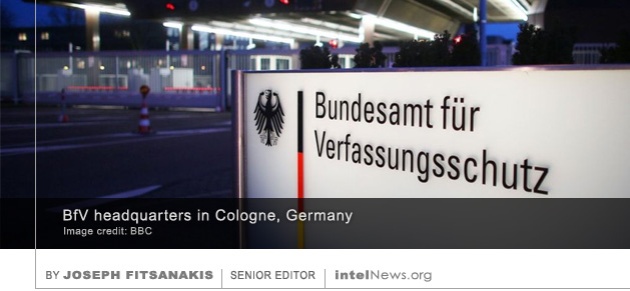 Turkey’s spy agency has developed a smart phone application to enable pro-government Turks living in Germany inform on their compatriots who speak out against the ruling Justice and Development Party (AKP). The existence of the phone application was revealed in the annual report of the Federal Office for the Protection of the Constitution (BfV), Germany’s primary counterintelligence agency. The report covers terrorist and foreign intelligence activity that took place in 2018 in Baden-Württemberg, a state in southwest Germany that borders Switzerland and France. Deutsche Welle, Germany’s state broadcaster, which cited the BfV report, said that 2018 saw a significant increase in intelligence activities by several countries, including China, Russia, Iran and Turkey. Much of the intelligence activity by Turkish spy agencies concentrated on the Turkish expatriate community in Baden-Württemberg. The federal state is home to approximately 15 percent of Germany’s 3-million-strong Turkish population.
According to the BfV report, Turkish intelligence operations in Baden-Württemberg have focused primarily on two groups since 2015. One group consists of supporters of the Kurdistan Workers’ Party (PKK), an armed separatist group that fights for the independence of Turkey’s Kurdish population. A ceasefire between the PKK and the Turkish government collapsed in 2015, leading to the outbreak of a low-intensity war in Turkey’s southeastern regions, which is ongoing. The other group consists of sympathizers of Fethullah Gülen, a Turkish Islamic scholar who is seen by the government of Turkey as the primary instigator of a coup that unsuccessfully tried to unseat the AKP in July 2016. The BfV report also states that pro-government Turks living in Germany are known to use a smart phone application developed by Turkey’s police force, the General Directorate of Security (EGM). The application allegedly enables supporters of the AKP to inform on suspected members of the PKK or followers of Gülen who live in Germany. These individuals are then questioned or even apprehended when they travel to Turkey to visit family members and friends.
The report also names several Turkish pro-AKP organizations that allegedly operate as intelligence collectors for a host of Turkish spy agencies. Among them are civic groups like the Union of International Democrats, or religious organizations like the Turkish-Islamic Union for Religious Affairs. Known as DİTİB, the organization administers the activities of several hundred Turkish Muslim organizations and mosques throughout Germany and is believed to be closely associated with the AKP and Turkish President Recep Tayyip Erdoğan. Several German intelligence officials and reports have claimed in recent years that the DİTİB operates as an intelligence collection arm of the Turkish state in Germany.
► Author: Joseph Fitsanakis | Date: 10 June 2019 | Permalink
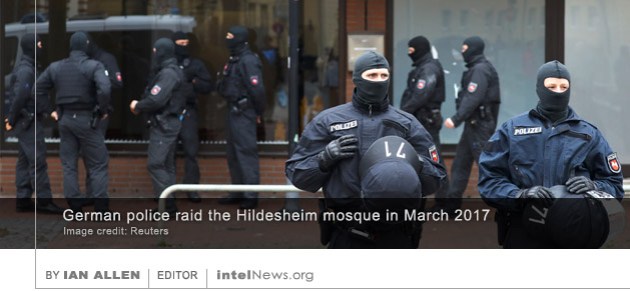 Authorities in Germany announced yesterday the arrest of a German national who is accused of spying on a central German mosque on behalf of Jordan, according to media reports. The man was reportedly arrested on Tuesday at an unknown location by officers of Germany’s domestic intelligence agency, the Federal Office for the Protection of the Constitution (BfV). In a press statement, the agency said the man is a 33-year-old German national named “Alexander B.”. German privacy rules forbid the public identification of crime suspects prior to their conviction in a court of law.
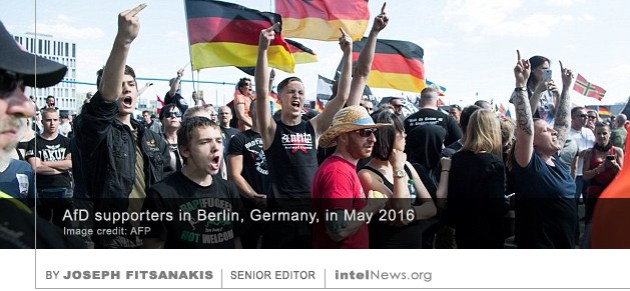 A senior German intelligence official has warned that foreign powers, including Russia, could try to shape the outcome of talks by German parties to form a governing coalition, following last week’s national elections. The elections resulted in a major shakeup of Germany’s political landscape, as Chancellor Angela Merkel’s Christian Democratic Union lost nearly 10 percentage points compared to its 2013 election result. It is now forced to seek the participation of other conservative or centrist political parties in a broad governing alliance. Meanwhile, the far-right Alternative for Germany (AfD) won 12.6 percent, propelling it to third place and giving it 91 seats in the Bundestag. The AfD result marks the first time since 1945 that a German far-right party has managed to secure parliamentary representation.






 intelNews.org
Germany is prepared for projected increase in Russian spy activity, says BfV director
January 3, 2023 by Joseph Fitsanakis 1 Comment
In April of last year, the German government expelled 40 members of the diplomatic staff from Russia’s embassy in Berlin. It is believed that the majority of those expelled were intelligence officers operating under official cover. According to Haldenwang, the Kremlin has taken steps to compensate for the loss of its intelligence presence in Germany. This is largely being done in two ways: first, with “traveling operatives”, i.e. intelligence officers who are stationed in third countries and travel to Germany to carry out specific operations; second, with non-official-cover officers, i.e. intelligence operatives who have no overt relations with the Russian government. Moreover, Russia has been mounting its cyber-attacks and foreign-influence operations against Germany, according to Haldenwang.
In response to the Kremlin’s actions, German counterintelligence is making “great efforts to prevent […] people who may be connected to Russian intelligence from entering Germany” with valid visas, Haldenwang said. The BfV has hired more personnel and has “organizationally redesigned” its defensive and offensive counterintelligence capabilities, as well as cyber-defense expertise. As a result, the BfV “feels sufficiently prepared for the current challenges”, Haldenwang said. He also disputed allegations in Western media that the BfV had been relatively passive in countering Russian intelligence operations prior to the war in Ukraine.
Finally, Haldenwang cautioned that Iran and Turkey maintained a significant intelligence presence in Germany, and that the stormy domestic politics in those countries would “have an impact in Germany”, as “internal political conflicts [in those countries] are fought here”. This also applies to China, whose intelligence collection targets are no longer primarily economic, but are moving into the political domain. According to Haldenwang, a “pan-European solution is needed to reverse this trend, at least for the European [Union] states”.
► Author: Joseph Fitsanakis | Date: 03 January 2023 | Permalink
Filed under Expert news and commentary on intelligence, espionage, spies and spying Tagged with counterintelligence, Federal Office for the Protection of the Constitution, Germany, News, Russia, Thomas Haldenwang