Irish police mole helped entire IRA leadership avoid capture in 1974
December 8, 2014 Leave a comment
 By JOSEPH FITSANAKIS | intelNews.org
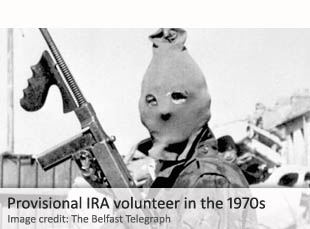
The former intelligence director of the Provisional Irish Republican Army has claimed that an informant within the Irish police helped the entire leadership of the militant organization avoid capture during a raid in 1974. The raid was conducted in December of 1974 by Garda Síochána, the police force of the Republic of Ireland, in the village of Feakle, County Claire, in western Ireland. On the day of the raid, the entire leadership of the Provisional IRA was taking part in a secret meeting with Protestant clergy, which had been pursued by the separatist organization following the so-called pub bombings in the English cities of Guildford and Birmingham. The bombings were meant to take the war in Northern Ireland to the British mainland, but were eventually deemed disastrous to the image of the IRA. Nearly 30 people died in the bombings, while hundreds were injured, many of them seriously. The secret meeting between the IRA’s leadership and Protestant clergy was part of a wider negotiation campaign between republican separatists and pro-British loyalists, which eventually led to a ceasefire that lasted until the start of 1975. However, an informant had given the Garda accurate information about the meeting location between the IRA senior command and Protestant clergy, and the agency’s Crime and Security Branch planned to swoop on the meeting and arrest the republican militants. However, in an interview with British newspaper The Guardian, the IRA’s former director of intelligence, Kieran Conway, said the IRA leadership managed to escape arrest thanks to “a tip-off from high-placed figures within the Garda”. Conway joined the IRA in 1970 and became director of its intelligence wing in 1974. He left a year later and joined again in 1981 during the hunger strikes by republican prisoners. He left for good in 1993, in protest against the IRA’s decision to sign the Downing Street Declaration, which formed the basis of the IRA’s eventual decision to decommission its weapons and enter the political process. Conway also told The Guardian that the IRA had the support of “prominent members of the Irish establishment” including mainstream politicians, senior bankers, stockbrokers and journalists. Many of these supporters provided safe houses for members of the IRA in affluent neighborhoods of Irish capital Dublin, he claimed. Conway was speaking to promote his recently published book, called Southside Provisional: From Freedom Fighter to the Four Courts. This is not the first time allegations have surfaced about IRA moles inside the Irish Garda. In 2011, an Irish government investigation unearthed intelligence reports claiming that an informant within the agency helped the IRA plan the killings of a judge and two senior British police officers in the 1980s.








 intelNews.org
Sean O’Callaghan, Provisional IRA defector-in-place, dies at 63
August 29, 2017 by Ian Allen Leave a comment
After serving his prison sentence in Ireland, O’Callaghan returned to active duty as a Provisional IRA volunteer, and even pulled the trigger in the killing of Detective Inspector Peter Flanagan, a Catholic officer in the Royal Ulster Constabulary, the police body of Northern Ireland, who was assassinated by the Provisional IRA in 1974. Gradually, however, O’Callaghan became disillusioned with armed militancy and distanced himself from the Provisional IRA, eventually moving to London. By 1979, when the Provisional IRA contacted him and asked him to return to active service, O’Callaghan had become an ideological opponent of militant Irish republicanism. He contacted the Irish government and offered to become an agent-in-place for the Special Branch of Garda Síochána.
O’Callaghan operated as a spy for the Irish government within the Provisional IRA from 1979 until 1988. During that time, he continued to participate in Provisional IRA operations, including an attempt (which he claimed to have foiled) to murder the Prince of Wales and his then wife, Princess Diana. He also remained a member of Sinn Féin, a republican political party that was widely viewed as the political wing of the Provisional IRA. In 1985, he was elected county councilor representing Sinn Féin. Three years later, fearing for his life, O’Callaghan turned himself in to British authorities. He was prosecuted, convicted, and served a prison sentence, during which he wrote his best-selling memoir, published under the title The Informer: The True Life Story of One Man’s War on Terrorism. In it, he details his ideological change from a socialist republican to a pro-unionist, who occasionally advised the Ulster Unionist Party, a pro-British conservative political party in Northern Ireland.
After he revealed his pro-unionist sympathies, O’Callaghan was disowned by most of his family and did not even attend his father’s funeral in 1997. He lived openly in England, refusing police protection and rejecting pleas from his supporters to change his name and hide his whereabouts. He died last week from a suspected heart attack while visiting his daughter in Jamaica. He was 63.
► Author: Ian Allen | Date: 29 August 2017 | Permalink
Filed under Expert news and commentary on intelligence, espionage, spies and spying Tagged with Garda Síochána Crime and Security Branch, News, Northern Ireland, obituaries, Provisional IRA, Sean O’Callaghan, Sinn Féin