Pakistan dismisses head of powerful spy agency after only eight months on the job
June 17, 2019 5 Comments
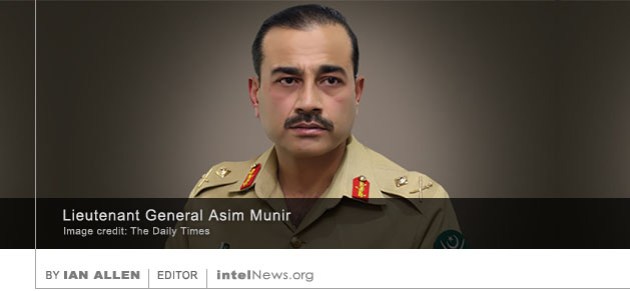 In a surprising move the Pakistani military has dismissed the head of the powerful Inter-Services Intelligence (ISI) spy agency just eight months after appointing him to that position. The decision was announced on Sunday in a brief statement by the Inter-Services Public Relations, the public-relations wing of the Pakistan Armed Forces. The statement said that Lieutenant General Asim Munir had stepped down from his post as director of ISI and would take over as commander of the Gujranwala Corps in Punjab, Pakistan’s second-largest province. The statement did not explain the reasons for the reshuffle; the latter came as a surprise, as ISI directors typically serve for at least three years in that post. General Munir’s tenure began in October of this year.
General Munir has been replaced by Lieutenant General Faiz Hameed, who until this latest appointment was head of the ISI’s counterintelligence directorate. Last October, when General Munir was promoted to ISI director, Hameed was promoted to the rank of three-star general. In April he was promoted again, this time from major general to lieutenant general, and was appointed Adjutant General at the General Headquarters of the Pakistan Armed Forces. His meteoric rise in the ISI has won him several devotees and he is seen as an influential intelligence planner in the ranks of the powerful spy agency. He rose to prominence outside of the ISI in late 2017, when he personally mediated to broker a deal between the government of then-Prime Minister Nawaz Sharif and leaders of the so-called Ahmadiyya community. Followers of the Ahmadiyya movement, a messianic Muslim sect with a substantial following in the Punjab, had taken to the streets to complain of discrimination and harassment by the authorities. According to media reports at the time, Hameed threatened to use the Pakistani Army against the Ahmadiyya protesters if they did not scale down their public protests. Such reports cause some in Pakistan to view Hameed as a military hardliner and a firm believer in the view of the military as the guarantor of political normalcy in Pakistan.
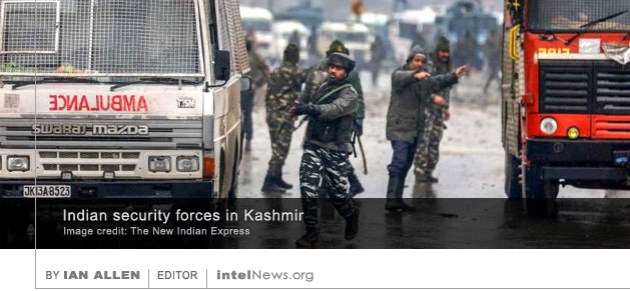
Meanwhile in an unrelated development Indian officials said on Sunday that Islamabad had alerted Delhi of a possible attack by al-Qaeda in a region of Indian-administered Kashmir. Media reports said that Indian officials had been warned by the ISI that al-Qaeda forces planned to carry out “a major terror strike” in the Pulwama region of southern Kashmir. Security observers noted the move as a rare instance of intelligence cooperation between the two rival nuclear-armed nations. As a result, India said it had deployed nearly 500 additional companies of police officers in the southern Kashmir region.
► Author: Ian Allen | Date: 17 June 2019 | Permalink
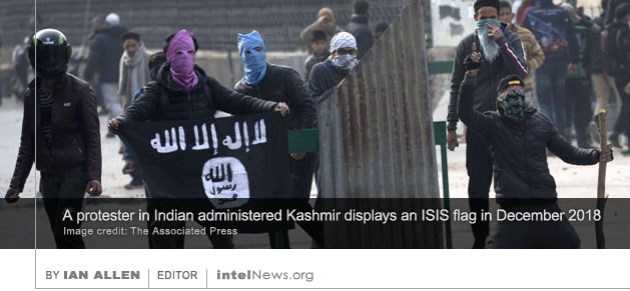 The group calling itself the Islamic State has announced the establishment of a new overseas province in India’s Jammu and Kashmir state. The announcement was made over the weekend by Amaq, which serves as the news agency of the Islamic State. According to the news release, the Islamic State (known also as the Islamic State of Iraq and Syria) has named the new province “wilayah al-Hind” (province of Hind), and said it is based in the Muslim-majority Kashmir Valley, which is located in one of the three administrative divisions of the Indian administered state of Jammu and Kashmir.
 The government of Pakistan employed terrorist groups to attack India, according to Pakistan’s former president, Pervez Musharraf, who also accused India of doing the same. Musharraf, 75, took power in Pakistan in 1999 through a coup d’état supported by the country’s military leadership. The four-star Army general ruled as Pakistan’s 10th president until 2008, when he resigned from power to avoid being impeached. He currently lives in exile in the United Arab Emirates and is wanted in Pakistan for alleged crimes, including high treason. His critics accuse him of arresting several judges in 2007 and suspending the country’s constitution.
 The former director of Pakistan’s powerful intelligence agency has been stripped of his military pension and associated benefits for co-authoring a controversial book about intelligence with his Indian counterpart. Lieutenant General Asad Durrani (ret.) served as director-general of Pakistan’s Directorate for Military Intelligence between 1988 and 1989. From 1990 to 1992 he was director of the Inter-Services Intelligence Directorate, which is arguably Pakistan’s most powerful government institution. Durrani, 78, has been severely criticized in some Pakistani nationalist circles for co-authoring a book entitled The Spy Chronicles: RAW, ISI and the Illusion of Peace, with his Indian counterpart, A.S. Daulat. Daulat, 79, headed India’s Research and Analysis Wing from 1999 to 2000.
 A joint Indian-American counterintelligence operation, described as “unprecedented in its scale and scope”, reportedly foiled a major suicide attack by the Islamic State in New Delhi and helped achieve “a string of victories” against the group in Afghanistan and Pakistan.
  The international advocacy group Human Rights Watch has joined calls for information on the whereabouts of Sheikha Latifa, a member of the royal family of the United Arab Emirates, who some say was abducted in international waters by Emirati and Indian special forces. Princess Latifa, 32, is the daughter of Sheikh Mohammed bin Rashid Al Maktoum, ruler of the Emirate of Dubai and Prime Minister of the UAE. But she has fallen out with the royal family and has repeatedly issued public calls for democratic reforms and more rights for women. In 2002, when she was just 18, she attempted to leave the UAE but was forcibly repatriated by her father’s bodyguards. In recent years, Princess Latifa has continued to vocalize her opposition to her father’s rule, whom she has accused of deploying “death squads” to suppress dissent within the UAE royal family.
 Indian authorities have arrested an Indian Air Force officer for allegedly giving classified documents to two Pakistani spies on Facebook, who posed as women interested in him. The officer has been named as Arun Marwaha, a wing commander stationed at the Indian Air Force headquarters in Delhi. Marwaha, 51, is a para-jumping instructor who trains members of India’s Garud Commando Force —the Special Forces unit of the Indian Air Force. He was reportedly due to retire in 2019.
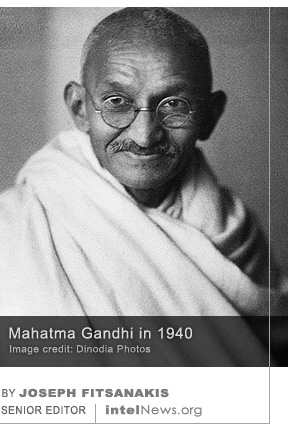 A researcher is seeking access to a potentially revealing classified telegram sent by a United States diplomat who witnessed the assassination of Indian leader Mahatma Gandhi in 1948. Gandhi, the leader of the Indian movement for independence, and a towering civil rights figure of the 20th century, was assassinated on January 30, 1948, as he was about to hold a prayer meeting in downtown New Delhi. His assassin, Nathuram Vinayak Godse, was a member of a Hindu nationalist paramilitary group, who blamed Gandhi for the bloody partition of India. He and a co-conspirator, Narayan Apte, were arrested for Gandhi’s murder and put to death in 1949.
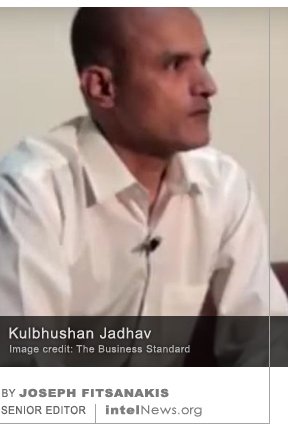 Analysts warn that South Asia may witness its worst crisis since the 2008 Mumbai attacks if Pakistan carries out its threat to execute an Indian former naval officer whom it accuses of espionage. Authorities in Islamabad say Kulbhushan Jadhav (pictured) worked for the Indian Navy until 2003, when he was recruited by India’s Research and Analysis Wing (RAW), a government intelligence agency that conducts operations abroad. The Pakistanis claim that Jadhav was arrested in southwest Pakistan in 2016, where he was engaged in funding and training secessionist militants from Pakistan’s Baluch minority. The Baluch are an Iranic people, most of whom live in a region known as Baluchistan, which is split between Iran and Pakistan. There are populous Baluch communities in the southern city of Karachi, one of Pakistan’s most populous ports. Some members of the Baluch community have secessionist aspirations and are accused of terrorism by Iranian and Pakistani authorities.
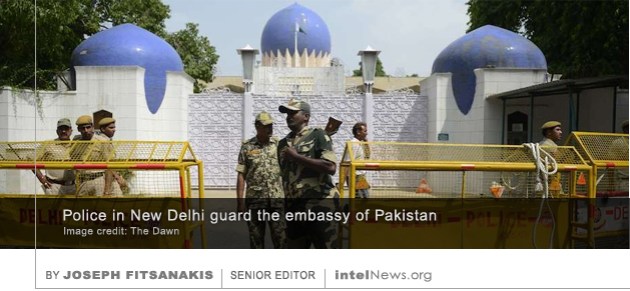 India is in the process of recalling eight of its diplomats from Pakistan, after their names and photographs were published in Pakistani newspapers with accusations that they are intelligence officers. According to anonymous sources in the government of Pakistan, three of the eight recalled diplomats have already left Islamabad for New Delhi. Five more are expected to leave the country before the end of the week. The three who left Pakistan yesterday were
  For the first time in history, India has refused to extend temporary residency visas for three senior Chinese media correspondents, effectively expelling them from the country, allegedly for espionage activities. All three reporters are employees of China’s state-run Xinhua news agency. They include Xinhua’s bureau chief in the Indian capital, New Delhi, Wu Xiang, and the agency’s Mumbai bureau chief, Lu Tang. A third journalist, She Yonggang, also based in Mumbai, has been asked to leave India by no later than July 31.
 Fifty years after the 1965 Indo-Pakistani War, Pakistani former soldiers have spoken for the first time about their role in a secret effort by Pakistan to infiltrate India and incite a Muslim uprising. The conflict between India and Pakistan over Jammu and Kashmir is largely rooted in Britain’s decision to partition its former colonial possession into mainly Hindu India and Pakistan, a mostly Muslim state. As soon as the British withdrew in 1947, the two states fought a bloody war that culminated in a violent exchange of populations and led to the partition of Kashmir. Today India controls much of the region, which, unlike the rest of the country, is overwhelmingly Muslim. Indian rule survived an uprising by some of the local population in August 1965, which led to yet another war between the two countries, known as the 1965 Indo-Pakistani War.







 intelNews.org
Indian officials admit for first time Islamic State militants are present in Kashmir
June 19, 2019 by Ian Allen Leave a comment
The four young men have been named as Haris Mushtaq Khan, Tahir Ahmad Khan, Asif Suhail Nadaf and Asif Majid. They were apprehended in Srinagar, Jammu and Kashmir’s largest city, following the arrest in September of 2018 of two other men who were allegedly affiliated with a group calling itself the Islamic State in Jammu and Kashmir (ISJK). The group has since renamed itself to Islamic State – Khorasan Province, while recently it proclaimed an overseas province in the region, which it calls “wilayah al-Hind” (province of Hind). Three of the four men have been charged with attacking a tourist visitor center in the area with hand grenades. In their official indictment against the four men, officers of India’s National Investigation Agency accuse them of being “confirmed terrorists of the Islamic State”, which amounts to the first confirmation in Indian government documents of the presence of Islamic State militants in India. The 28-page indictment states that the four men were among several locals who “acted as ground workers and […] provided logistics to the ISJK cadres”.
Additionally, two of the men, Haris and Tahir, are accused of having been in contact online with a man identified as Abu Huzefa, an Islamic State recruiter based in Afghanistan. According to the court documents Huzefa is a Pakistani national and “an active cadre of the Islamic State based in Afghanistan”. He was allegedly in regular contact with the two Indian men and provided them with Islamic State literature and other propaganda material. In their indictment the NIA officers also admit that the arrests of the four men point to “a larger conspiracy of these terrorist elements propagating pan-Islamic ideology of IS by recruiting and radicalizing Kashmiri youth towards jihad and targeting security forces”.
► Author: Ian Allen | Date: 20 June 2019 | Permalink
Filed under Expert news and commentary on intelligence, espionage, spies and spying Tagged with counterterrorism, India, Islamic State, Kashmir (India), News