Iran warns of repercussions as US intensifies campaign against Tehran
July 23, 2018 1 Comment
 Iranian military officials have warned of extracting “revenge from foreign intelligence services”, as Reuters reported that an aggressive campaign against Tehran has been launched by Washington. On Sunday, the Reuters news agency said that senior officials in the administration of US President Donald Trump had launched a concerted offensive “meant to foment unrest” in the Islamic Republic. Citing information from “more than half a dozen current and former officials”, Reuters said that the US offensive is directly supported by President Trump’s Secretary of State Mike Pompeo and his National Security Adviser John Bolton. Both officials are known for their aggressive stance against the Iranian government.
The campaign, said Reuters, is meant to “work in concert” with President Trump’s push to “economically throttle Iran”. The US leader announced a series of economic sanctions on the Islamic Republic and has intensified his critical statements against Tehran after May of this year, when Washington pulled out of the Iran nuclear agreement. Known as the Joint Comprehensive Plan of Action (JCPOA), the international agreement was reached in 2015 between Iran and a group of nations known as the P5+1, namely the five permanent members of the United Nations Security Council plus Germany. As part of the deal, Iran agreed to halt its nuclear weapons program in exchange for an end to economic sanctions by the West. But President Trump abandoned the agreement, saying it was a form of appeasing Tehran.
According to Reuters, Washington’s campaign involves the spreading of information that “paints Iranian leaders in a harsh light” and in some cases makes claims about Tehran that are “exaggerated”. For example, said Reuters, some social media posts by the US Department of State’s Farsi-language news service claim that Iran is close to al-Qaeda, despite the fact that Shiite Islam, which is Iran’s state religion, is viewed as a heresy by Sunni members of al-Qaeda. Other –perhaps more believable– accusations include claims that the leaders of Iran are wasting funds released by the JCPOA instead of using it for their people’s welfare, and that Tehran funds the Taliban in Afghanistan.
Meanwhile, a spokesman for the Islamic Revolutionary Guard Corps (IRGC), arguably the most powerful branch of the Iranian Armed Forces, issued a warning on Sunday against “foreign intelligence services”. The spokesman, Brigadier General Ramezan Sharif, said Iran would take revenge on foreign spy services “who try to disrupt the security of Iran’s borders”. He was referring to an armed attack that took place on Saturday in Iran’s northwestern Marivan region, near the Iran-Iraq border. The attack concentrated on an Iranian military compound in the village of Dari and culminated with the bombing of an IRGC arms depot. According to Iranian media reports, the explosion killed 11 Iranian border guards. Reuters said it contacted the White House and the Department of State about the alleged campaign against Iran, but that both declined to comment.
► Author: Joseph Fitsanakis | Date: 23 July 2018 | Permalink
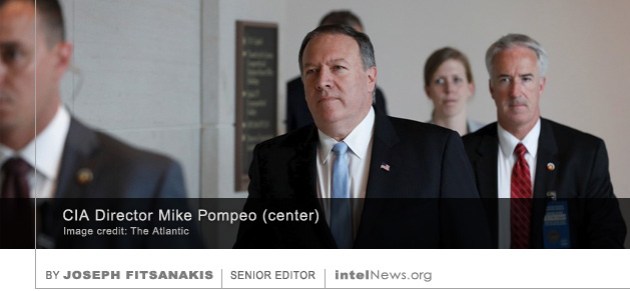 The outgoing director of the Central Intelligence Agency, Mike Pompeo, appeared on Thursday to confirm reports from last February that United States troops killed more than 200 Russian soldiers in Syria.
  The Central Intelligence Agency has reportedly established back channels for negotiation between the United States and North Korea, which the Department of State is now using to communicate with Pyongyang. Rex Tillerson, who was summarily fired as US Secretary of State by President Donald Trump last week, was famously in favor of diplomatic negotiations between the US and North Korea. The White House had resisted and even publicly criticized Tillerson’s views. Ironically, Tillerson was fired just as his pro-diplomacy views on North Korea are being adopted by the White House.
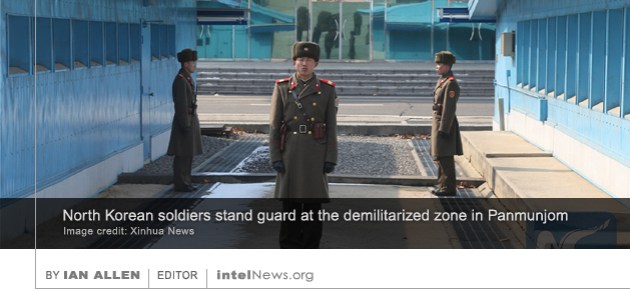 The director of the United States Central Intelligence Agency made an unannounced visit to South Korea over the weekend, to discuss the rising tensions in the Korean Peninsula with his South Korean counterpart and other senior officials. A spokesperson from the US embassy in Seoul made an official






 intelNews.org
US threatens to end intelligence sharing if Australian state joins Chinese venture
May 25, 2020 by Joseph Fitsanakis 1 Comment
The initial goal of the venture was to encourage economic cooperation between China and countries of the Eurasian region. Eventually, the project’s scope expanded to include agreements with countries in Asia, Africa and Europe, mostly through the Chinese-led construction of telecommunications and transportation networks, which trace the trading routes of the Silk Road of ancient times.
Although Australia is not a participant in the Belt and Road Initiative, the Australian state of Victoria announced its decision to join the project in late 2019. The decision has been criticized by senior Australian federal officials, including Prime Minister Scott Morrison and Home Affairs Minister Peter Dutton. These officials argue that any interference by China in the Australian national telecommunications network could compromise the national security of the country as a whole.
On Sunday, the US Secretary of State Mike Pompeo warned Australia that Washington would look “incredibly closely” at aspects of the Belt and Road Initiative affecting telecommunications. Pompeo, who was Director of the Central Intelligence Agency before his current post, told Sky News that some aspects of the project were designed to “build up the capacity of the Chinese Communist Party to do harm” around the world.
In his interview, Pompeo referred to the so-called “Five Eyes” alliance (also known as “UKUSA”), which is a longstanding intelligence-sharing agreement between the United States, Britain, Canada, Australia and New Zealand. He added that the US government was concerned that the Victoria state government’s decision to participate in the Chinese venture project could “have an adverse impact on our ability to protect telecommunications from our private citizens, or security networks for our defense and intelligence communities”.
If that were to happen, said Pompeo, then the US would “not take any risks to our telecommunications infrastructure, [or] any risk to the national security elements of what we need to do with our Five Eyes partners”. In the US government determined that these risks were real, “we simply disconnect, we will simply separate”, Pompeo concluded.
► Author: Joseph Fitsanakis | Date: 25 May 2020 | Permalink
Filed under Expert news and commentary on intelligence, espionage, spies and spying Tagged with AUSCANZUKUS, Australia, Belt and Road Initiative, China, intelligence cooperation, Mike Pompeo, News, UKUSA