October 26, 2017
by Joseph Fitsanakis
 In a surprise move, the president of Mozambique has fired the head of the military and the director of the country’s intelligence service, two weeks after attacks by an unidentified group left 16 people dead in a northern town. The attacks occurred on October 5 and 6 in Mocimboa da Praia, a small town of about 30,000 people located along Mozambique’s extreme northern coastline. The town lies only a few miles south of Mozambique’s border with Tanzania and within sight of several offshore gas fields in the Indian Ocean. According to local reports, several dozen assailants targeted police stations in Mocimboa da Praia with firearms and explosives, killing two police officers. An estimated 14 assailants also died in the coordinated attacks, while at least 12 more were wounded. Police forces were able to reclaim control of the town only after the eventual arrival of reinforcements from the tourist resort of Pemba, located 350 miles to the south of Mocimboa da Praia.
Two weeks after the attacks, however, the ideological backgrounds and motives of the assailants remain unclear. Mozambique has seen armed attacks by guerrillas before, but these are usually attributed to Renamo, a rightwing paramilitary group that was financially supported by Rhodesia and apartheid-era South Africa during the Cold War. The group is still in existence, but has mostly transformed itself into a political party. Its military wing declared a unilateral ceasefire in December of last year, which has been broadly observed. Importantly, the government did not attribute the Mocimboa da Praia attacks to Renamo. But if Renamo was not behind the attacks, then who was it? Local reports have mentioned a so-called “radical Islamist sect”; but Mozambique is a predominantly Christian country and does not have a history of Islamic radicalism. Nor is there known activity in Mozambique of African Islamist groups like Boko Haram or Al-Shabaab, which are strong in western and eastern Africa respectively.
In the days following the attacks in Mocimboa da Praia, police detained 52 people, including Muslim religious leaders, and confiscated half a dozen firearms, as well as hundreds of rounds of ammunition. But by the middle of last week, police officials began to dismiss earlier claims that the attackers were linked to an organized terrorist group. Some southeastern Africa watchers have suggested that the assailants were members of Swalissuna, a locally based militant opposition group that rejects the authority of the central government in capital Maputo, located in Mozambique’s south. The group is virtually unknown and is believed to have been founded in 2011 or 2012. It has no religious affiliation and its members are motivated by domestic grievances related to economic restructuring, corruption and political reform.
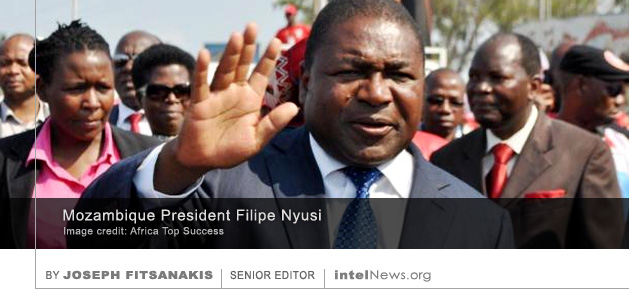
On Tuesday, Mozambique President Filipe Nyusi announced the surprise replacement of the country’s two most powerful security officials. Lagos Lidimo, director general of the State Information and Security Service (SISE), which reports directly to the President, was dismissed overnight and replaced by Julio Jane, who until Monday was the commander of the Mozambican National Police. Also replaced was Graça Chongo, head of the country’s armed forces. His replacement has not yet been named.
► Author: Joseph Fitsanakis | Date: 26 October 2017 | Permalink
 • South African intelligence concerned about spread of insurgency in Mozambique. This is the first public expression of concern from the South African government that the violence in neighboring Mozambique could spread. Previously, the South African Parliament was informed the matter was only to be discussed behind closed doors. Earlier in June, the South African military reportedly participated in Operation COPPER, in support of the Mozambican Defense Force.






 intelNews.org
US designates two African armed groups as foreign terrorist organizations
March 16, 2021 by Ian Allen Leave a comment
THE UNITED STATES DEPARTMENT of state has designated two armed groups, based in Mozambique and the Democratic Republic of the Congo, as foreign terrorist organizations. In a statement released last week, the US Department of State identified the groups as Mozambique’s Ahlu Sunnah Wa-Jama and Congo’s Allied Democratic Forces (ADF). In its statement, the US Department of State also said that the two groups have declared allegiance to the Islamic State of Iraq and Syria (ISIS).
Established in Uganda in 1996, the ADF has had a presence in the eastern regions of Congo for over two decades. The ADF insurgency is rooted in regional ethnic rivalries. However, the group’s rhetoric became increasingly Islamist-centered in the 2000s. In 2013, following an intense recruitment campaign in Uganda, the ADF launched a series of attacks in northeastern Congo. It is currently involved in an insurgency against the Congolese military, which launched a major offensive against the group in 2019. Mozambique Ahlu Sunnah Wa-Jama, known locally as Al-Shabab (no relation to the Somali group by the same name), first appeared in 2017. Two years later, its leader, Abu Yasir Hassan, declared the group’s allegiance to ISIS and proclaimed that its goal was to establish an Islamic emirate in Mozambique.
US officials regularly refer to the two groups as “ISIS-DRC” and “ISIS-Mozambique”. In the spring of 2019, ISIS declared that the two groups were the armed wings of the so-called Islamic State Central Africa Province (ISCAP). The militant group added that the mission of ISCAP was to build a caliphate in central, eastern, and eventually southern Africa. In addition to designating ISIS-DRC and ISIS-Mozambique as foreign terrorist organizations, the US Department of State named their leaders, Seka Musa Baluku and Abu Yasir Hassan, as “specially designated global terrorists”.
► Author: Ian Allen | Date: 16 March 2021 | Permalink
Filed under Expert news and commentary on intelligence, espionage, spies and spying Tagged with Africa, Ahlu Sunnah Wa-Jama, Allied Democratic Forces, Democratic Republic of the Congo, Islamic State, Mozambique, terrorism, United States