Book alleges 1980s British Labour Party leader was Soviet agent
September 21, 2018 1 Comment
 The leadership of the Labour Party in Britain has reacted with disdain after a new book by a leading author and columnist claimed that Michael Foot, who led the Party in the early 1980s was paid agent of the Soviet KGB. Foot, a staunch and vocal representative of the postwar British left, was a member of parliament for over 40 years, eventually serving as leader of the House of Commons. He rose to the post of deputy leader of the Labour Party and in 1980 succeeded Jim Callahan as head of the Party. But he stepped down in 1983 in the aftermath of Labour’s largest electoral defeat in over half a century.
Two years later, in 1985, Oleg Gordievsky, a colonel in the Soviet KGB, defected to Britain and disclosed that he had been a double spy for the British from 1974 until his defection. In 1995, Gordievsky chronicled his years as a KGB officer and his espionage for Britain in a memoir, entitled Next Stop Execution. The book was abridged and serialized in the London-based Times newspaper. In it, Gordievsky claimed that Foot had been a Soviet “agent of influence” and was codenamed “Agent BOOT” by the KGB. Foot proceeded to sue The Times for libel, after the paper published a leading article headlined “KGB: Michael Foot was our agent”. The Labour Party politician won the lawsuit and was awarded financial restitution from the paper.
This past week, however, the allegations about Foot’s connections with Soviet intelligence resurfaced with the publication of The Spy and the Traitor, a new book chronicling the life and exploits of Gordievsky. In the book, Times columnist and author Ben Macintyre alleges that Gordievsky’s 1995 allegations about Foot were accurate and that Gordievsky passed them on to British intelligence before openly defecting to Britain. According to Macintyre, Gordievsky briefed Baron Armstrong of Ilminster, a senior civil servant and cabinet secretary to British Prime Minister Margaret Thatcher. Lord Armstrong, a well-connected veteran of British politics, in turn communicated the information to the Secret Intelligence Service (MI6) in the summer of 1982, says Macintyre. The Times columnist alleges that MI6 received specific information from Lord Armstrong, according to which Foot had been in contact with the KGB for years and that he had been paid the equivalent of £37,000 ($49,000) in today’s money for his services. The spy agency eventually determined that Foot may not himself have been conscious that the Soviets were using him as an agent of influence. But MI6 officials viewed Gordievsky’s allegations significant enough to justify a warning given to Queen Elizabeth II, in case the Labour Party won the 1983 general election and Foot became Britain’s prime minister.
The latest allegations prompted a barrage of strong condemnations from current and former officials of the Labour Party. Its current leader, Jeremy Corbyn, who like Foot also comes from the left of the Party, denounced Macintyre for “smearing a dead man, who successfully defended himself [against the same allegations] when he was alive”. Labour’s deputy leader, John McDonnell, criticized The Times for “debasing [the] standards of journalism in this country. They used to be called the gutter press. Now they inhabit the sewers”, he said. Neil Kinnock, who succeeded Foot in the leadership of the Labour Party in 1983, said Macintyre’s allegations were “filthy” and described Foot as a “passionate and continual critic of the Soviet Union”.
► Author: Joseph Fitsanakis | Date: 21 September 2018 | Permalink
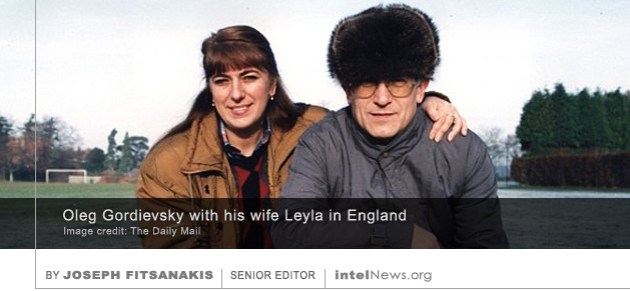 A Soviet double spy, who secretly defected to Britain 30 years ago this month, has revealed for the first time the details of his exfiltration by British intelligence in 1985. Oleg Gordievsky was one of the highest Soviet intelligence defectors to the West in the closing stages of the Cold War. He joined the Soviet KGB in 1963, eventually reaching the rank of colonel. But in the 1960s, while serving in the Soviet embassy in Copenhagen, Denmark, Gordievsky began feeling disillusioned about the Soviet system. His doubts were reinforced by the Soviet invasion of Czechoslovakia in 1968. It was soon afterwards that he made the decision to contact British intelligence.







 intelNews.org
Death of Soviet defector Gordievsky not seen as suspicious, British police say
March 24, 2025 by Joseph Fitsanakis 8 Comments
By 1974, Gordievsky had established contact with Danish and British intelligence and was regularly providing information to Britain’s Secret Intelligence Service (MI6). After 1982, when Gordievsky was posted to the Soviet embassy in London, MI6 deliberately subverted his superiors at the embassy by expelling them. This effectively enabled Gordievsky to take their place and rise to the position of resident-designate of the KGB station in London.
Intelligence historians credit Gordievsky’s intelligence with having shaped the strategic thinking of British and American decision-makers in relation to the Soviet Union. Crucially, Gordievsky’s warnings to MI6 that the Kremlin was genuinely concerned about a possible nuclear attack by the West prompted British and American leaders to temper their public rhetoric against the Soviet Union in the mid-1980s. Some even credit Gordievsky with having helped the West avoid a nuclear confrontation with the Soviet Union.
In 1985, while undergoing interrogation by the Soviet authorities, Gordievsky was smuggled out of Russia by British intelligence, hidden inside a car that made its way to Finnish territory. He was subsequently sentenced in absentia to death for treason against the Soviet Union. In 1991, following an agreement between British and Soviet authorities, Gordievsky’s wife and daughters were allowed to join him in England.
According to Surrey Police, officers were called to a residential address in the city of Godalming on Tuesday March 4, where they found 86-year-old Gordievsky’s body, surrounded by members of his family. Godalming is a small market town in southeastern England, located around 30 miles from London. Surrey Police noted in a statement that the investigation into Gordievsky’s death was led by counterterrorism officers. However, his death was “not being treated as suspicious”.
Gordievsky spent nearly 40 hours in a coma in 2007, from which he eventually recovered. He subsequently claimed that he had been poisoned after taking sleeping pills tainted with a lethal toxin, which had been supplied to him by a man he referred to as a “business associate” with a Russian background.
► Author: Joseph Fitsanakis | Date: 24 March 2025 | Permalink
Filed under Expert news and commentary on intelligence, espionage, spies and spying Tagged with Cold War, defectors, KGB, MI6, Oleg Gordievsky, UK