NSA places its Trump-appointed lawyer on administrative leave, pending probe
January 22, 2021 Leave a comment
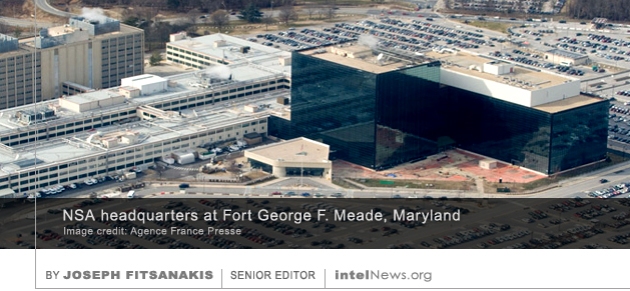 AMERICA’S LARGEST SPY AGENCY, the National Security Agency, has reportedly placed on administrative leave its general counsel, who was installed on orders by the White House just hours before the end of Donald Trump’s presidency. Michael Ellis worked as an aide to Representative Devin Nunes (R-Ca) until 2017, when he joined the White House as the senior associate counsel to President Trump and deputy legal advisor to the National Security Council (NSC). In 2020 he was promoted to NSC’s senior director for intelligence.
Last November, days after losing the presidential election, Trump attempted to appoint Ellis as NSA general counsel —effectively the chief legal officer at the spy agency. There was speculation that Trump’s move was part of an effort to declassify documents that he believed would harm the reputation of his domestic political enemies. But the NSA resisted the move, with its director, General Paul Nakasone, allegedly dismissing it as “an attempt to burrow a political appointee [who is] not qualified for the post into a career civil service position”. The Trump administration persisted, however, and last week the then-acting Secretary of Defense Christopher Miller ordered General Nakasone to appoint Ellis, as instructed, effective by 6:00 pm on January 16. The NSA continued to stall the move, but it eventually appointed Ellis as its general counsel at 6pm on January 19.
Now, however, it appears that Ellis has been placed on administrative leave, pending an investigation into his NSA appointment, which has been launched by the Department of Defense’s Office of the Inspector General. According to The Washington Post, the investigation concerns “the circumstances of [Ellis’] selection” to serve as NSA’s general counsel. CBS News cites “a source familiar” with the case, who claims that Ellis is also facing allegations that he may have mishandled classified documents.
The NSA said it would not “comment on personnel matters”. The Department of Defense’s Office of the Inspector General said it would not confirm nor deny that Ellis was under investigation.
► Author: Joseph Fitsanakis | Date: 22 January 2021 | Permalink
 The director of America’s largest spy agency claims in a signed affidavit that a forthcoming book by John Bolton, President Donald Trump’s former national security adviser, would critically compromise intelligence secrets if published. Bolton served in that capacity from April 2018 until September 2019. His memoir of his time as President Trump’s national security advisor, titled






 intelNews.org
NSA, CIA senior officials address artificial intelligence threats and opportunities
October 2, 2023 by Joseph Fitsanakis Leave a comment
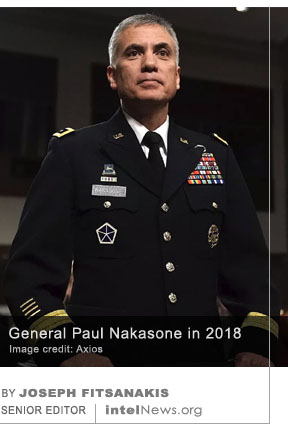
Nakasone (pictured) noted in his remarks that the US Intelligence Community, as well as the Department of Defense, have been using artificial intelligence for quite some time. Thus, artificial intelligence systems are already integral in managing and analyzing information on a daily basis. In doing so, such systems contribute in important ways to the decision-making by the NSA’s human personnel. At the same time, the NSA has been using artificial intelligence to develop and define best-practices guidelines and principles for intelligence methodologies and evaluation.
Currently, the United States maintains a clear advantage in artificial intelligence over is adversaries, Nakasone said. However, that advantage “should not be taken for granted”. As artificial intelligence organizational principles are increasingly integrated into the day-to-day functions of the intelligence and security enterprise, new risks are emerging by that very use. For this reason, the NSA has launched its new Artificial Intelligence Security Center within its existing Cybersecurity Collaboration Center. The mission of the Cybersecurity Collaboration Center is to develop links with the private sector in the US and its partner nations to “secure emerging technologies” and “harden the US Defense Industrial Base”.
Nakasone added that the decision to create the Artificial Intelligence Security Center resulted from an NSA study, which alerted officials to the national security challenges stemming from adversarial attacks against the artificial intelligence models that are currently in use. These attacks, focusing on sabotage or theft of critical artificial intelligence technologies, could originate from other generative artificial intelligence technologies that are under the command of adversarial actors.
Last Wednesday, the CIA’s Raman discussed some of the ways that artificial intelligence is currently being put to use by her agency to improve its analytical and operational capabilities. Raman noted that the CIA is developing an artificial intelligence chatbot, which is meant to help its analysts refine their research and analytical writing capabilities. Additionally, artificial intelligence systems are being used to analyze quantities of collected data that are too large for human analysts to manage. By devoting artificial intelligence resources to the relatively menial and low-level tasks of data-sifting and sorting, the CIA enables its analysts to dedicate more time to strategic-level products.
At the same time, however, the CIA is concerned about the rapid development of artificial intelligence by nations such as China and Russia, Raman said. New capabilities in artificial intelligence, especially the generative kind, will inevitably provide US adversaries with tools and capabilities that will challenge American national security in the coming years, she concluded.
► Author: Joseph Fitsanakis | Date: 02 October 2023 | Permalink
Filed under Expert news and commentary on intelligence, espionage, spies and spying Tagged with artificial intelligence, CIA, Lakshmi Raman, News, NSA, NSA Artificial Intelligence Security Center, NSA Cybersecurity Collaboration Center, Paul Nakasone, United States