Tension in Iraq as government arrests members of powerful Shi’a militias
June 29, 2020 1 Comment
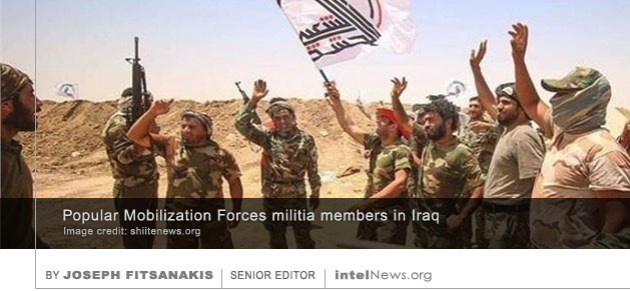 There was growing tension in Iraq over the weekend, as the government in Baghdad announced it had arrested over a dozen members of a powerful Shi’a militia backed by Iran. The arrests marked the first time that the Shi’a dominated Iraqi government moved to curtail the growing power of these heavily armed groups, which some say are threatening the cohesion of the country’s fragile state institutions.
Most of Iraq’s paramilitary groups are members of the Popular Mobilization Forces (PMF), a collection of around 40 different Shiite militias consisting of over 150,000 armed fighters, who helped the Iraqi government defeat the Islamic State in 2017. The militias began to form in the summer of 2014, after Sayyid Ali al-Husseini al-Sistani, the spiritual leader of the Iraqi Shiite community, issued a fatwa (religious degree) that called or the destruction of the Islamic State. The Iranian-supported PMF proved instrumental in the territorial defeat of ISIS. However, the group’s leadership is ideologically aligned with Iran, and many of its members have called for the end of American military and diplomatic presence in Iraq.
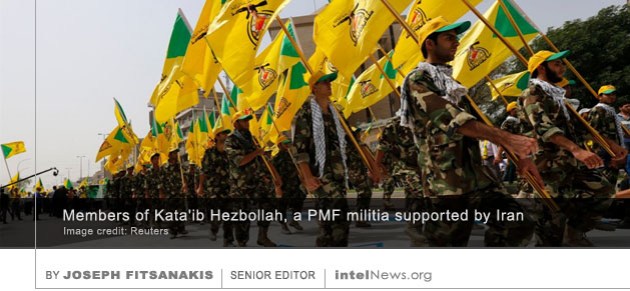
In January of this year, many of these groups declared war on the United States, after Washington launched a drone strike that killed the Iranian general Qassem Soleimani and Abu Mahdi al-Muhandis, the leader of the Kita’ib Hezbollah (KH). KH is one of the most powerful Shia militias in Iraq, and controls much territory around the country. In a surprise move on Thursday, Iraqi counterterrorism forces announced they had arrested 14 members of KH, after receiving an intelligence tip. According to the government, the KH members were planning to launch large-scale attacks on Baghdad’s Green Zone, a heavily fortified area of the Iraqi capital that houses the headquarters of most ministries, as well as several embassies.
The arrests were reportedly ordered by Iraq’s new Prime Minister, Mustafa al-Kadhimi, former director of Iraq’s National Intelligence Service, who assumed his new duties on May 7. His appointment ended a prolonged political impasse, as the country had struggled to replace the government of his predecessor, Adil Abdul-Mahdi, who resigned in 2019 following a wave of popular protests. Al-Kadhimi is known to have good relations with Washington, while also being in good standing with Tehran. However, he vouched last month that he would “crush” the paramilitaries, who he views as enemies of Iraqi democracy.
In response to al-Kadhimi’s pronouncements, Shi’a militias have been launching constant small-rocket attacks targeting the Green Zone in recent weeks. Observers warned on Saturday that arrests of KH members have never been known to take place before, so this may be the opening shots of an open war between al-Kadhimi and Iraq’s Shi’a paramilitaries.
► Author: Joseph Fitsanakis | Date: 29 June 2020 | Permalink
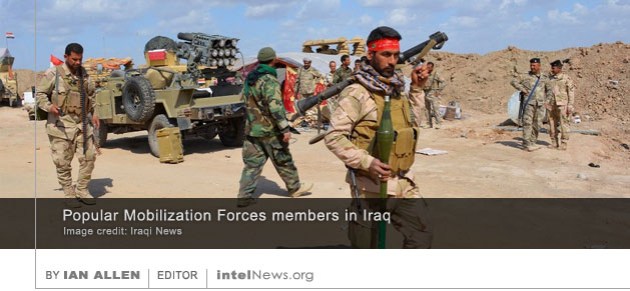 Iraq’s largest Shia militia, which controls parts of Iraq’s territory that were aptured from the Islamic State, has accused the United States and Israel for a series of mystery explosions at its arms depots around the country. Much of the territory captured from the Islamic State (known also as the Islamic State of Iraq and Syria, or ISIS) in northern Iraq is currently controlled by the Popular Mobilization Forces (PMF), a collection of around 40 Shia militias consisting of over 150,000 armed fighters. The Iranian-supported PMF proved instrumental in the territorial defeat of ISIS. However, the group’s leadership is ideologically aligned with Iran, and many of its members will
 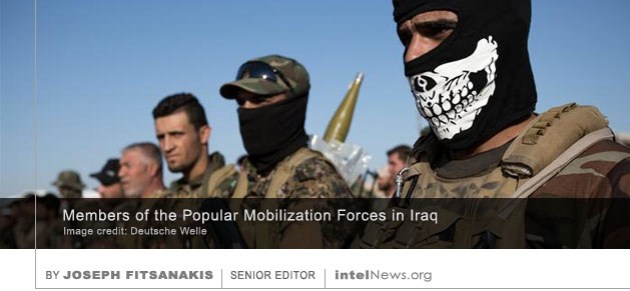 A powerful alliance of about 50 Shiite militias, who helped Iraq defeat the Islamic State, is resisting calls by the Iraqi government to surrender its weapons and join civilian life, according to observers on the ground. Much of the territory captured from the Islamic State (known also as the Islamic State of Iraq and Syria, or ISIS) in northern Iraq is currently controlled by the Popular Mobilization Forces (PMF), a collection of around 40 different Shiite militias consisting of over 150,000 armed fighters. The militias began to form in the summer of 2014, after Sayyid Ali al-Husseini al-Sistani, the spiritual leader of the Iraqi Shiite community, issued a fatwa (religious degree) that called or the destruction of ISIS. The Iranian-supported PMF proved instrumental in the territorial defeat of ISIS. However, the group’s leadership is ideologically aligned with Iran, and many of its members will not cooperate with the Iraqi Armed Forces, because of the latter’s proximity to the United States.
 The Shiite militias that fought in the war against the Islamic State are now “engaged in mafia-like practices” in former Islamic State strongholds, enraging Iraqi Sunnis and sparking fears of another Islamist insurgency, according to a






 intelNews.org
Iraq’s leading expert on paramilitary groups assassinated in Baghdad
July 14, 2020 by Joseph Fitsanakis Leave a comment
Starting in 2018, al-Hashimi focused his research on the rise of the Popular Mobilization Forces, a collection of over 150,000 armed members of around 40 different Shi’a militias, who helped the Iraqi government defeat the Islamic State in 2017. The Iranian-supported PMF proved instrumental in reclaiming territory taken by ISIS. However, it has since refused to acknowledge the authority of the central government in Baghdad and retains its weaponry and power.
In recent years, Al-Hashimi emerged as a vocal critic of the PMF and made regular appearances on Iraqi television to discuss the group, its tactics and goals. He taught courses on counterterrorism and advised the Iraqi government, as well as several foreign diplomats and journalists. In recent months, al-Hashimi had reportedly told relatives and friends that he believed the Shi’a militias were “out to get him”, and expressed fears for his life. He had contemplated leaving Baghdad and moving to Kurdish-controlled northern Iraq.
According to news reports, al-Hashimi was shot dead by two gunmen on a motorcycle, as he was leaving his home in north Baghdad. According to eye-witnesses, the gunmen shot al-Hashimi five times before leaving the scene of the crime. The terrorism expert was taken to a nearby hospital, where he was pronounced dead two hours later.
In a statement, Iraq’s newly installed Prime Minister, Mustafa al-Kadhimi, said his administration wound be launching a nationwide manhunt to find al-Hashimi’s killers. However, Monday’s assassination is widely seen as yet another sign that the Iraqi government is unable to control the PMF, and especially its most powerful wing, the Kita’ib Hezbollah (KH). Many were surprised late last month, when Iraqi counterterrorism forces moved to arrest 14 KH members for the first time since the group’s founding. However, all but one of those arrested were released in less than a week, with many accusing al-Kadhimi’s government of backing down out of fear or suffering repercussions by the militias.
► Author: Joseph Fitsanakis | Date: 14 July 2020 | Permalink
Filed under Expert news and commentary on intelligence, espionage, spies and spying Tagged with assassinations, Hisham al-Hashimi, Iraq, News, Popular Mobilization Forces