Russian spy agency reveals identities of undercover officers in rare move
January 29, 2020 5 Comments
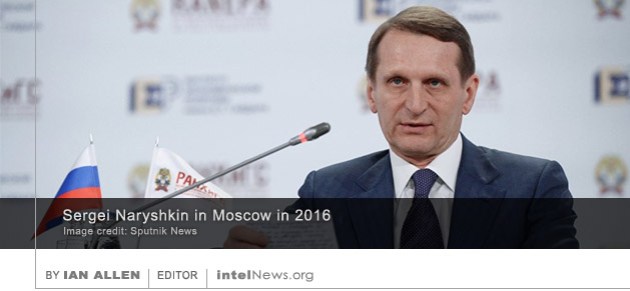 In an extremely rare move, the head of Russia’s spy agency has disclosed the identities of several undercover officers during an event marking the centenary of the KGB and its modern-day successor, the Russian Foreign Intelligence Service, or SVR.
The identities of the officers —most of whom are now retired or dead— were disclosed on Tuesday by Sergei Naryshkin, head of the SVR. Speaking at a press conference in Moscow, Naryshkin revealed the names and read the brief biographical notes of seven non-official-cover officers, referred to in Russian as “pазведчики-нелегалы”, or ‘illegals’. The term refers to undercover intelligence officers who are secretly posted abroad without diplomatic cover. Accordingly, they have no official connection to a Russian diplomatic facility, while some even pose as citizens of third countries.
Since 1922, illegals have operated out of the KGB’s and (after 1991) the SVR’s “S” Directorate, whose formal title is First Main Directorate or First Chief Directorate. It is customary to keep the identities of illegals secret following their retirement and even after death. However, in December of last year Naryshkin surprised many by announcing that he would soon disclose the identities of a number of former members of what he described as the “special reserve staff”, at an event to mark the centenary of the KGB and SVR.
He did so on Tuesday, when he disclosed the names of seven individuals and described their work in broad terms. The names disclosed by Naryshkin were: Yury Anatolievich Shevchenko (born 1939), Yevgeny Ivanovich Kim (1932-1998), Mikhail Anatolyevich Vasenkov (born 1942), Vitaly Viacheslavovich Netyksa (1946-2011) and his spouse Tamara Ivanovna Netyksa (born 1949), Vladimir Iosifovich Lokhov (1924-2002) and Vitaly Alekseyevich Nuykin (1939-1998).
The accompanying biographies released by the SVR disclose no specifics about the countries in which these illegals operated, the type of work they carried out, and the specific dates in which they were active. Most of them operated between the late 1960s and the early 1990s.
► Author: Ian Allen | Date: 29 January 2020 | Permalink
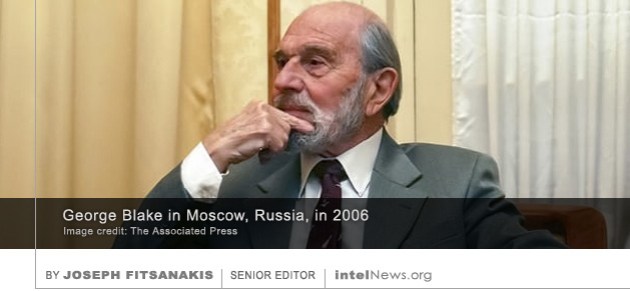 One of the Cold War’s most recognizable spy figures, George Blake, who escaped to the Soviet Union after betraying British intelligence, issued a rare statement last week, praising the successor agency to Soviet-era KGB. Blake was born George Behar in Rotterdam, Holland, to a Dutch mother and a British father. Having fought with the Dutch resistance against the Nazis, he escaped to Britain, where he joined the Secret Intelligence Service, known as MI6, in 1944. He was serving in a British diplomatic post in Korea in 1950, when he was captured by advancing North Korean troops and spent time in a prisoner of war camp. He was eventually freed, but, unbeknownst to MI6, had become a communist and come in contact with the Soviet KGB while in captivity. Blake remained in the service of the KGB as a defector-in-place until 1961, when he was arrested and tried for espionage.






 intelNews.org
News you may have missed #908
June 27, 2020 by Ian Allen 2 Comments
• India and Pakistan embassies to cut staff by half over spy row. India is expelling close to half of the staff at Pakistan’s embassy in New Delhi over espionage claims. Islamabad has reciprocated with the same orders for the Indian High Commission. Notably, both commissions do not have a permanent ambassador in place. Tensions have remained high since India scrapped Kashmir’s semi-autonomous status last year.
• Israel moves to redeploy spy agency to track surging virus cases. Israel’s parliament gave initial approval Wednesday to a controversial bill enabling the government to use its domestic security agency to track cases of coronavirus, which are rising again. Cabinet mandated Shin Bet to use cell phone surveillance as an emergency measure to combat the virus in mid-March as mounting numbers of Israelis tested positive for the novel coronavirus. The specifics were kept secret, but security officials said the agency had tracked virus carriers’ movements through their phones. The measure was discontinued on June 10 as infection rates dropped. But following two weeks that have seen growing numbers of Israelis infected with the virus, Prime Minister Benjamin Netanyahu decided to table the bill.
Filed under Expert news and commentary on intelligence, espionage, spies and spying Tagged with 0 India and Pakistan embassies to cut staff by half over spy row, 0 Israel moves to redeploy spy agency to track surging virus cases, 0 Russian spy chief in rare interview with the BBC, Coronavirus, COVID-19, diplomatic expulsions, India, Israel, news you may have missed, Pakistan, Sergei Naryshkin, SVR (Russia)