Pristine Cold War-era wiretapping rooms uncovered in Slovenian hotel
April 13, 2017 3 Comments
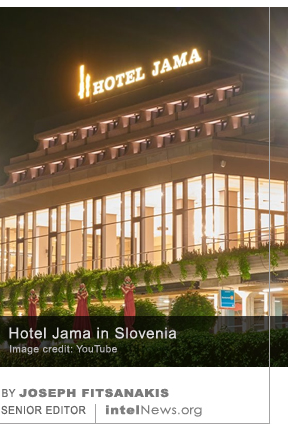 Four hidden communications-surveillance compartments which are believed to date back to the Cold War, have been found in one of the most prestigious hotels of the former Yugoslavia. The discovery was made during an extensive renovation project that was recently completed in the Hotel Jama. The hotel is located in the southeastern Slovenian city of Postojnska, near the Italian border. For over a century, Postojnska has been famous for its network of limestone caves, which are among the largest in the world. Eager to cater to Italian, Austrian and other Western tourists, the government of Yugoslavia began construction on Hotel Jama in 1969. The hotel opened its doors in 1971, amidst much publicity and fanfare. It eventually became known as one of the most luxurious hotels in the communist world.
As the hotel’s reputation soared, the government of Yugoslavia began hosting foreign dignitaries there. Though socialist, the government of Yugoslavia never became an integral member of the communist bloc, preferring a policy of nonalignment. Because of that, it was courted by both East and West, with many Western leaders and other officials visiting the country regularly. On many occasions, they would use Hotel Jama as a retreat. Numerous world leaders stayed there with their entourage, escorted by Yugoslavia’s longtime communist leader Josip Broz, known commonly as Tito.
Today the hotel is situated on the territory of Slovenia, a small mountainous state of two million people, which declared its independence from Yugoslavia in 1991. The regional instability caused by the Yugoslav Wars of the 1990s nearly demolished Slovenia’s tourism industry, and Hotel Jama was forced to declare bankruptcy. In 2010, under new ownership, the hotel underwent major renovations. These were completed in 2016, when the hotel opened its doors to the public once again. It was during these renovations that construction crews discovered the surveillance rooms. The four compartmented rooms were found behind a large door made of steel at the back of the hotel, and are adjacent to a network of limestone caves, for which the area is famous.
News reports said the four rooms feature 1970s-era wiretapping equipment, most of which appears to be in pristine condition. There is a thick layer of dust over all the surfaces, which indicates that the rooms have not been used in several decades. The construction crews also found sets of cables that run from the surveillance compartments to several guest rooms in the hotel’s original wing that dates to the early 1970s.
Experts suggest that the rooms were built in the early stages of the hotel’s construction in the late 1960s. The equipment was probably operated by the State Security Service (SDB), Yugoslavia’s internal security police. It is believed that the surveillance facilities were used to facilitate the systematic wiretapping of foreign dignitaries and delegations that frequented the hotel during the Cold War. Hotel Jama’s administration said on Wednesday that there are plans to turn the surveillance rooms into part of an exhibit on the Cold War history of the establishment.
► Author: Joseph Fitsanakis | Date: 13 April 2017 | Permalink








 intelNews.org
At least four Russians released in prisoner exchange with West are verified ‘illegals’
August 5, 2024 by Joseph Fitsanakis 2 Comments
In intelligence parlance, the term ‘illegals’ emerged during the Cold War to describe Russian intelligence personnel who operated without any formal association with Russian diplomatic facilities. In many cases, these operatives used third country passports. This enabled them to operate with an unusual degree of flexibility and evade the attention of rival intelligence services. At the same time, however, the absence of diplomatic credentials prevented these operatives from claiming diplomatic immunity if caught. It thus exposed them to the possibility of lengthy prison terms upon discovery.
THE TWO GRU ILLEGALS
Among the prisoners exchanged last week was Pavel Alekseyevich Rubtsov. Rubtsov was born in the Soviet Union as the grandson of a Spanish evacuee, who had been taken to Moscow as a child by the leftist Spanish Republic during the Spanish Civil War. At the age of 9, Rubtsov moved with his mother to Spain, where he had his name legally changed to Pablo González Yagüe and grew up in Catalonia and the Basque Country. He was arrested in Poland in 2022 and charged with participating in foreign intelligence activities against Poland on behalf of the Main Directorate of the Russian Armed Forces’ General Staff, which is commonly known as GRU.
IntelNews has previously reported on the case of Mikhail Valeryevich Mikushin, who was also released and returned to Russia on Thursday. Mikushin lived for several years in Canada and Norway using a Brazilian passport under the name of José Assis Giammaria. When he was arrested by Norwegian authorities, Mikushin was working as a researcher on arctic security affairs for the Arctic University of Norway. Among other things, Mikushin was a volunteer researcher for a UiT GreyZone, a scholarly project that studies contemporary hybrid threats and grey zone warfare. Like Yagüe, Mikushin is also believed to have been employed by the GRU.
THE TWO SVR ILLEGALS
Arguably the most unusual case of illegals among those unveiled last week is that of Artem Dultsev and Anna Dultseva. The couple moved from Argentina to Ljubljana, the capital of Slovenia, in 2017. They brought with them their two young children, a boy and a girl, both of whom appear to have been born in Argentina. Artem Dultsev’s Argentinian passport bore the name Ludvig Gisch, born in 1984 in the West African country of Namibia. Dultsev posed as an information technology executive. His wife, Anna Dultseva, who operated an art gallery, used the cover name Maria Rosa Mayer Munos and went by Mayer. Read more of this post
Filed under Expert news and commentary on intelligence, espionage, spies and spying Tagged with Anna Dultseva, Artem Dultsev, GRU, imprisoned spy swaps, José Assis Giammaria, Ludvig Gisch, Maria Rosa Mayer Munos, Mikhail Mikushin, News, non-official-cover, Pablo González Yagüe, Pavel Alekseyevich Rubtsov, Pavel Rubtsov, Poland, Russia, Slovenia, SVR (Russia), United States, Vadim Nikolaevich Krasikov