MI6 to revert to old-fashioned ways of recruitment, says director
March 3, 2017 1 Comment
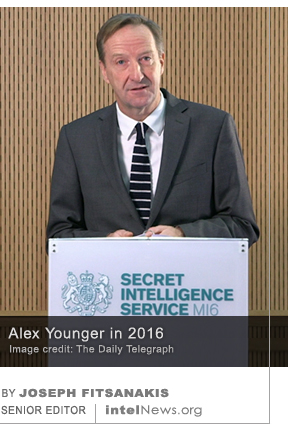 Britain’s primary external-intelligence agency will revert to old-fashioned ways of recruiting employees, including the co-called “tap on the shoulder” method, according to its director. Known informally as MI6, the Secret Intelligence Service (SIS) was founded in 1908 to protect Britain’s national security by collecting intelligence from foreign sources. However, the agency has had difficulty recruiting a diverse group of people, and many still view it as a professional destination for a small wealthy elite, drawn primarily from Britain’s most prestigious universities such as Oxford and Cambridge.
MI6 is now trying to diversify the makeup of its employees, according to its director, Alex Younger. Younger, who is known at MI6 as ‘C’, gave an interview to British newspaper The Guardian on Thursday. He did so as the agency he leads prepares to increase its personnel numbers by 40 percent in the next four years. Last year, the British government announced that MI6’s personnel strength would grow from its current size of 2,500 employees to approximately 3,500 by 2020. The reason for the increase, said Younger, is that Britain is facing “more threats than ever before […] from terrorist groups and hostile states”. As a result, “the demands on our services [and] capabilities are on the up”, Younger told The Guardian in his first-ever interview with a national newspaper.
But MI6 would function more efficiently and achieve better results it if had a “more diverse workforce”, said Younger. Therefore, he said, the agency must go out of its way to “draw in a new cadre of black and Asian officers”. In doing so, the spy service would need to reach out to minority communities who are “selecting themselves out” of working for the British intelligence community. Useful in this process are what Younger called “old recruitment techniques”, such as the so-called “tap on the shoulder”. The term refers to the deliberate recruitment of individuals who will be approached by MI6 without having applied for employment with the agency. “We have to go to people that would not have thought of being recruited to MI6”, said Younger, adding that the “tap on the shoulder” method can be redeployed in order to increase diversity among MI6’s workforce and “reflect the society we live in”.
The spy agency is preparing to launch an aggressive recruitment campaign next week, aiming at bringing its overall size to 3,500 —a historic high, according to intelligence observers.
► Author: Joseph Fitsanakis | Date: 03 March 2017 | Permalink
 Britain’s primary external intelligence agency, MI6, will see a 40 percent increase in personnel numbers in the next four years, according to a new report. The agency, which is formally known as the Secret Intelligence Service, currently employs about 2,500 people. But the BBC said on Wednesday that the number of MI6 employees will rise to approximately 3,500 by 2020. The broadcaster said that no public announcement had been made about the planned increase, but that it had verified the information “via Whitehall sources”, referring to the official seat of the British government.







 intelNews.org
MI6 spy chief outlines ‘fourth generation espionage’ in rare public speech
December 4, 2018 by Joseph Fitsanakis 1 Comment
After cautioning his audience that MI6’s methods, operations and people —some of whom “have paid the ultimate price”— must remain secret, Younger said that technological progress has “profoundly changed [MI6’s] operating environment”. Technological change, as well as the degree of interconnectedness, he said, has made the world “dramatically more complicated”. He went on to add that the resulting ambiguity is referred to by MI6 as a constant stream of “hybrid threats”, namely challenges posed by nation-states operating “in the gray spaces of the hybrid era”. They do so in order to probe the West’s “institutions and defenses in ways that fall short of traditional warfare”, said Younger. The British spy chief added that MI6, as “one of the few truly global intelligence agencies” is well positioned to respond to hybrid threats, mostly by augmenting its human intelligence role —using human spies to collect information.
Human intelligence, which is MI6’s core task, “will never change fundamentally”, said Younger, adding that “in fact it will become even more important in a more complex world”. However, it will need to evolve to meet the challenges of the hybrid age. Younger said that MI6 was pioneering a “fourth generation of espionage”, which is the product of the fusion of traditional human skills with “accelerated [technological] innovation”. This new generation of espionage said Younger, relies not on individual work but on operations that are carried out by dynamic teams within and across state agencies. Additionally, the ultimate task of these operations is not simply to know the actions of one’s adversaries, but “to change their behavior”, said the British spy chief. Furthermore, in order to successfully develop fourth generation espionage capabilities, MI6 will have to “ensure that technology is on our side, not that of our opponents”, noted Younger. The spy chief gave an example by referring to the case of the near-fatal poisoning of Sergei Skripal, the Russian former double spy who was allegedly attacked by two Russian military intelligence officers in Salisbury, England, last March. It was “bulk data combined with modern analytics” that exposed the culprits of the operation, he said. But the same methods, which make the modern world more transparent, can posed “a serious challenge if used against us”, warned the MI6 chief.
► Author: Joseph Fitsanakis | Date: 04 December 2018 | Permalink
Filed under Expert news and commentary on intelligence, espionage, spies and spying Tagged with Alex Younger, espionage, MI6, News, Newstex, UK