French spy agencies conclude Assad government was behind Syria gas attack
April 27, 2017 4 Comments
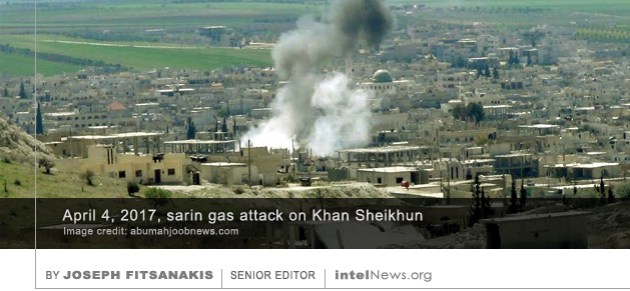 A comprehensive report released yesterday by the French Intelligence Community concludes with certainty that the government of Syrian President Bashar al-Assad was behind the April 4 sarin gas attack in northwestern Syria. The report, a “national evaluation” based on France’s own intelligence sources and scientific analysis of samples collected from the site of the attack, indicates that the poison gas used in the attack came from stockpiles that belong to the Syrian government.
The sarin gas attack targeted Khan Sheikhun, a town of approximately 50,000 people in the southern region of Syria’s Idlib Governorate. The city is located on the main highway that connects the Syrian capital Damascus with the city of Aleppo in the north of the country. The surprise attack killed nearly 100 people and drew near-universal condemnation from the international community. It also sparked a military attack by the United States, which launched a missile attack at a Syrian military base from where the sarin gas attack allegedly originated.
On Wednesday, France’s Minister of Foreign Affairs, Jean-Marc Ayrault, announced the publication of a report, which, he said, proves conclusively that the Syrian government perpetrated the attack. The six-page declassified version of the report concludes that “the Syrian armed forces and security services perpetrated a chemical attack using sarin against civilians”. It alleges that the conclusion rests on “intelligence collected by our services”, which includes “samples from the scene of the attack”. The latter are reportedly identical with samples collected from sites of previous chemical attacks perpetrated by the Syrian government. Additionally, the French report concludes that the attack was conducted with the use of airplanes, which the Syrian rebel forces do not have.
The French intelligence report comes after a similar report from the United States concluded that Assad’s government was behind the attack on Khan Sheikhun. A few days after the attack, medical tests conducted on victims of the attack by Turkish experts showed that sarin gas had been used, but did not implicate a specific culprit. The Syrian and Russian governments deny all involvement in the attack and claim that it was carried out by al-Qaeda-linked rebels.
► Author: Joseph Fitsanakis | Date: 27 April 2017 | Permalink
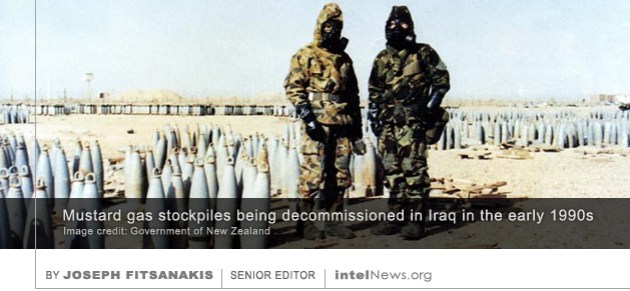 Germany’s foreign intelligence agency says it has evidence that the Islamic State is making use of chemical weapons in northern Iraq, according to media reports. The German Federal Intelligence Service, known as BND, says its operatives in the Middle East were able to collect biological samples from Kurdish fighters engaged in battles against the Islamic State forces. The samples pointed to chemical poisoning that most likely came from sulfur mustards, more commonly known as mustard gas. The chemical, which is banned from use in warfare by the 1993 Chemical Weapons Convention, causes skin irritation that gets progressively worse until sufferers develop debilitating blisters filled with yellow fluid.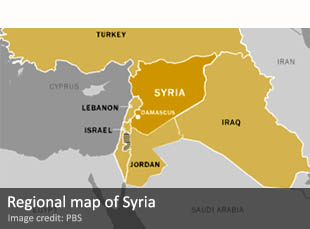







 intelNews.org
Concern mounts over Russia’s possible use of chemical weapons in Ukraine
March 11, 2022 by Joseph Fitsanakis Leave a comment
This is not the first time that Moscow has leveled such accusations against the United States and Ukraine. For over a decade, senior officials in the administration of Russian President Vladimir Putin have claimed that the United States and Britain have maintained secret networks of biological weapons laboratories in Eastern Europe. But the Kremlin’s accusations have been getting more frequent and more specific in recent days. On March 7, Igor Kirillov, Chief of the Russian military’s Radiation, Chemical and Biological Defense Forces, alleged that American and Ukrainian soldiers were destroying biological weapons facilities in Western Ukraine. Their goal, Kirillov claimed, was to keep lethal biological agents from falling into the hands of the Russian military.
Two days later, on March 9, Russian Defense Ministry spokesperson Major General Igor Konashenkov stated that Ukrainian forces had secretly transported “80 tons of ammonia” to a location northwest of Kharkiv. The purpose of the operation, Konashenkov said, was to carry out a “provocation using toxic substances”, and then blame Russia of using chemical weapons. During the Syrian Civil War, Moscow leveled similar allegations against Syrian rebels shortly before the government of Syrian President Bashar al-Assad launched chemical attacks against rebel-held areass.
There is also concern among Western analysts that the disconnection of the Chernobyl Nuclear Power Plant’s electrical network from Ukraine’s electrical grid may be “a Russian attempt to trigger nuclear panic over a potential radiological incident” in Ukraine. In light of this incident, some observers are beginning to interpret prior attacks on the Zaporizhia nuclear facility on March 4, and on a research facility containing a nuclear reactor in Kharkiv on March 6, as deliberate acts by Moscow. They say that the Kremlin may actively be seeking to introduce unconventional weapons into the war in Ukraine.
► Author: Joseph Fitsanakis | Date: 11 March 2022 | Permalink
Filed under Expert news and commentary on intelligence, espionage, spies and spying Tagged with 2022 Russian invasion of Ukraine, chemical warfare, chemical weapons, false flag operations, Igor Kirillov, Igor Konashenkov, News, nuclear security, Russia, Ukraine