Israel intel official says Bahrain and Oman could follow UAE in normalizing relations
August 17, 2020 Leave a comment
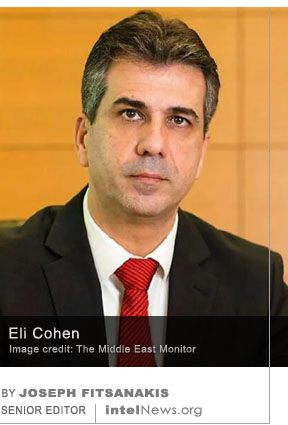 Israel’s minister of intelligence has said Bahrain and Oman could follow the United Arab Emirates in establishing diplomatic relations with Israel, following last week’s historic announcement. Israel said on Thursday that the UAE had agreed to establish formal diplomatic relations with the Jewish state, in return for Israel’s pledge to cancel its planned annexation of parts of the West Bank. The agreement, which was sponsored by Washington, makes the UAE only the third Arab country to establish formal diplomatic relations with Israel, after Egypt in 1979 and Jordan in 1994.
The announcement was greeted with enthusiasm and skepticism, with some observers claiming it could reshape Middle East politics, and others warning it could bring Palestinian factions closer to Iran. But on Sunday, Eli Cohen, Israel’s Minister of Intelligence and member of the country’s Security Cabinet, said the agreement between Israel and the UAE was likely to be the first of several similar deals. Speaking on Israel Army Radio, Cohen said that “additional agreements” would follow “in the wake of this agreement”, and that “Bahrain and Oman are definitely on the agenda”. The two Gulf countries are close allies of the United States and Saudi Arabia, which is one of Iran’s strongest regional rivals. In official statements issued on Thursday, Bahrain and Oman praised the normalization of relations between the UAE and Iran, but did not speak to whether they were contemplating following in the UAE’s footsteps. Meanwhile, the government of Kuwait said in an official statement last week that its position toward Israel remained unchanged, signaling that a change of status in its treatment of the Jewish state was not on the horizon.
Cohen also told Israel Army Radio that, in his assessment, “there is a chance that already in the coming year there will be [agreements between Israel and] Muslim countries in Africa […] chief among them Sudan”. In recent years, Israeli Prime Minister Benjamin Netanyahu has met with Omani and Sudanese leaders. The Israeli prime minister said last week he expected “more countries will be joining us in the peace circle”, adding that the Israel-UAE agreement signaled “a historic change which advances peace with the Arab world and will eventually advance a real, sober and secure peace with the Palestinians”. There are many critics of this view, especially among Netanyahu’s own voter base, which was highly supportive of his prior pledges that Israel would annex parts of the West Bank.
► Author: Joseph Fitsanakis | Date: 17 August 2020 | Permalink








 intelNews.org
Israel reportedly trying to recover spy’s remains from Syria
December 16, 2024 by Joseph Fitsanakis 2 Comments
The spy agency utilized Cohen’s fluency in Arabic and Spanish and sent him to Argentina, where he built his intelligence cover under the name Kamel Amin Thaabet. He pretended to be a Syrian businessman whose family had immigrated to Argentina in the 1920s. While in Argentina, Cohen became an active member of the Arab and Syrian diasporas and joined the Syrian Ba’ath Party.
In 1962, shortly before Ba’athist officers seized power in Syria, the Mossad instructed Cohen to relocate to Damascus. While there, Cohen became a well-known socialite with close connections to the administration of Syrian President Amin al-Hafiz. However, in 1965, Cohen’s espionage was uncovered by Syrian counterintelligence, who utilized technical countermeasures provided by Soviet intelligence. Cohen was convicted of espionage and publicly executed by hanging in Damascus on May 18, 1965.
Since Cohen’s execution, the Syrian state has rejected requests to reveal the location of his tomb and the whereabouts of his remains. On at least two instances, Israel, which views Cohen as a national hero, has offered to exchange Syrian and other Arab prisoners of war in return for the spy’s remains, but Damascus has rebuffed these offers. There are rumors that Syrian authorities regularly relocate Cohen’s remains so as to prevent Israel from covertly retrieving them.
According to reports from Middle Eastern media, since the fall of the administration of former Syrian President Bashar al-Assad, Israeli officials have been in negotiations to gain access to Cohen’s remains. The negotiations are allegedly taking place between Israeli government representatives and former members of the Assad regime, who have knowledge of the whereabouts of the late spy’s remains. In a television interview last week, Eli Cohen’s widow, Nadia, implied that Mossad Director David Barnea is personally involved in the ongoing negotiations.
► Author: Joseph Fitsanakis | Date:16 December 2024 | Permalink
Filed under Expert news and commentary on intelligence, espionage, spies and spying Tagged with Eli Cohen, Israel, Kamel Amin Thaabet, Mossad, News, non-official-cover, Syria