UK spied on Argentina to prevent second Falklands war, papers show
April 6, 2015 Leave a comment
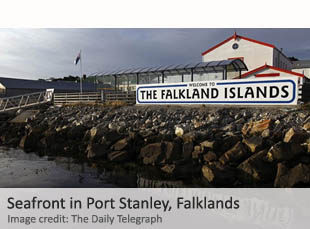 By JOSEPH FITSANAKIS | intelNews.org
The British government carried out an extensive program of intelligence collection and psychological operations in Argentina until 2011, because it was concerned about the security of the Falkland Islands, according to newly leaked documents. In 1982, the two countries went to war over the islands, which are ruled by Britain but are claimed by Argentina. The 74-day conflict, which killed nearly 1,000 soldiers and civilians on both sides, ended in defeat for the Argentinian forces and solidified British authority in the South Atlantic territory. But Argentina continues to dispute Britain’s rule over the Falklands, which it calls Malvinas, and has repeatedly threatened to take them over.
Documents released last week by Argentine online news portal TN.com, reveal that a consortium of British intelligence units implemented a broad program of spying and propaganda operations against Argentina. The program, codenamed Operation QUITO, lasted from 2006 to 2011, and was aimed at hampering perceived efforts by the Argentine government to subvert British rule in the Falklands. The news portal said it received the documents from Edward Snowden, an American former intelligence contractor who currently lives in Russia under political asylum. According to TN.com, the secret program was implemented by the Joint Threat Research Intelligence Group (JTRIG, as reported by intelNews in February 2014). It is believed that JTRIG is an office operating under the command of the Government Communications Headquarters (GCHQ), Britain’s signals intelligence agency. Its focuses on psychological operations —known in Britain as “effects operations”— which are aimed at discrediting their targets through sabotage and misinformation campaigns.
According to the newly released documents, JTRIG launched Operation QUITO as a “long-term, far reaching” program that included the interception of communications of Argentine politicians, the planting of computer viruses on Argentine networks and the spreading of misinformation or pro-British propaganda online. As of Sunday night there had been no official response to the news report from either the Argentine or the British governments.
 By IAN ALLEN | intelNews.org






 intelNews.org
Fake URL shortening service was part of British online spy operation
August 2, 2016 by Joseph Fitsanakis 2 Comments
According to the leaked documents, the website, lurl.me, was devised by a specialist until of the Government Communications Headquarters (GCHQ), Britain’s intelligence agency that collects signals intelligence. The unit, called Joint Threat Research Intelligence Group (JTRIG), devised the website as part of an operation codenamed DEADPOOL. The leaked documents state that the purpose of the website was to operate as a “shaping and honeypot” tool, by helping disseminate messages in support of the protests while at the same time allowing the GCHQ to monitor the protesters’ online activities. Lurl.me first appeared in June 2009 as a self-described “free URL shortening service”, using the slogan: “we help you get links to your friends and family fast”. It was used repeatedly on Twitter and other social media platforms to spread messages against the government of Iran. But the vast majority of social media accounts that made use of the website, like @2009iranfree, were operational only for a short period of time, had few followers, and ceased all activity at the end of the Iranian Green Movement. By that time, hardly anyone was using lurl.me. But the website made its appearance again on social media in April of 2011, with messages against the government of Syria. According to Vice’s Motherboard website, Tweets using the lurl.me service appeared to be active only between 9 a.m. and 5 p.m. UK time, and only on weekdays.
Both in 2009 and 2011-2013, lurl.me was used to instruct anti-government activists on how to avoid being monitored by the authorities. Some links contained instructions on how to access the Internet via satellite. Others provided directions on using proxies to access websites that were blocked by the authorities. At the same time, however, the documents leaked by Snowden show that the GCHQ also used the service to track the activities of anti-government activists who clicked on the lurl.me links, and even to ‘deanonymize’ (=to establish the real identity) of these users.
IntelNews first reported on JTRIG in February 2014, when its existence was first revealed by Snowden. The specialist unit has been associated with targeting self-described ‘hacktivist’ groups like Anonymous or LulzSec, using malware, social engineering, and other techniques. JTRIG also appears to have conducted online intelligence operations against the government of Argentina.
Motherboard reports that lurl.me was last used in November 2013, shortly after Snowden began leaking files from his secret hiding place in Russia. Motherboard said it contacted GCHQ for a reaction to the lurl.me allegations, but the agency said it would “not comment on intelligence matters”.
► Author: Joseph Fitsanakis | Date: 02 August 2016 | Permalink
Filed under Expert news and commentary on intelligence, espionage, spies and spying Tagged with 2009 Iranian presidential election protests, Arab Spring, GCHQ, GCHQ Joint Threat Research Intelligence Group, Iran, News, operation DEADPOOL, Twitter, UK