Western agencies warned Lebanese prime minister of assassination plot, say Saudis
November 7, 2017 Leave a comment
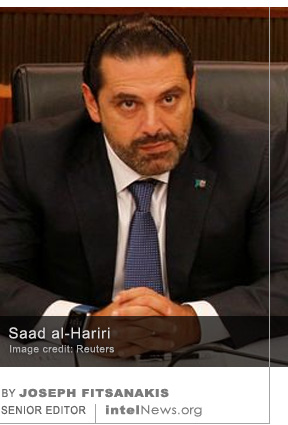 Western intelligence services warned Lebanon’s former Prime Minister Saad al-Hariri of an assassination plot against him, thus prompting him to resign on Sunday, according to Saudi news media. Hariri is a Saudi-born Lebanese politician, reputed to be one of the world’s wealthiest people. He is the second son of the late Rafiq Hariri, who ruled Lebanon for much of the 1990s but was assassinated in 2005. Saad al-Hariri spent most of his life in Saudi Arabia, the United States and France, but returned to Lebanon in 2014 to lead the Future Movement, a center-right political party supported by Sunni Muslims and some Christians. He became prime minister in 2016.
On Friday, Hariri flew from Beirut to Riyadh for a scheduled high-level visit. But on Sunday he shocked the Arab world by announcing his resignation from the post of prime minister. He did so in a surprise television address from the Saudi capital, which was broadcast live in Lebanon. Hariri told stunned Lebanese audiences that he was resigning in order to protect himself from a plot that was underway to assassinate him. He added that the political climate in Lebanon was intolerably tense and reminded him of the conditions that led to the assassination of his father 12 years ago. He also accused Iran and Hezbollah of acting as the primary destabilizing factors in Lebanon and much of the Middle East. Hariri and his supporters believe that Hezbollah was behind his father’s assassination in 2005. There was intense speculation in Lebanon on Monday that Hariri would remain in Saudi Arabia for the foreseeable future, fearing for his life if he returned to Lebanon.
On Sunday, the Saudi-based newspaper Asharq al-Awsat claimed that Hariri decided to resign after he “received warnings from Western governments” that there would be an assassination plot against him. The newspaper did not name the Western governments, nor did it identify those who are allegedly trying to kill Hariri. Later on Sunday, Saudi television station al-Arabiya al-Hadath alleged that an assassination attempt against Hariri had been stopped at the last minute in the Lebanese capital Beirut earlier in the week. Both news media cited “sources close” to the Lebanese leader, but did not provide specific information, nor did they give details of the alleged plot or plots. It is worth noting, however, that Lebanese security officials denied these reports from Riyadh. Lebanese media quoted senior security official Major General Abbas Ibrahim as saying that no information about assassination plots had been uncovered. Major Ibrahim, who heads Lebanon’s General Directorate of General Security, said that his agency had no information about attempts to kill Hariri or other Lebanese political figures.
This could mean that the information about a possible assassination plot against Hariri was given directly to him by Western intelligence agencies, probably because the latter fear that Lebanese security agencies are infiltrated by Hezbollah sympathizers. Or it could mean that the Saudi media reports are inaccurate. Lebanon is now awaiting further details by Hariri regarding the alleged assassination plot against him. In the meantime, the already fragile political life of Lebanon appears to be entering a period of prolonged uncertainty.
► Author: Joseph Fitsanakis | Date: 07 November 2017 | Permalink | Research Credit: B.M.
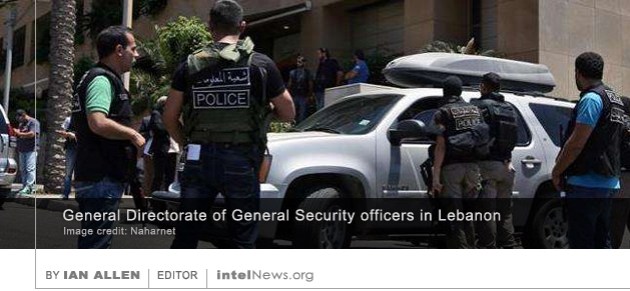 The security services of Lebanon announced on Wednesday that they had arrested five foreign nationals who were allegedly spying of Israel. A brief statement issued by Lebanon’s General Directorate of General Security (GDGS, also known as the General Security Directorate) said the five individuals were members of a “spy ring” set up by the Mossad, Israel’s external intelligence agency. The five —three men and two women— are accused of contacting Israeli embassies in countries in the Middle East, Europe and Asia, with the aim of passing information about domestic Lebanese affairs.






 intelNews.org
Lebanese spy agency used Android app to spy on thousands, say researchers
January 19, 2018 by Joseph Fitsanakis Leave a comment
According to the Lookout/EFF research team, the trojanized phone application was camouflaged as a secure messaging service, resembling popular applications like Signal or WhatsApp. However, once an Android user downloaded it, it gave remote users access to the compromised phone’s cameras and microphone, thus turning it into a bugging device. The virus also stole email and text messages, pins and passwords, lists of contacts, call logs, photographs, as well as video and audio recordings stored on the compromised device. The report states that compromised devices were found in over 20 countries, including Lebanon, France, Canada, the United States and Germany. The majority of those targeted by the virus were civilian and military officials of foreign governments, defense contractors, and employees of manufacturing companies, financial institutions and utility providers.
On Thursday, Reuters contacted Major General Abbas Ibrahim, who serves as director general of GDGS. He insisted that the GDGS is known for collecting intelligence using human sources, not cyber technologies. “General Security does not have these type[s] of capabilities. We wish we had these capabilities”, General Ibrahim told the news agency.
► Author: Joseph Fitsanakis | Date: 19 January 2018 | Permalink
Filed under Expert news and commentary on intelligence, espionage, spies and spying Tagged with cellular telephony, communications interception, Electronic Frontier Foundation, GDGS (Lebanon), Lebanon, Lookout Mobile Security, News