Czechs ask EU and NATO to expel Russian diplomats in solidarity against Moscow
April 20, 2021 Leave a comment
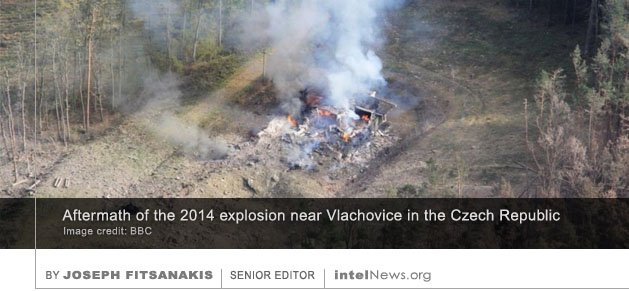
 CZECH GOVERNMENT OFFICIALS SAID they would welcome the expulsion of Russian diplomats from European Union and North Atlantic Treaty Organization countries, in support of Prague’s ongoing diplomatic spat with Moscow. The Czech Republic expelled 18 Russian diplomats last weekend, in order to protest against an explosion at a remote munition depot in the east of the country, which the government claims was part of a Russian intelligence operation.
As intelNews reported on Monday, the explosion occurred in October of 2014. It killed two people and destroyed a munitions storage facility belonging to the Military Technical Institute of the Czech Ministry of Defense. Although the blast was initially classified as an accident, Czech investigators have recently come to the conclusion that it was in fact caused by Unit 29155, a Russian elite spy outfit. Little is known about Unit 29155, which is believed to operate under the Main Directorate of the General Staff of the Russian Armed Forces, commonly known as GRU.
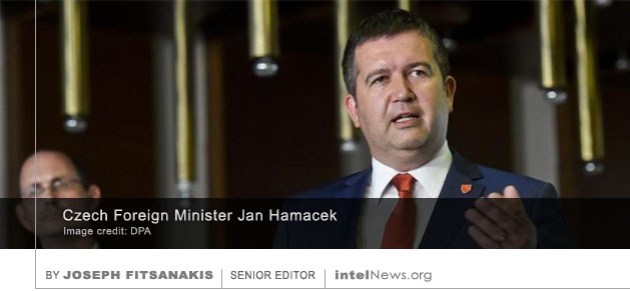
The Kremlin responded to the expulsions of its diplomats by ordering 20 Czech diplomats to leave Russia, and condemning Prague’s move as an “unprecedented” and “a hostile act” that was designed “to please the United States”. Meanwhile the Czech Republic’s acting Minister of Foreign Affairs, Jan Hamacek (pictured), stated on Tuesday that Prague “would welcome” if its allies in the EU and NATO “expelled officers of Russian special services” in the coming days, in an act of solidarity with the efforts of his office.
Following consultations with Hamacek, the office of the EU’s High Representative for Foreign Affairs and Security Policy said that it stood in “full support and solidarity” with the Czech Republic. No EU or NATO country has so far announced that it plans to expel Russian diplomats in response to Prague’s request. According to Czech media, discussions on the matter between Hamacek and several of his counterparts in the EU’s so-called Visegrad Group —consisting of Poland, the Czech Republic, Hungary, and Slovakia— are ongoing.
► Author: Joseph Fitsanakis | Date: 20 April 2021 | Permalink
 An elite group Russian military intelligence officers, who have participated in assassinations across Europe, have been using resorts in the French Alps as logistical and supply bases, according to a new report. The report concerns Unit 29155 of the Main Directorate of the General Staff of the Russian Armed Forces, commonly known as GRU.







 intelNews.org
Poland and Germany charge Russian operatives with assassination, sabotage plots
April 22, 2024 by Joseph Fitsanakis 4 Comments
Polish and Ukrainian authorities announced last week the arrest of Paweł K., a Polish citizen, who is believed to have been engaged in collecting information about the security of the Rzeszów-Jasionka Airport. Located in southeastern Poland, Rzeszów-Jasionka is a relatively small provincial airport. Its proximity to the Ukrainian border has made it central to efforts by Kyiv’s allies to supply it with war materiel following the expansion of Russia’s occupation of Ukraine in February 2022. Military supplies are transported to Rzeszów-Jasionka from across the world and then transferred across the Ukrainian border with trucks. Additionally, many high-level meetings between Ukrainian and Western officials take place at the airport. The United States military is currently providing security at the Rzeszów-Jasionka Airport.
Polish authorities said last week that Paweł K. was part of a Russian intelligence collection operation that was “intended to assist in the planning of a potential assassination of a foreign state leader”, namely President Zelenskyy. The Security Service of Ukraine (SBU) said it informed its Polish counterpart agency about the assassination plot, which had been foiled “as a result of the close co-operation” between Ukrainian and Polish intelligence. Paweł K. is not a diplomat and thus has no immunity from prosecution in Poland. If convicted, therefore, he could face up to eight years in prison.
In a seemingly unconnected development, police in the southeastern German state of Bavaria arrested two dual German-Russian nationals, who have been charged with planning to sabotage military and industrial facilities on German soil. The plot appears to be part of broader Russian efforts to disrupt the production and delivery of military aid to Ukraine. At least one of the locations that the suspects are accused of targeting is a local military base under the command of the United States. The two suspects have been identified as Dieter S., 39, and Alexander J., 37. Both were arrested in the small city of Bayreuth.
Germany’s Federal Foreign Office, led by Minister Annalena Baerbock, summoned Sergei Nechayev, Russian Ambassador to Berlin, shortly after the arrest of Dieter S. and Alexander J. Some media reports noted the “unusually hasty” way Nechayev was summoned, which may indicate that German authorities have acquired “unequivocal proof of the link between the plot and the Kremlin”. An announcement made by the Russian embassy in Berlin confirmed that Nechayev had been summoned in connection to the arrests, but added that the ambassador had been presented with “no proof” that the two suspects were connected with Russian intelligence or that they had planned acts of sabotage.
► Author: Joseph Fitsanakis | Date: 22 April 2024 | Permalink
Filed under Expert news and commentary on intelligence, espionage, spies and spying Tagged with 2022 Russian invasion of Ukraine, assassinations, Germany, GRU, GRU Unit 29155, News, Poland, Russia, Rzeszów-Jasionka Airport, sabotage, SBU (Ukraine), Ukraine