Turkey says Canadian spy helped British schoolgirls travel to Syria

CCTV footage of UK girls heading to SyriaBy JOSEPH FITSANAKIS | intelNews.org
In a development described by observers as “highly unusual”, a Turkish government minister has claimed that a Canadian spy helped three British schoolgirls travel to territory controlled by the Islamic State of Iraq and Syria. The three girls, Kadiza Sultana, 16, Shamima Begum, 15, and Amira Abase, also 15, crossed into ISIS-controlled territory on February 17, after having traveled by plane from London to Istanbul. The incident prompted renewed international criticism of the Turkish government’s hands-off attitude toward the growing influx of Western Islamists who cross into Syria from Turkey, intent on joining ISIS.

But Turkey’s Minister of Foreign Affairs, Mevlut Cavusoglu said on Thursday that the girls had been assisted during their trip by an intelligence agent working for a foreign country. In responding to criticism against Turkey, the minister claimed during a television interview that Turkish security forces had arrested a foreign intelligence operative who had enabled the three British citizens to cross into Syria. The man, said Cavusoglu, was a spy from a member-state of the military coalition fighting ISIS. “It is not a member-state of the European Union”, he added, “nor is he from the United States. But he is working for the intelligence [agency] of a country within the [anti-ISIS] coalition”. Later on Thursday, an unnamed Turkish government source told local media that the agent was not a Turkish citizen and that he had been arrested earlier in March.

Several press agencies, including Reuters and Agence France Presse reported on Thursday that the individual in question was “connected” with the Canadian Security Intelligence Service, but stopped short of saying that he was working for the government of Canada. A statement from the office of Steven Blaney, Canada’s Minister for Public Safety, who is responsible for overseeing the work of CSIS, said simply that the Ministry was “aware of these reports” but would “not comment on operational matters of national security”. An anonymous government source in Ottawa denied that the individual arrested in Turkey was a Canadian citizen or that he ever worked for CSIS.

News you may have missed #878 (ISIS edition)

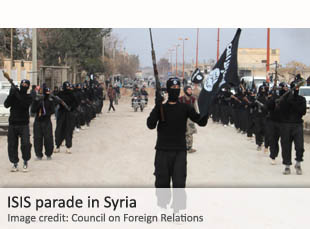
ISIS parade in SyriaBy IAN ALLEN | intelNews.org
►►Backgrounder on Islamic State in Iraq and Greater Syria. The Islamic State in Iraq and Greater Syria (ISIS), a predominantly Sunni jihadist group, seeks to sow civil unrest in Iraq and the Levant with the aim of establishing a caliphate —a single, transnational Islamic state based on sharia. The group emerged in the ashes of the US-led invasion to oust Saddam Hussein as al-Qaeda in Iraq, and the insurgency that followed provided it with fertile ground to wage a guerrilla war against coalition forces and their domestic allies.
►►ISIS stole $425m and became world’s richest terrorist group. The most stunning revelation to emerge out of the wreckage of Mosul this week is that ISIS just got extremely rich. Several ISIS insurgents stopped at Mosul’s central bank, where an incredible amount of cash was reportedly on hand, and the group made off with 500 billion Iraqi dinars —approximately US$425 million.
►►The Battle for Iraq Is a Saudi War on Iran. Currently on vacation in Morocco, Saudi Arabia’s King Abdullah has so far been silent on the developments in Iraq. But the situation there could well prompt him to cut short his stay and return home. This is because the ISIS advance represents a setback for Iraqi Prime Minister Nouri al-Maliki, which has been the dream of Saudi Arabia’s King Abdullah for years. He has regarded Maliki as little more than an Iranian stooge, refusing to send an ambassador to Baghdad and instead encouraging his fellow rulers of the Gulf Cooperation Council to take a similar standoff-ish approach.
►►Iran deploys Revolutionary Guard forces to fight Iraq militants. The threat of Sunni extremists eclipsing the power of its Shiite-dominated Arab ally presents Iran with the biggest security and strategic challenge it has faced since the US-led invasion of Iraq in 2003. With ISIS, an offshoot of al Qaeda, rapidly gaining territory, Iran deployed Revolutionary Guards units to Iraq, according to Iranian security officials.
►►Jihadist gains in Iraq blindside American spies. United States intelligence agencies were caught by surprise when fighters from ISIS seized two major Iraqi cities this week and sent Iraqi defense forces fleeing, current and former US officials said Thursday. With US troops long gone from the country, Washington didn’t have the spies on the ground or the surveillance gear in the skies necessary to predict when and where the jihadist group would strike.
US ‘quietly expanding’ intelligence presence in war-torn Iraq

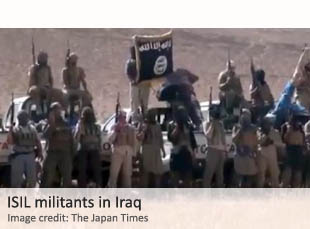
ISIL militants in IraqBy JOSEPH FITSANAKIS | intelNews.org
The United States is “quietly expanding” its intelligence operations in Iraq in response to the worsening security situation in the country, according to American government sources. The Reuters news agency reports that US officials have been holding a series of “urgent meetings” in Washington and Iraqi capital Baghdad. The meetings center on finding ways to contain the growing destabilization in the Middle Easter country, which the US occupied from 2003 to 2011. The news agency cited one former and two current US government officials in claiming that a “high-level Pentagon team” is already in Iraq holding successive consultations with Iraqi military and intelligence figures. Many of the conversations in these meetings are believed to center on the activities of the Islamic State of Iraq and the Levant (ISIL), a Sunni militant group that has been ideologically aligned with al-Qaeda for most of its existence. Founded in response to the US invasion of Iraq, ISIL became informally known as “al-Qaeda in Iraq” until 2014, when al-Qaeda officially severed all ties to the group, following a bitter power struggle. According to Reuters’ sources, the pressure for the US to respond to the worsening situation in Iraq comes mostly from the Pentagon. But it is unclear whether the White House will continue to intensify American involvement in the country, said the source, adding that Washington’s intelligence presence in Iraq is now “more than before, but not really a lot”. The news agency cited another US government source, who said that a second group of “senior US policy officials”, known as the “Deputies Committee”, has been meeting in Washington to discuss possible responses to the deteriorating security situation in Iraq. Read more of this post

News you may have missed #868

Jonathan PollardBy IAN ALLEN | intelNews.org
►►Honduras suspends eight consuls in US. Honduras has suspended eight of its 10 consuls in the US, days after local media alleged that the consuls had issued illegal papers in exchange of payments of up to $50. The consulates affected are in Atlanta, Chicago, Dallas, Houston, Los Angeles, Miami, New Orleans and New York. The case came to light after a group representing Hondurans living in the US said a number of consulates were issuing “consular IDs” —documents that bear the crest and flag of Honduras, but which are not officially recognized forms of identification.
►►Al-Qaeda’s expulsion of Syrian group prompts US debate. The Obama administration is engaged in a debate on whether a law giving the president authority to attack al-Qaeda affiliates still applies to the Islamic State of Iraq and Greater Syria (ISIS), after al-Qaeda’s recent decision to sever ties with the group. Current and former US intelligence officials said last week’s expulsion marked the first time al-Qaeda had ejected a group that had formally joined its fold, a potentially risky move at a time when the terrorist network’s affiliates have largely eclipsed the core group in strength and relevance.
►►Ex CIA head says anti-Semitism likely in Pollard case. Former CIA Director James Woolsey says anti-Semitism could be a factor in the US refusal to release Jonathan Pollard, a Jewish American jailed for spying for Israel. Wolsey has long advocated for releasing Pollard who was sentenced to life in prison in 1985 for spying on the United States. “I certainly don’t think that it is universally true, but in the case of some American individuals, I think there is anti-Semitism at work here”, Woolsey said.

Newspaper retracts report of Turkish jets attacking Syrian rebels

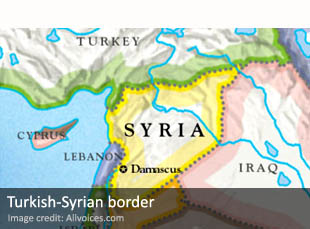
Turkish-Syrian borderBy IAN ALLEN | intelNews.org
A Turkish newspaper has retracted a report stating that Turkish military jets entered Syrian territory and destroyed an outpost belonging to an al-Qaeda-linked rebel group, after its members attacked a Turkish military garrison along the Syrian-Turkish border. In a published correction, the paper said instead that the Turkish army opened fire from inside Turkey. Today’s Zaman, the English-language edition of Turkish daily Zaman, reported on January 29 that Turkish F-16s had entered Syrian territory and had bombed a stationary convoy of vehicles belonging to the Islamic State of Iraq and Greater Syria, or ISIS, an al-Qaeda-linked group that made its appearance in Syria in April of last year. The origins of ISIS are in Iraq, where it was founded in 2003 as a Sunni armed paramilitary force, in response to the invasion by the United States. In 2004, the group pledged allegiance to al-Qaeda and Osama bin Laden, and changed its name to Al-Qaeda in Iraq (AQI). Many observers argue that, in recent months, ISIS has turned into “one of the most powerful forces on the ground” in Syria, with 7,000 well-armed fighters, many of whom are battle-hardened foreign Islamists. It is widely believed that ISIS now dominates Syria’s northwest, having established outposts in a series of “strategic towns” in the region, which are referred to by its leaders as “mini emirates”. Through these outposts, ISIS fighters are able to monitor border traffic between Syria and Turkey, and effectively control most border passages. After retracting its earlier report, Today’s Zaman said the Turkish military used “tanks and artillery fire” to attack the ISIL outpost. Read more of this post

Analysis: How al-Qaeda changed the Syrian Civil War

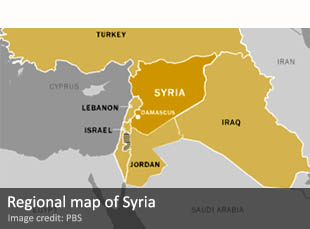
Regional map of SyriaBy IAN ALLEN | intelNews.org
Until relatively recently, few observers believed that the government of Bashar al-Assad had a future in war-torn Syria. But the situation in the world’s most active battle zone has changed drastically in recent months, and now many suggest that the Assad forces are dominating the conflict. In a recent article in The New York Review of Books, Sarah Birke, a Middle East correspondent for The Economist, argues that it was the presence of al-Qaeda that changed the balance of power between the warring sides. She points the finger at the Islamic State of Iraq and Greater Syria, or ISIS, an al-Qaeda-linked group that made its appearance in Syria in April of last year. Since that time, ISIS has turned into “one of the most powerful forces on the ground”, with 7,000 well-armed fighters, many of whom are battle-hardened foreign Islamists. The origins of ISIS are in Iraq, where it was founded in 2003 as a Sunni armed paramilitary force, in response to the invasion by the United States. In 2004, the group pledged allegiance to al-Qaeda and Osama bin Laden, and changed its name to Al-Qaeda in Iraq (AQI). The United States government has pledged $10 million in return for information leading to the capture of the group’s leader, Abu Bakr al-Baghdadi, but with no success so far. In the spring of 2003, the Iraqi-born al-Baghdadi announced the merger of AQI with the Al-Nusra Front, AQI’s branch in Syria. Since that time, the two unified groups have been commonly referred to as the Islamic State of Iraq and al-Sham —al-Sham being a reference to ‘greater Syria’, known also as ‘the Levant’. Birke reports that ISIS now dominates Syria’s northwest, having established outposts in a series of “strategic towns” in the region, which are referred to by its leaders as “mini emirates”. Through these outposts, ISIS fighters are able to monitor border traffic between Syria and Turkey, and effectively control most border passages. This has crippled the Free Syrian Army, which used to dominate the Syrian opposition with the help of generous donations of money and war material coming in from Turkey. Read more of this post