Senior US intelligence official tells Congress not to ‘micromanage’ spy efforts
December 5, 2016 1 Comment
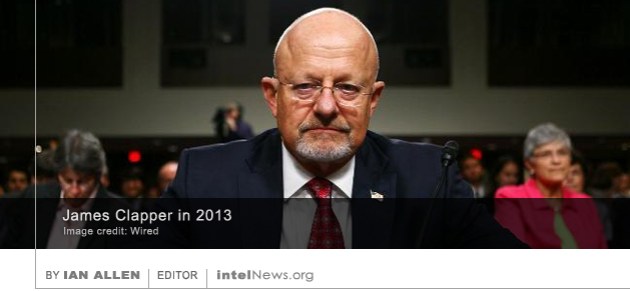 The United States’ senior intelligence officer has told Congress that new legislation requiring spy agencies to act against alleged Russian covert operations constitutes “micromanagement” of the American Intelligence Community. The Intelligence Authorization bill, which includes a number of intelligence-related requirements and provisions, is debated and enacted each year by Congress. This year’s legislation has already been approved by the intelligence committees of the Senate and House of Representatives. Last week it was enacted by the House, while the Senate is preparing to debate it this week.
The legislation currently under debate includes instructions to the US Intelligence Community to set up an interagency committee to formulate responses to perceived Russian covert operations around the world. The term ‘covert operations’ refers to actions by intelligence agencies designed to influence foreign political, military or economic affairs or events. The topic received media attention during the 2016 US presidential election, when Washington repeatedly accused Moscow of trying to shape its outcome. This year’s Intelligence Authorization bill requires every US intelligence agency to appoint a representative to serve on a joint panel that will address alleged Russian covert operations in the US, Europe and elsewhere in the world.
But in September of this year, the Director of National Intelligence, James Clapper, America’s most senior intelligence official, authored a letter to Congress arguing that the requirement for an interagency panel to look into Russian covert operations should be scrapped. According to the Reuters news agency, which said last week that it saw a copy of the letter, Clapper argues that his letter echoes the unanimous view of the US Intelligence Community. He goes on to claim that the requirement to set up a special committee with an operational focus exceeds Congress’ role of overseer of the Intelligence Community and enters the realm of prescribing intelligence tasks. That, says Clapper in his letter, amounts to “micromanagement” of the Intelligence Community by Congress. Furthermore, he argues, the Intelligence Community has already taken steps to address Russian covert operations, thus the suggested panel would “duplicate current work” on the issue. Finally, Clapper’s letter suggests that the required panel would “hinder cooperation” with some of America’s overseas allies, though the Reuters report did not explain the precise justification for that claim.
► Author: Ian Allen | Date: 05 December 2016 | Permalink
 Two more members of a computer hacker group that targeted senior United States intelligence officials, including the director of the Central Intelligence Agency, have been arrested by the Federal Bureau of Investigation. The arrests of Justin Liverman, 24, and Andrew Boggs, 22, took place on Thursday in Morehead City and North Wilkesboro, in the US state of North Carolina. They are






 intelNews.org
US intelligence officials called to resign despite Trump’s Russia retraction
July 19, 2018 by Joseph Fitsanakis 1 Comment
But President Trump dismissed those conclusions on Monday, while speaking alongside Russian President Vladimir Putin following the US-Russia summit in the Finish capital. During the joint press conference of the two leaders, the US president was asked to publicly adopt the US Intelligence Community’s conclusion that Russia interfered in the 2016 elections. But instead of doing so, Trump said his Russian counterpart had strongly denied the American accusations. “My people came to me”, said Trump, referring by name to his Director of National Intelligence (DNI) Dan Coats, and “said they think it’s Russia”. However, Trump continued, “President Putin […] just said it’s not Russia. I will say this, I don’t see any reason why it would be”. Following strong criticism of that comment, much of it from his own supporters, the US president retracted it on Tuesday in Washington, saying he misspoke in Helsinki. According to Trump, he said “would” when he meant to say “wouldn’t”.
The US president’s odd retraction came just hours after DNI Coats –a Trump appointee– issued a rare public statement rejecting Trump’s comments in Helsinki. “We have been clear in our assessments of Russian meddling in the 2016 election and their ongoing, pervasive efforts to undermine our democracy”, said Coats, adding that his office’s conclusion had been based on “unvarnished and objective intelligence”. Coats’ predecessor, former ODNI James Clapper, said during an interview with CNN on Tuesday that, if he still led the ODNI and had been “publicly thrown under the bus” by the president in that manner, he “would have stepped down in a heartbeat”. Read more of this post
Filed under Expert news and commentary on intelligence, espionage, spies and spying Tagged with Dan Coats, Donald Trump, James Clapper, John Brennan, John McLaughlin, Michael Hayden, Michael Morell, News, Newstex, Russia, Steve Hall, United States