Is Trump signaling possible CIA covert operations against drug cartels?
January 21, 2025 1 Comment
 THERE WERE REPORTS LATE on Monday that United States President Donald Trump was considering authorizing covert operations by the Central Intelligence Agency (CIA) against drug cartels. During his inaugural address on Monday afternoon, Trump said he would be “designating the cartels as foreign terrorist organizations”. Later the same day, the incoming president signed an executive order to that effect.
According to US law, the Foreign Terrorist Organization (FTO) designation may be applied to non-US organizations which participate in activities that fall under the US Department of State’s definition of terrorism. Historically the FTO list has included leftwing militant groups, armed nationalist or separatist organizations, as well as Islamist violent extremist groups.
In some cases, FTO organizations have actively participated in the manufacture and distribution of illicit drugs. However, they are distinguished from purely criminal organizations by the overarching political motives that guide their activities. In contrast, drug cartels are primarily motivated by financial profit and tend to engage in politics only to the extent that doing so will boost their money-making ability.
While signing his executive order on Monday evening —one of nearly a hundred he signed that day— President Trum said he would instruct his administration “to use the full and immense power of federal and state law enforcement to eliminate the presence of all foreign gang criminal networks” from the US and Mexico.
According to some observers, the FTO designation is “a strong indication” that the new US president plans to issue a presidential finding —a classified directive issued by the commander-in-chief— authorizing the CIA to engage in covert action targeting the drug cartels. A number of Trump allies have reportedly compiled a list of targeted cartels, which are located mostly in Mexico. They include notorious criminal organizations, such as the Cartel Jalisco Nueva Generación (CJNG), the Sinaloa Cartel, and the Gulf Cartel.
Additionally, the FTO designation might constitute the first step toward an American military presence inside Mexico, or missile strikes directed against designated FTO strongholds, including drug production and storage facilities. In November of last year, there were reports in the American media claiming that key figures in the incoming Trump administration were contemplating launching a military invasion of northern Mexico.
► Author: Joseph Fitsanakis | Date: 21 January 2025 | Permalink
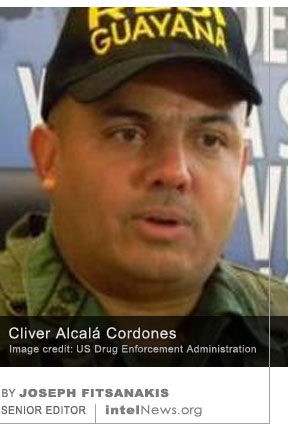 LAWYERS FOR A FORMER Venezuelan military officer, who tried to topple President Nicolás Maduro in 2020 with the help of American former soldiers, have claimed that senior officials in the United States Central Intelligence Agency were aware of his activities “at the highest levels”. The court case centers on Major General Clíver Alcalá Cordones, a retired member of Venezuela’s Bolivarian Army, who is being tried in a Manhattan court. Alcalá is accused of being a member of a drug smuggling ring that worked closely with Colombian terrorist organizations to smuggle over 250 metric tons of cocaine to the US.
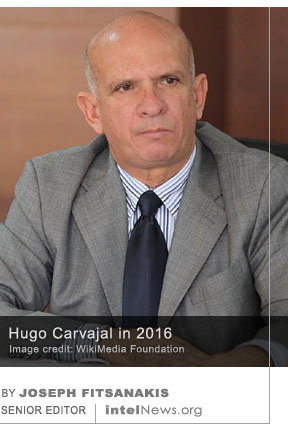 THE FORMER DIRECTOR OF Venezuela’s military spy agency has been captured in Madrid after two years on the run, and is now likely to be extradited to the United States, where he will face drug trafficking charges. Hugo Carvajal is a retired general and former diplomat, who was a member of the late Venezuelan President Hugo Chávez’s inner circle. From 2004 to 2011, under Chávez’s tutelage, Carvajal headed Venezuela’s Directorate General of Military Counterintelligence (DGCIM).
 Police in Italy have announced the seizure of the largest shipment of amphetamines in counter-narcotics history, containing drugs believed to have been manufactured by the Islamic State in Syria. The drugs shipment was intercepted at the port of Salerno, located south of Naples in southwestern Italy.
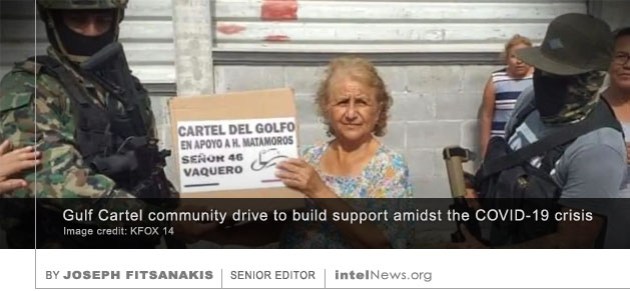 Drug cartels are organizing sophisticated ‘care package’ drives throughout Mexico in an attempt to build political capital and solidify their community support. Nearly every drug cartel in Mexico is organizing its own handout distribution
 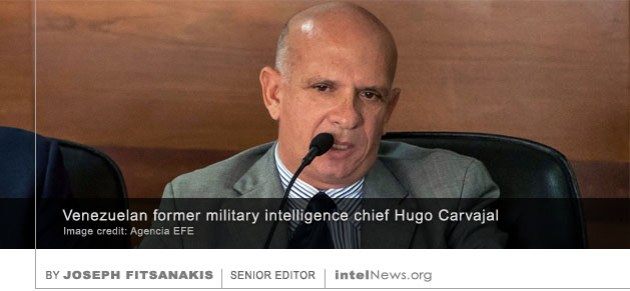 The former director of Venezuela’s military spy agency, who is wanted in the United States for drug trafficking, reportedly disappeared in Spain as authorities there were attempting to extradite him to Washington. Hugo Carvajal is a retired general and former diplomat, who was a member of the late Venezuelan President Hugo Chávez’s inner circle. From 2004 to 2011, under Chávez’s tutelage, Carvajal headed the Directorate General of Military Counterintelligence (DGCIM).
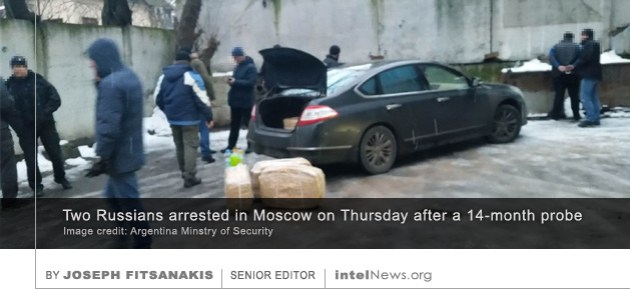 A Russian former diplomatic employee and an Argentine police officer are among six people arrested following the discovery of nearly 1000 pounds of cocaine inside the Russian diplomatic compound in Buenos Aires. The arrests took place last Thursday and were announced in Argentina by the country’s Security Minister Patricia Bullrich. She told reporters that the arrests came after a 14-month investigation in Argentina, Russia and Germany. She added that the investigation unveiled “one of the most complex and extravagant drug-dealing operations” in Argentina’s history.
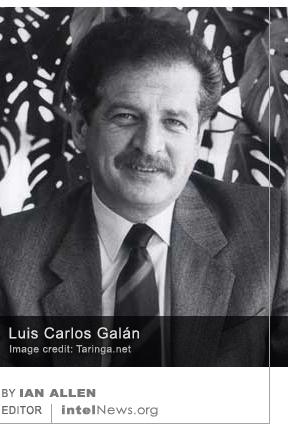 The former director of Colombia’s intelligence service returned to court this week to face charges of complicity in the assassination of a leading presidential hopeful, who was gunned down in 1989 by a powerful drug cartel. Luis Carlos Galán, a senator and former minister, was tipped to win the 1990 presidential election in which he stood on the Liberal Party ticket. His popularity with the electorate is largely attributed to his uncompromising stance against Colombia’s powerful drug cartels. He had vowed to arrest leading drug lords and send them to the United States to face criminal charges. He would do so, he said, after signing a mutual extradition treaty with Washington. However, Galán was assassinated on August 18, 1989, during a campaign rally in Soacha, a working-class suburb of Colombia’s capital, Bogotá. The assassination took place before thousands of spectators who were present at the rally, and is considered one of the highest-profile political killings in the history of Colombia.








 intelNews.org
Colombian spy chief claims intelligence-sharing with CIA continues despite dispute
December 1, 2025 by Joseph Fitsanakis 3 Comments
The political dispute between the two countries made headlines on November 11, when Colombian President Gustavo Petro (pictured) ordered his government’s intelligence agencies to “suspend intelligence sharing with US intelligence agencies”. The leftist leader made the announcement in response to the targeting of Colombian boats that Washington accuses of involvement in narcotics smuggling in the Caribbean. Two weeks earlier, the White House had personally accused Petro of participating in illicit drug trade activities and imposed sanctions on him and his immediate family.
Two days after the dramatic breakdown in intelligence cooperation between Colombia and the United States, Colombian officials claimed that Bogota would continue to share intelligence with international spy agencies, including those of the United States. Petro’s Minister of the Interior, Armando Benedetti, said that reports about the alleged breakdown in intelligence cooperation between the two countries were due to “a misunderstanding”. He added that Colombia would “continue working […] against drug trafficking and crime with the United States”.
Now the director of the DNI, Jorge Lemus, has told Agence France Presse that his agency’s relationship with the CIA had not been disrupted, despite the high-level political dispute between Colombia and the United States. The CIA “are collaborating a lot, and so are we”, said Lemus. The spy chief added that Colombian counternarcotics forces had destroyed “over 10,000” illicit cocaine labs in 2025 and were continuing operations against drug cartels “together with them [the CIA], hand-in-hand with them. We continue exactly as before […] not only with the CIA, but with all agencies”.
Lemus’ comments are reportedly the first high-level confirmation of Benedetti’s November 13 statement that intelligence cooperation between Colombia and the United States continued unabated despite the political falling-out between the two countries’ leaders.
► Author: Joseph Fitsanakis | Date: 01 December 2025 | Permalink
Filed under Expert news and commentary on intelligence, espionage, spies and spying Tagged with Colombia, Gustavo Petro, intelligence cooperation, intelligence sharing, narcotics trade, National Intelligence Directorate (Colombia), News, United States