Analysis: West should prepare for chemical attacks by the Islamic State
October 23, 2017 Leave a comment
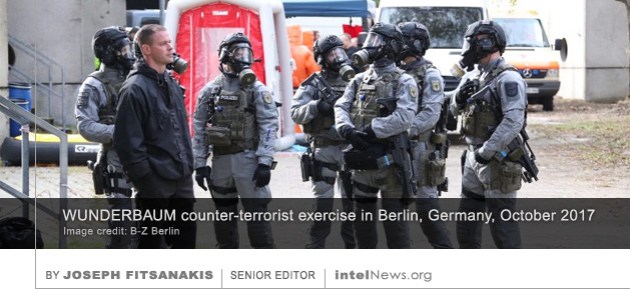 A German newspaper reported last week that at least one European intelligence agency has already warned that the Islamic State is exploring the use of chemicals for attacks in Europe. Such an eventuality would be a radical departure from prior attacks by the Islamic State in the West. In the past, the militant group has shown a strong preference for low-tech means of dispensing violence, such as firearms, vehicles and knives. But it has utilized chemical substances in Iraq and Syria, and its technical experts have amassed significant knowledge about weaponized chemicals.
Last week, several European and American counter-terrorism experts participated in a bioterrorism preparedness exercise in Berlin. Codenamed WUNDERBAUM, the exercise was one of several anti-terrorism drills that have taken place in the German capital this year alone. But last week’s drill was the first with an exclusive focus on preparing for a bioterrorist attack. German authorities insisted that the drill was not sparked by concrete intelligence of a pending biological or chemical attack. But the Berlin-based national newspaper Die Welt claimed on Friday that it had information about at least one such warning by a European intelligence agency. The paper did not name the agency, but said that “a foreign intelligence agency” had warned European security authorities of a possible terrorist attack by the Islamic State using chemical weapons. According to Die Welt, the warning was “explicit” and cautioned that the Sunni militant group may be preparing to use improvised bombs utilizing chemicals, including toxic gasses. The warning was communicated to European intelligence agencies, including Germany’s said Die Welt.
How likely is such a scenario? Terrorist groups tend to be conservative in their use of lethal technologies. They typically opt for time-tested methods using explosives or firearms, because these have a higher of success in comparison to more sophisticated, hi-tech weapons. The latter are also more expensive to build and require scientific and technical capabilities that are not typically available to terrorist organizations. Militants are usually strapped for cash, and are not science-savvy, so exceptions to this general trend are rare. But the Islamic State is different. Read more of this post
 There’s a reason why America has not experienced another 9/11, and it’s not because militants are not trying. Through a series of sweeping reforms prompted by the tragic events of that day, United States intelligence and security agencies have become extremely efficient at preventing large-scale terrorist and criminal violence. Using increasingly sophisticated methods of intelligence collection, analysis and even prediction, counter-terrorism and security experts have neutralized countless attempts to replicate —or even surpass— the horror of 9/11.
 Montana. Most important of all, they work alone, which makes it immensely difficult to sense their murderous intentions. Counter-terrorism and security experts are trained to detect possible attacks by penetrating the communications between members of a conspiracy. When the operative is a lone wolf, and does not communicate his or her plans, the points of possible penetration diminish, as does the possibility of detection.








Officials puzzled by attacks that killed 16 in relatively stable Mozambique
October 26, 2017 by Joseph Fitsanakis Leave a comment
Two weeks after the attacks, however, the ideological backgrounds and motives of the assailants remain unclear. Mozambique has seen armed attacks by guerrillas before, but these are usually attributed to Renamo, a rightwing paramilitary group that was financially supported by Rhodesia and apartheid-era South Africa during the Cold War. The group is still in existence, but has mostly transformed itself into a political party. Its military wing declared a unilateral ceasefire in December of last year, which has been broadly observed. Importantly, the government did not attribute the Mocimboa da Praia attacks to Renamo. But if Renamo was not behind the attacks, then who was it? Local reports have mentioned a so-called “radical Islamist sect”; but Mozambique is a predominantly Christian country and does not have a history of Islamic radicalism. Nor is there known activity in Mozambique of African Islamist groups like Boko Haram or Al-Shabaab, which are strong in western and eastern Africa respectively.
In the days following the attacks in Mocimboa da Praia, police detained 52 people, including Muslim religious leaders, and confiscated half a dozen firearms, as well as hundreds of rounds of ammunition. But by the middle of last week, police officials began to dismiss earlier claims that the attackers were linked to an organized terrorist group. Some southeastern Africa watchers have suggested that the assailants were members of Swalissuna, a locally based militant opposition group that rejects the authority of the central government in capital Maputo, located in Mozambique’s south. The group is virtually unknown and is believed to have been founded in 2011 or 2012. It has no religious affiliation and its members are motivated by domestic grievances related to economic restructuring, corruption and political reform.
On Tuesday, Mozambique President Filipe Nyusi announced the surprise replacement of the country’s two most powerful security officials. Lagos Lidimo, director general of the State Information and Security Service (SISE), which reports directly to the President, was dismissed overnight and replaced by Julio Jane, who until Monday was the commander of the Mozambican National Police. Also replaced was Graça Chongo, head of the country’s armed forces. His replacement has not yet been named.
► Author: Joseph Fitsanakis | Date: 26 October 2017 | Permalink
Filed under Expert news and commentary on intelligence, espionage, spies and spying Tagged with Filipe Nyusi, Graça Chongo, Lagos Lidimo, Mozambican National Police, Mozambique, News, Newstex, State Information and Security Service (Mozambique)