MI5 undercover officer named as key witness in biggest IRA trial since 1980s
October 13, 2020 2 Comments
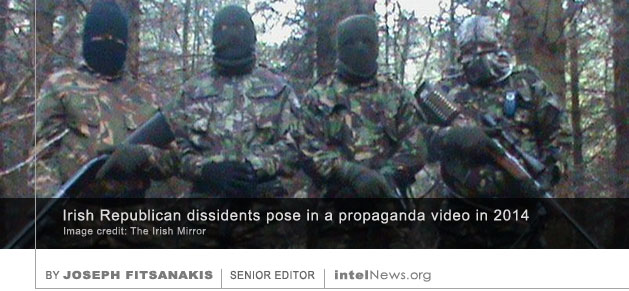
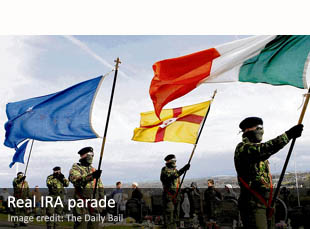
A man who spent years as an undercover officer for Britain’s Security Service (MI5) has been named as a key witness in a long-awaited trial, described by experts as the largest against violent Irish republicans in 25 years. The accused include leading figures in dissident Irish republicanism, who are members of a group calling itself the New Irish Republican Army (New IRA).
The case represents the culmination of Operation ARBACIA, which was launched nearly a decade ago against dissident Irish republicans by MI5 in collaboration with the Police Service of Northern Ireland. The case centers on the evidence provided by Dennis McFadden, who has just been identified as a key witness for the prosecution. It has been reported that McFadden, born in Scotland, was a police officer before he joined MI5. He spent two decades as an MI5 officer, much of that undercover.
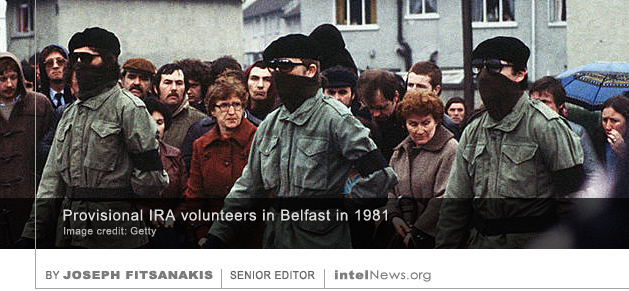
At first, McFadden joined Sinn Féin, which is widely considered to have operated as the political wing of the Provisional IRA (PIRA). From the late 1960s until 2005, the PIRA waged an armed campaign for the reunification of British-ruled Northern Ireland with the Republic of Ireland. Following the dissolution of the Provisional IRA, McFadden kept contact with dissident Irish republicans, a term used to identify those who disagreed with the Provisional IRA’s decision to end its armed campaign. McFadden joined the New IRA as soon as it was founded in 2012.
Gradually, McFadden rose through the ranks of the New IRA until he joined the group’s high command. This gave him access to the New IRA’s network of safe houses in Northern Ireland and Scotland. Many of these locations were eventually bugged by MI5, and the information acquired from these bugs is expected to be used as evidence in the trial of the New IRA’s leaders next year. Ten people —almost all in their 40s and early 50s— have been arrested as part of Operation ARBACIA. They include a 62-year-old Palestinian doctor who lives in the United Kingdom, who is accused of having participated in the preparation of terrorist acts. Some observers have also stated that the court will be hearing evidence connecting the New IRA with Arab militant groups in the Middle East.
The MI5 moved McFadden out of Northern Ireland last summer, just as the Real IRA suspects were arrested by authorities in a series of coordinated raids. He is believed to be living in a secret location under police protection. Meanwhile, the 10 suspects are being held in Maghaberry prison, a high-security complex in Lisburn, a city located a few miles southwest of Belfast.
► Author: Joseph Fitsanakis | Date: 13 October 2020 | Permalink
 The British Security Service (MI5) has over 700 officers —more than 20 percent of its entire force— stationed in Northern Ireland, due to fears that the Brexit process might reignite the centuries-long sectarian conflict there. In 1922, nationalist rebels managed to dislodge Ireland from the British Empire. But six counties in Ireland’s north remained under British dominion, and today form the British territory of Northern Ireland. Irish nationalists have for decades engaged in an unsuccessful campaign —at times peaceful and at times violent— to unite these counties with the Republic of Ireland. Following the Good Friday Agreement of 1998, nationalist and British loyalist groups in Northern Ireland terminated their armed operations and entered the political arena, effectively sharing power in the British territory. The integration of Ireland and Britain into the European Union helped in that process by effectively bringing to an end border checks between the two countries. Thus, pro-British loyalists continued to live under British rule, while nationalists have been able to cross from Northern Ireland to the Irish Republic and back without restrictions, as if the two states were effectively unified.
 Sean O’Callaghan, one of the most contentious figures in the history of the Provisional Irish Republican Army, has died in Jamaica. He was born in County Kerry, Republic of Ireland, in a strongly republican family, which sided with opponents of the Ango-Irish treaty and fought against the official Irish government in the Irish Civil War of 1922-1923. In 1971, aged just 17, O’Callaghan joined the Provisional Irish Republican Army, which fought to unite British-controlled Northern Ireland with the independent Republic of Ireland. Not long after, O’Callaghan was arrested by the Garda Síochána (Irish police) in his home county of Kerry, when a small quantity of explosives he was hiding in his parents’ house accidentally detonated.
 A British court has convicted a lone-wolf female dissident Irish republican, who plotted attacks against police officers after using Facebook to lure two men into joining a fictitious militant organization. Her two male accomplices took their own lives in recent months. The rare case centers on Christine Connor, a 31-year-old resident of Northern Ireland and self-described dissident republican.
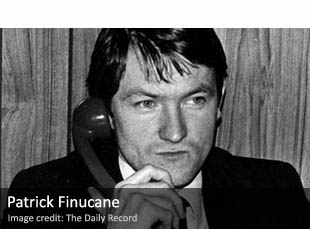
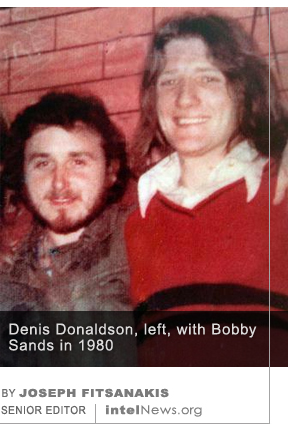 A former member of the Provisional Irish Republican Army, who was an agent for the British security services, has alleged that Gerry Adams, leader of the second-largest political party in Northern Ireland, ordered the killing of a British spy in 2006. The former agent was referring to the killing of Denis Donaldson, a senior member of the Provisional IRA, who was found dead months after it was revealed that he had been secretly spying on the republican organization on behalf of British intelligence.







 intelNews.org
Decades after end of Northern Irish conflict, the legacy of spies remains obscure
August 4, 2022 by Joseph Fitsanakis 1 Comment
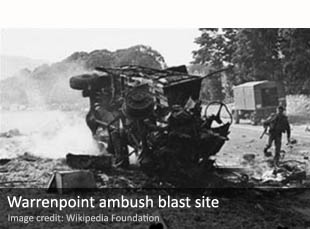
Although the bloody conflict has been the subject of numerous studies, its intelligence component is still obscure. This is especially so when it comes to the legacy of the spies who —by all accounts— were central to the day-to-day progression of this persistent conflict, which came to be known as “the Troubles”. In an insightful paper, Eleanor Williams, a PhD candidate at Queen’s University Belfast, and Thomas Leahy, Senior Lecturer at Cardiff University, examine this little-studied aspect of the Northern Irish conflict. The article, “The ‘Unforgivable’?: Irish Republican Army (IRA) informers and dealing with Northern Ireland conflict legacy, 1969-2021”, was published on Wednesday in the peer-reviewed journal Intelligence and National Security.
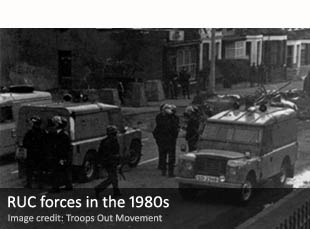
The authors list the substantial number of UK security agencies that had a role in recruiting and running informers during the Troubles. They include: the Security Service (MI5); the Metropolitan Police Special Branch; the Royal Ulster Constabulary Special Branch; and the Northern Irish Police Special Branch. Informants were also recruited by a host of intelligence organizations belonging to the British Armed Forces, such as the Military Reaction Force and the Force Research Unit. Although these agencies coordinated their intelligence activities to some extent, cooperation was not close. Consequently, there were hundreds of informants recruited by numerous UK state elements of the throughout the 30-year conflict. Their exact number remains unknown to this day. Read more of this post
Filed under Expert news and commentary on intelligence, espionage, spies and spying Tagged with academic research, Analysis, Northern Ireland, Provisional IRA, UK