Germany’s most famous spy on trial for tax evasion, claims money is not his
October 3, 2016 Leave a comment
 The most famous intelligence operative in Germany went on trial last week after his name was linked to dozens of offshore bank accounts and shell companies. But he claims he used these accounts to rescue hostages as part of his undercover work. Werner Mauss became known in 1997, when he was arrested in Colombia while using a forged passport. He had traveled to the Latin American country to secure the release of a German woman who had been kidnapped by leftist guerrillas. The Colombian authorities eventually released him, following heavy diplomatic pressure from the German government. But the German media began investigating his background, and it soon became known that he was working for the Federal Intelligence Service, specializing in negotiating the release of hostages.
Now, in his mid-70s, Mauss enjoys celebrity status in Germany. He claims on his personal website that he was directly involved in neutralizing over 100 criminal gangs and that his work led to the capture of 2,000 criminals and spies. He also claims to have helped prevent dangerous chemical substances from falling into the hands of terrorist groups.
Last Monday, however, Mauss appeared in court in the North Rhine-Westphalian city of Bochum, accused of placing millions of euros in undeclared offshore accounts. The German state prosecutor accuses the spy of having dozens of accounts in his name in offshore tax havens such as the Bahamas, Turks and Caicos, and Panama. Government investigators say Mauss hid nearly €15 million (approximately $23 million) in secret accounts between 2002 and 2013. It appears that at least some of the accounts had been opened under aliases that Mauss used during his spy operations.
According to reports in the German media, Mauss first appeared on the government’s radar several years ago, when investigators in North Rhine-Westphalia purchased a CD from a whistleblower who worked in Luxembourg’s UBS bank. Earlier this year, Mauss’ name appeared again, this time in the so-called Panama papers, the massive data leak of documents belonging to Panamanian law firm Mossack Fonseca that specialized in offshore wealth management.
According to his lawyers, Mauss did nothing wrong, and claims that he used the shell companies and offshore bank accounts to channel funds to kidnappers in order to secure the release of hostages. Mauss’ legal team also claims that the 76-year-old former spy cannot properly defend himself because he is prevented from speaking freely by the clandestine nature of his work for the government. It is believed that the trial will continue until the end of this year.
► Author: Ian Allen | Date: 3 October 2016 | Permalink
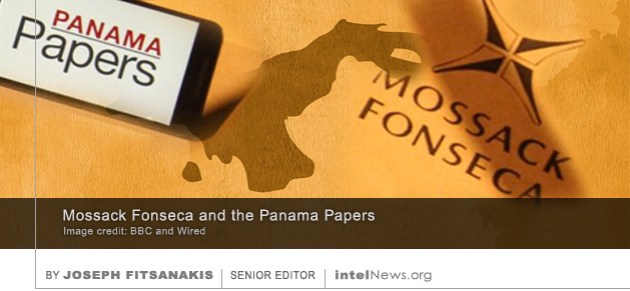 The massive data leak of documents belonging to Panamanian law firm Mossack Fonseca has revealed the names of intelligence officials and agents form several countries, who employed front companies to conceal their financial activities. According to German newspaper Süddeutsche Zeitung, which was the initial recipient of the largest data leak in history last summer, the list of names includes intelligence officials from the Middle East, Latin America and Africa, as well as “close intermediaries of the [United States] Central Intelligence Agency”.
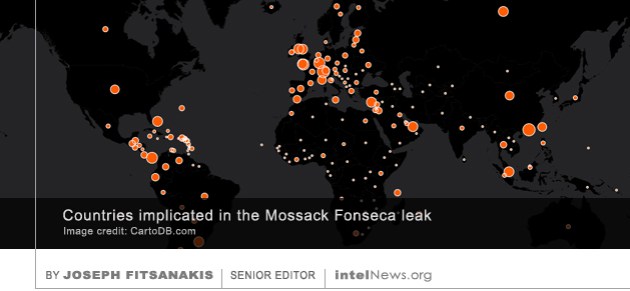 Aside from their immediate shock value, the Panama Papers reveal the enormous extent of tax evasion on a worldwide scale. This unprecedented phenomenon is inextricably tied with broader trends in globalized finance-capitalism that directly threaten the very survival of the postwar welfare state. National intelligence agencies must begin to view offshore tax evasion as an existential threat to the security of organized government and need to augment their economic role as part of their overall mission to protect and secure law-abiding citizens.
 countries. On Sunday, following a year-long analysis of the data, the reporting partners began publishing revelations from the Panama Papers, and say they will continue to do so for several days to come.
 statements, which means they have not been paying taxes in their country of citizenship or residency. Thus, there are now thousands of Mossack Fonseca clients in






 intelNews.org
Maltese reporter who exposed high-level political corruption killed in car bomb
October 17, 2017 by Joseph Fitsanakis Leave a comment
Caruana Galizia began her career in the late 1980s as a regular columnist for The Sunday Times of Malta, before being appointed associate editor of The Malta Independent. She eventually launched her personal English-language news blog, called Running Commentary, which became one of Malta’s most influential websites. The site’s popularity was only augmented by the fact that it reported scandals affecting both of Malta’s main political parties, the governing Labor Party and the opposition Nationalist Party. In April of 2016, following the release of the so-called Panama Papers, Caruana Galizia accused senior members of the Labor government, as well as the prime minister’s wife, of being involved in large-scale tax-evasion schemes and receiving bribes from oil-rich Azerbaijan’s ruling family. The allegations led to the resignation of the government and national elections, which the Labor Party won.
On Monday, Caruana Galizia died instantly when the rented Peugeot 108 car she was driving exploded near her home in the village of Bidnija, near Mosta, in central Malta. Eyewitnesses said that the explosion was so powerful that it tore apart the vehicle and was heard from several miles away. Subsequent reports in the Maltese media alleged that the investigative journalist had recently filed reports with the police, claiming that she was receiving threats against her life from persons unknown.
The bomb attack shocked Maltese society and immediately threw the European Union member-state’s political life into disarray. The country’s Prime Minister, Joseph Muscat, said in a statement that he was “devastated” by Caruana Galizia’s assassination, adding that he had instructed the island country’s police and intelligence agencies to “take all necessary steps to investigate” the murder and uncover its culprits. The killing was also condemned by nearly every senior European Union official and by the International Consortium of Investigative Journalists, the international arm of the Washington-based Center for Public Integrity, which uncovered the existence of the Panama Papers.
► Author: Joseph Fitsanakis | Date: 17 October 2017 | Permalink | Research credit: J.A.
Filed under Expert news and commentary on intelligence, espionage, spies and spying Tagged with assassinations, corruption, Daphne Caruana Galizia, Malta, Panama Papers