FBI’s top New York official urges personnel to ‘dig in’ for ‘battle’ with White House
February 3, 2025 4 Comments
 THE HEAD OF THE Federal Bureau of Investigation’s largest field office sent an email to his staff last night, urging them to “dig in” for “battle” after the White House began scrutinizing the Bureau’s investigation into the January 6 riots. James E. Dennehy, assistant director in charge of the FBI’s New York field office, sent a defiant email to FBI employees just hours after the Department of Justice (DOJ) began compiling the names of Bureau personnel who participated in the probe of the January 6, 2021, attack on the U.S. Capitol.
On January 31, President Donald Trump’s administration summarily dismissed nine senior FBI officials. The following day, the Bureau’s interim leadership received a DOJ directive instructing them to provide information on all employees involved in the January 6 investigation. This request applies not only to special agents but also to thousands of FBI personnel who provided support services for what remains the largest investigation in the agency’s history.
Approximately 15% of the FBI’s workforce —an estimated 6,000 employees— was involved in the investigation. On Sunday, around 4,000 of them received an email from the Department of Justice asking them to voluntarily disclose their role in the probe. Reports indicate that recipients must submit the requested information by 6:00 p.m. Eastern Time today. Many within the FBI fear this inquiry is part of a broader effort by the Trump administration to remove rank-and-file employees who worked on January 6 cases.
In response, Dennehy, a former U.S. Marine who joined the FBI after seven years in the Corps, sent an email on Sunday afternoon to personnel in the New York field office, delivering what appears to be a message of defiance. “Today,” he wrote, “we find ourselves in the middle of a battle of our own, as good people are being walked out of the FBI and others are being targeted because they did their jobs in accordance with the law and FBI policy.”
Dennehy praised the Bureau’s interim leaders, Brian Driscoll and Robert C. Kissane, for resisting DOJ requests to provide lists of FBI personnel, calling them “warriors.” He also recounted his Marine Corps experience, describing a time when he had to dig a five-foot-deep foxhole to survive, stating he would “dig in” similarly now. He emphasized that he had no plans to resign from the FBI or step down from his current position. Read more of this post
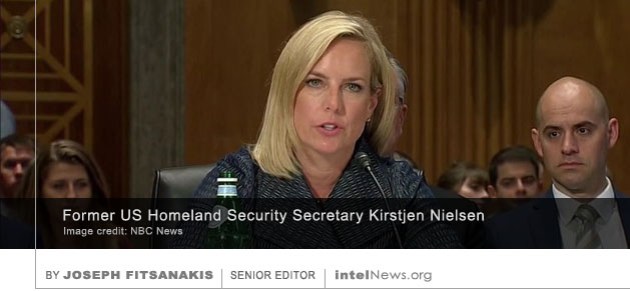 The former head of intelligence at the United States Department of Homeland Security (DHS) has filed a whistleblower complaint, alleging that he was pressured to manipulate his analyses for political reasons. The 24-page complaint was filed on Tuesday with the Office of the DHS Inspector General. The whistleblower is identified as Brian Murphy, who served as acting chief of intelligence for the DHS. The contents of the complaint have been
  There has been much consternation and confusion over the maneuverings engineered by United States President Donald Trump with the National Security Council (NSC). By now everyone knows the Chairman of the Joint Chiefs of Staff and the head of the Office of the Director of National Intelligence (ODNI) have been essentially demoted down to Principals Committee meetings, with the no-doubt unsatisfying caveat that “when their specific expertise” is needed they will be asked to attend the main Principals meeting with the President. The irony, of course, is that both of these offices have always been oversight and unifying leadership positions: the Chairman of the Joint Chiefs oversees and coordinates discussion and debate between the heads of all the military branches while the ODNI was basically created to go do the thing the Department of Homeland
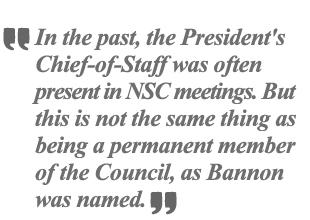 Security was initially meant to do after 9/11 —coordinate and improve communication and cooperative transparency across the entire US Intelligence Community. It is therefore somewhat mystifying as to why two deeply experienced actors with comprehensive knowledge of military and intelligence affairs writ large would be inexplicably categorized as ‘knowledge specialists’, not required for the big general meeting. It is not like the ODNI came into the NSC meetings pre-Trump as the ‘Basque subject matter expert’ alone, or the Chairman of the Joint Chiefs laid claim to being the world’s only ‘Gulf of Aden’ maritime security specialist. While it is still too early to know, it seems a logical bet that there is some personality conflict or discomfort between these two men and the incoming member(s) that Trump has designated. Safe money is on General Michael Flynn. But since that right now will remain unsubstantiated rumor and gossip, we are left with nothing but conjecture.






 intelNews.org
Opinion: Amidst war with Iran, Netanyahu tries to subjugate Israel Security Agency
June 20, 2025 by intelNews 2 Comments
This temporary appointment arises from Israeli Prime Minister Benjamin Netanyahu’s insistence on nominating Major General (ret.) David Zini for the position. However, Zini’s nomination has been met with legal challenges. The Supreme Court of Israel has ruled that Netanyahu cannot appoint the chief of the ISA, due to a conflict of interest. This is because the ISA is currently conducting a comprehensive investigation into the connections of Netanyahu’s close advisors with Qatar—a case popularly referred to as Qatargate.
Yet, even amidst Israel’s war with Iran, Netanyahu finds time to advocate for Zini’s appointment as ISA chief, arguing that the ongoing war creates an urgent need for a permanent ISA chief. The matter is once again pending a Supreme Court decision. Nevertheless, it seems that, given the unique circumstances that Israel is currently facing, Zini is likely to be appointed head of the ISA.
It is important to note that Zini lacks experience in intelligence operations. Following the failure of the ISA to provide a warning before the Hamas attack on October 7, 2023, the ISA chief has been expected to have extensive experience in intelligence operations, and to be well-versed in Arab affairs, which are central to ISA’s operations.
The issues surrounding the appointment of Major General Zini are complex. There is concern about the fact that Zini is being nominated personally by the prime minister, who is also requesting that the ISA head relinquish their autonomy and comply with the Prime Minister’s directives. Thus, the ISA could be used as a tool by the Netanyahu administration to advance the prime minister’s own political agenda.
What are the potential immediate risks if Zini is appointed to the role of ISA chief?
Read more of this post
Filed under Expert news and commentary on intelligence, espionage, spies and spying Tagged with Analysis, Avner Barnea, David Zini, Israel, Israel Security Agency, politicization