April 26, 2026
by intelNews
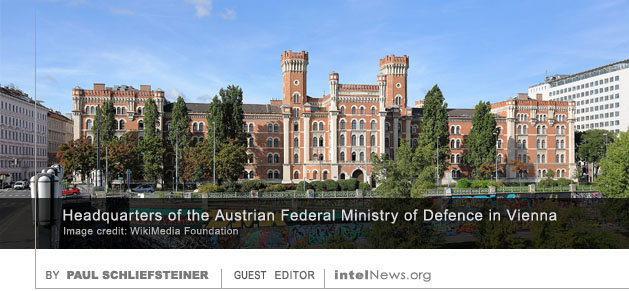 THE AUSTRIAN DEFENSE INTELLIGENCE Agency, the Abwehramt (AbwA), as well as the Austrian Chief of the General Staff, have publicly warned in recent weeks that intelligence targeting of the Austrian military, the Bundesheer, has increased markedly. There has not only been a significant rise in unauthorized drone flights near and over military installations, but also instances of individuals gathering information through vehicular-based surveillance outside facilities. Traditional recruitment methods by foreign intelligence services have also been observed—although no public disclosure has emerged on how frequent these attempts are.
Reinhard Ruckenstuhl, head of the AbwA, notes in his contribution to the Risk Monitor 2026 – The End of Order, which provides brief risk assessments for public consumption, that “[t]he armament and defense efforts of Austria and its neighboring countries […] represent particularly attractive targets for foreign military intelligence services.” He states that, while technological developments open new avenues for gathering information and facilitating espionage, human agents and sources remain important, even “en vogue,” as he puts it. Here he identifies a problem since “[i]n Austria, [foreign agents] are predominantly deployed under diplomatic cover. In the case of this type of cover, they particularly benefit from the strong presence of international organizations and the respective national missions in Austria.”
Ruckenstuhl continues by specifically naming Russia, noting that its intelligence services are “increasingly relying on civilians recruited digitally to carry out their missions.” These assignments “range from simple tasks such as carrying out socially polarizing actions to spying on military support for Ukraine to specific acts of sabotage.” The individuals recruited in this way do not receive any training. Although not mentioned in his assessment, it is now a widely held view in German-speaking Europe that it is part of the calculus of the Russian intelligence services, that such individuals will be  caught sooner rather than later. This has led to them being labeled “Wegwerfagenten” (“throwaway agents”). While Ruckenstuhl does not address this aspect, he clearly states that the success of this method will likely lead other (antagonistic) intelligence services to adopt similar approaches, which he describes as a “non-professionalization.” As a result, he concludes that “this confronts Austrian intelligence services with challenges that will have to be met with equally adapted methods backed by an appropriate legal basis.” Ruckenstuhl finishes with what seems—in the eyes of this author—like a thinly veiled cautionary note to executive and legislative decision-makers when he notes that, noting: “At the same time, the penalties for foreign intelligence operations in Austria lag behind those in other European countries, thereby limiting their deterrent effect. Austria will therefore remain an important hub and safe haven for foreign intelligence services.” Read more of this post









Analysis: Austrian officials warn of increased spying against military targets
April 26, 2026 by intelNews 9 Comments
Reinhard Ruckenstuhl, head of the AbwA, notes in his contribution to the Risk Monitor 2026 – The End of Order, which provides brief risk assessments for public consumption, that “[t]he armament and defense efforts of Austria and its neighboring countries […] represent particularly attractive targets for foreign military intelligence services.” He states that, while technological developments open new avenues for gathering information and facilitating espionage, human agents and sources remain important, even “en vogue,” as he puts it. Here he identifies a problem since “[i]n Austria, [foreign agents] are predominantly deployed under diplomatic cover. In the case of this type of cover, they particularly benefit from the strong presence of international organizations and the respective national missions in Austria.”
Ruckenstuhl continues by specifically naming Russia, noting that its intelligence services are “increasingly relying on civilians recruited digitally to carry out their missions.” These assignments “range from simple tasks such as carrying out socially polarizing actions to spying on military support for Ukraine to specific acts of sabotage.” The individuals recruited in this way do not receive any training. Although not mentioned in his assessment, it is now a widely held view in German-speaking Europe that it is part of the calculus of the Russian intelligence services, that such individuals will be caught sooner rather than later. This has led to them being labeled “Wegwerfagenten” (“throwaway agents”). While Ruckenstuhl does not address this aspect, he clearly states that the success of this method will likely lead other (antagonistic) intelligence services to adopt similar approaches, which he describes as a “non-professionalization.” As a result, he concludes that “this confronts Austrian intelligence services with challenges that will have to be met with equally adapted methods backed by an appropriate legal basis.” Ruckenstuhl finishes with what seems—in the eyes of this author—like a thinly veiled cautionary note to executive and legislative decision-makers when he notes that, noting: “At the same time, the penalties for foreign intelligence operations in Austria lag behind those in other European countries, thereby limiting their deterrent effect. Austria will therefore remain an important hub and safe haven for foreign intelligence services.” Read more of this post
Filed under Expert news and commentary on intelligence, espionage, spies and spying Tagged with Abwehramt (Austria), Analysis, Austria, Austrian Chief of the General Staff, Paul Schliefsteiner, Reinhard Ruckenstuhl, Rudolf Striedinger